How to Build a Content Cluster for AI Search in 2026
Search is changing quickly.
People are no longer relying only on traditional search results to find information. They are increasingly using AI-powered search experiences to ask complex questions, compare options, discover websites, and find solutions.
This creates a new opportunity for website owners:
How can you organize your website so that search engines and AI systems can better understand your expertise?
One effective strategy is building a content cluster.
A content cluster connects a central topic with a group of closely related articles. Instead of publishing random blog posts, you create a structured collection of useful resources that covers different aspects of one subject.
For example, a website focusing on AI search could have content covering AI visibility, AI citations, website optimization, structured data, Generative Engine Optimization, and content strategy.
Together, these pages can form a strong topical structure.
This guide explains how to build a content cluster step by step.
1. What Is a Content Cluster?
A content cluster is a group of related webpages organized around one central topic.
It normally contains two main elements:
The Pillar Page
The pillar page provides a broad overview of the main subject.
Supporting Articles
Supporting articles answer specific questions related to that subject in greater detail.
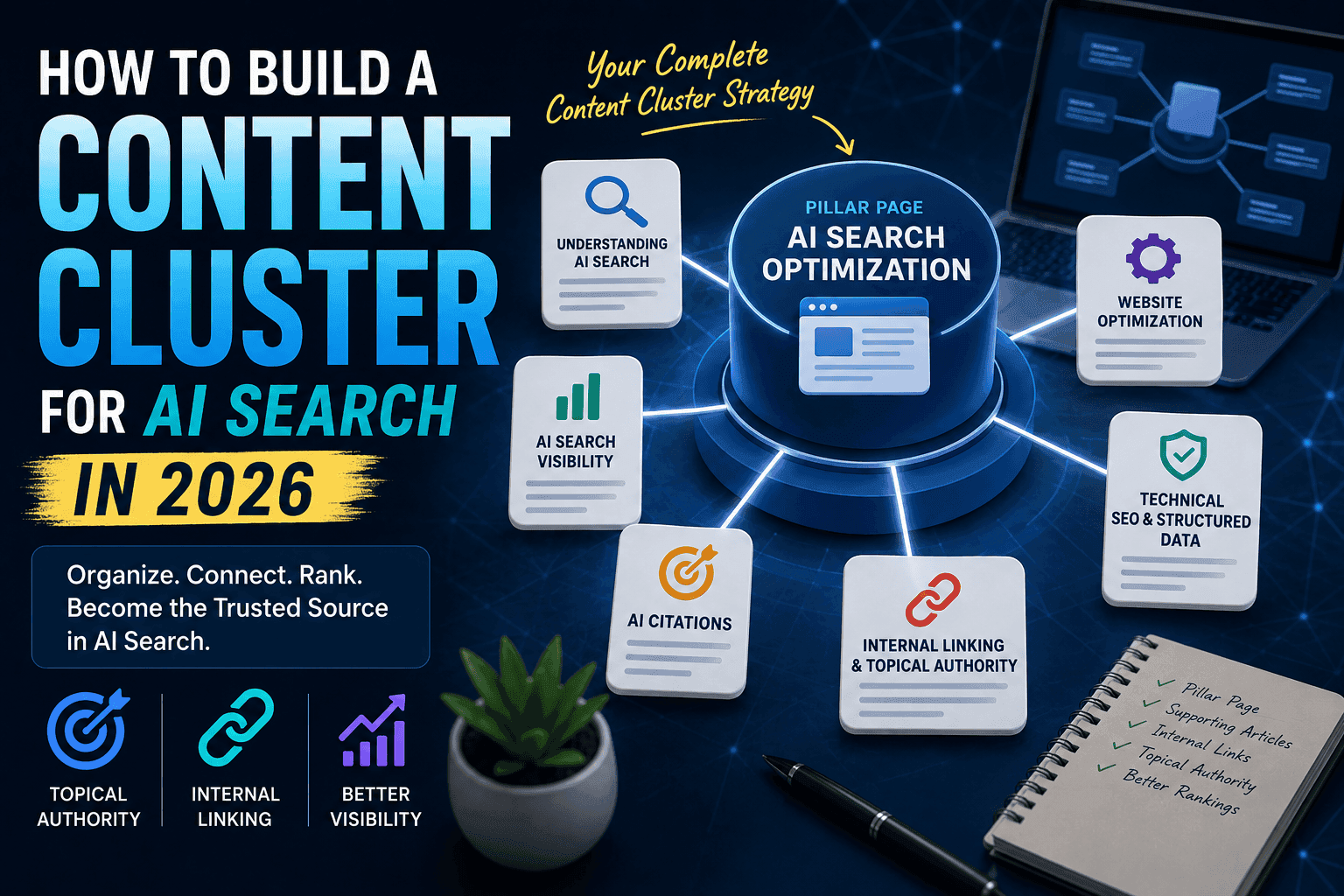
The structure can look like this:
Main Topic
↓
Pillar Page
↓
Supporting Article 1
Supporting Article 2
Supporting Article 3
Supporting Article 4
Supporting Article 5
The pages are connected through relevant internal links.
For example, if your main topic is AI Search Optimization, supporting articles might include:
How to Rank in AI Search Engines
How to Track AI Search Visibility
How to Get Your Website Cited by AI Search Engines
How to Make Your Website AI-Friendly
How to Optimize Your Website for AI-Powered Search
Your goal isn’t simply to have many articles.
Your goal is to make those articles work together.
If you’re new to AI-focused optimization, you can first understand the broader concept through this guide on Generative Engine Optimization (GEO).
2. Why Content Clusters Matter for AI Search
A single article can answer one question.
A well-organized content cluster can cover an entire subject from multiple useful angles.
Google’s current guidance for generative AI features emphasizes valuable, unique, people-first content and clear organization. Google also explains that its AI search experiences are built on core Search systems, meaning traditional SEO fundamentals remain important.
A content cluster supports this broader approach by creating logical relationships between related information.
Imagine two websites.
Website A
Has 30 articles about completely different subjects.
Website B
Has 20 useful articles covering different aspects of one clearly defined subject, with relevant connections between them.
Website B has created a much clearer topical structure.
This doesn’t guarantee higher rankings.
However, it gives users a more logical way to explore the subject and makes the website’s information architecture easier to understand.
You can learn more about how AI, entities, and modern search are changing SEO in The Future of SEO: AI, Entities, and Search.
3. How a Content Cluster Helps Connect Information
Think of your website as a knowledge map.
Each article represents one piece of information.
Internal links connect those pieces.
For example:
AI Search Optimization
↙ ↓ ↘
AI Visibility
AI Citations
AI-Friendly Websites
Then each topic can go deeper.
For example:
AI Visibility
→ Checking AI search appearance
→ Tracking AI search visibility
This creates relationships between broad subjects and specific questions.
Google explains that links help Google discover pages and understand their relevance, while descriptive anchor text gives both users and Google useful context about the destination page.
If you’re trying to determine whether your website is already appearing in AI search results, read How to Check If Your Website Appears in AI Search Results.
4. How to Choose Your Main Topic
The first step in building a content cluster is selecting the right main topic.
Don’t start with:
“Which keyword has the highest search volume?”
Instead ask:
“What subject do I want my website to become known for?”
This is a much stronger starting point.
Your main topic should ideally be connected to your:
Expertise
Services
Audience
Existing content
Business goals
For example, an SEO website could create clusters around:
AI Search Optimization
Technical SEO
Local SEO
WordPress SEO
Content Marketing
SEO for Small Businesses
A website offering web development could create clusters around:
WordPress Website Design
Website Performance
Conversion Optimization
Small Business Websites
Website Maintenance
The topic should make sense for the website.
Choose a Topic That Is Specific Enough
Avoid choosing a topic that is so broad that you cannot realistically cover it.
For example:
Digital Marketing
is extremely broad.
A more focused cluster could be:
AI Search Optimization for Small Business Websites
Now you can create specific supporting content around the subject.
This also makes it easier to identify unanswered questions.
5. How to Find Supporting Topics
Once you have your main topic, break it into smaller questions.
Suppose your main topic is:
AI Search Optimization
You could ask:
Beginner Questions
What is AI search?
How does AI search work?
How is AI search different from traditional search?
Optimization Questions
How do I optimize my website for AI search?
How do I make my website AI-friendly?
How can I improve AI visibility?
Measurement Questions
How can I check AI search visibility?
How can I track AI search performance?
Citation Questions
How can I get my website cited?
Why are competitors being cited instead of my website?
Technical Questions
Does structured data help?
How should internal links be organized?
Can search engines crawl my website?
Each question can potentially become a supporting article.
But don’t create a new article just because a keyword exists.
The question should represent a genuine user need.
Use Existing Content Before Creating New Content
This is one of the most important parts of a content cluster strategy.
Before creating another article, check what you already have.
You may discover that your website already answers many of the supporting questions.
For example, you might already have content about:
AI entities
Structured data
AI visibility
GEO
AI citations
AI-friendly websites
AI-powered search
That means you don’t necessarily need dozens of new pages.
You may simply need to connect and strengthen the pages you already have.
For example, your article about How Structured Data Helps AI can become part of the technical side of your AI Search cluster.
Real-Life Example
Imagine a website has these five articles:
How to Rank in AI Search Engines
How to Track AI Search Visibility
How to Get Your Website Cited
How to Make Your Website AI-Friendly
How to Optimize Your Website for AI-Powered Search
Individually, these are useful articles.
But if they don’t connect to each other, they become isolated resources.
Now organize them under:
AI Search Optimization
↓
Pillar Page
↓
Ranking
Visibility
Citations
Website Optimization
AI-Friendly Website
Then connect the pages with contextual internal links.
Now the content becomes a system rather than a collection of isolated articles.
Why Random Publishing Is Not Enough
Publishing an article every day doesn’t automatically create topical authority.
You could publish 100 articles and still have a poorly organized website.
Instead, think about:
Topic → Search Intent → Supporting Content → Internal Links → Content Gaps
This creates a more sustainable strategy.
The goal isn’t maximum content volume.
The goal is maximum usefulness and logical coverage.
Part 1 Checklist
Before moving to Part 2, ask:
☐ What is my main cluster topic?
☐ Is it relevant to my business?
☐ What existing articles already cover this topic?
☐ Which questions do those articles answer?
☐ Which questions are still missing?
☐ Can I create a pillar page?
☐ Which articles should be connected with internal links?
What We’ll Cover in Part 2
In Part 2, we’ll build the actual structure.
We’ll cover:
How to create a pillar page
How to create supporting articles
How to connect articles with internal links
How to avoid keyword cannibalization
How to connect informational content with service pages
How to create a logical hub-and-spoke structure
Part 2: Build Your Pillar Page, Supporting Articles & Internal Link Structure
In Part 1, we explained what a content cluster is, why it matters, how to choose a main topic, and how to identify supporting questions.
Now we can build the actual structure.
A successful content cluster isn’t just a collection of articles containing similar keywords.
Each page should have a clear purpose and a natural relationship with other pages.
6. How to Create a Pillar Page
The pillar page is the central resource of your content cluster.
It provides a broad overview of the main subject and links to more detailed supporting articles.
For example:
Pillar Page
Complete Guide to AI Search Optimization
Supporting pages:
- How to Rank in AI Search Engines
- How to Track AI Search Visibility
- How to Get Your Website Cited
- How to Make Your Website AI-Friendly
- How to Optimize Your Website for AI-Powered Search
The pillar page introduces the major concepts.
The supporting pages provide deeper information.
What Should a Pillar Page Include?
A strong pillar page should normally contain:
A Clear Introduction
Explain what the topic is and why it matters.
Major Subtopics
Break the subject into logical sections.
Links to Supporting Content
When you mention a subject that has its own detailed article, link to it.
Practical Examples
Show readers how the concepts work.
FAQs
Answer common questions.
Clear Navigation
Help visitors move between related resources.
The goal is not simply to make the pillar page extremely long.
It should make the topic easier to understand.
Don’t Confuse Length With Quality
A 10,000-word article isn’t automatically better than a well-structured 3,000-word guide.
Google’s current generative AI guidance specifically says there is no ideal page length and recommends focusing on useful content for your audience rather than creating content just to satisfy search systems.
Your pillar page should be as comprehensive as necessary—not as long as possible.
7. How to Create Supporting Articles
Supporting articles focus on specific questions within the larger topic.
For example:
Ranking
How to Rank in AI Search Engines
Visibility
How to Track AI Search Visibility
Citations
How to Get Your Website Cited by AI Search Engines
Website Optimization
How to Make Your Website AI-Friendly
AI Search Optimization
How to Optimize Your Website for AI-Powered Search
GEO
What Is Generative Engine Optimization?
Each article has a different purpose.
That distinction is important.
Give Every Article Its Own Search Intent
Two articles shouldn’t exist simply because they contain slightly different keywords.
Instead, give each page a specific job.
For example:
How to Track AI Search Visibility
The user wants to measure visibility.
How to Get Your Website Cited by AI Search Engines
The user wants to increase citations and mentions.
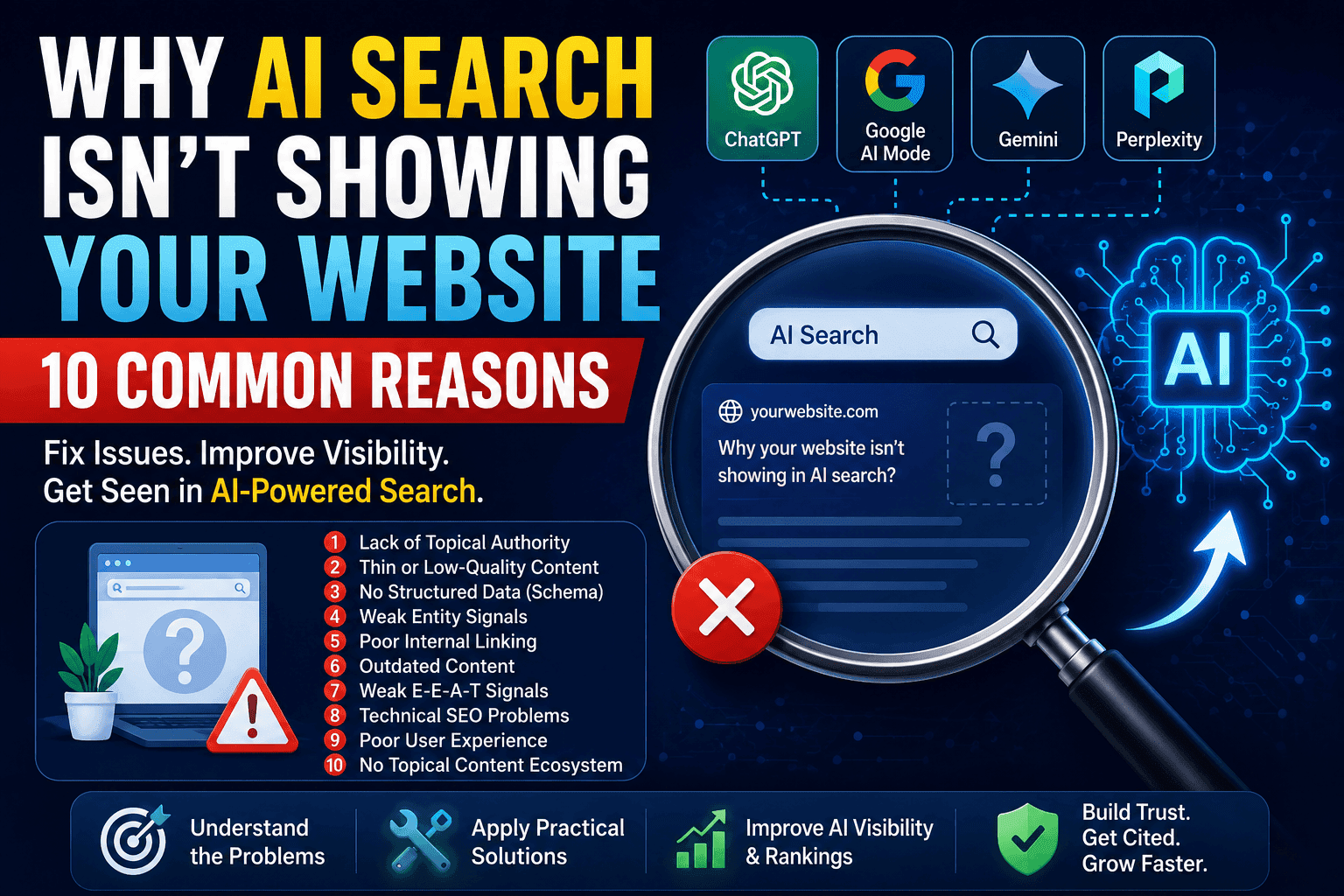
Why AI Search Isn’t Showing Your Website
The user wants to understand and fix a visibility problem.
These are related topics, but their primary intent is different.
You can connect them naturally.
For example, readers interested in measuring visibility can continue to How to Track AI Search Visibility for Your Website.
Readers who want to understand citations can explore How to Get Your Website Cited by AI Search Engines.
8. How to Connect Your Content With Internal Links
This is where the content cluster starts becoming a real network.
Suppose you have an article about making a website AI-friendly.
While explaining technical preparation, you can naturally reference your guide on How to Optimize Your Website for AI-Powered Search.
If you discuss structured information, you can point readers to How Structured Data Helps AI.
If you discuss measuring results, you can link to your AI visibility tracking article.
Each link should answer the question:
“Would this page help the reader understand this subject better?”
If yes, add the link.
If no, don’t.
Use the Hub-and-Spoke Model
One useful way to visualize a content cluster is the hub-and-spoke model.
The pillar page is the hub.
Supporting articles are the spokes.
For example:
AI Search Optimization
↙ ↓ ↓ ↓ ↘
Ranking
Visibility
Citations
Website Optimization
Technical SEO
The pillar page links to the supporting articles.
The supporting articles can also link back to the pillar and to other relevant pages.
This creates a connected information structure.
Google recommends using crawlable links and descriptive anchor text so users and Google can better understand the destination page.
Use Descriptive Anchor Text
Avoid generic anchor text such as:
Click here
Read more
This article
Instead use:
How to Track AI Search Visibility
How to Get Your Website Cited by AI Search Engines
How to Make Your Website AI-Friendly
The anchor text should give the reader a reasonable idea of what they’ll find after clicking.
Don’t Put Links Everywhere
More links do not automatically mean better SEO.
If every sentence contains a link, the article becomes difficult to read.
Google’s link guidance also emphasizes context and warns against excessive or unnatural linking.
A better approach is:
Useful context → Natural anchor → Relevant destination
9. How to Avoid Keyword Cannibalization
As your content cluster grows, you may face another problem:
Keyword cannibalization.
This can happen when several pages target essentially the same search intent.
For example, imagine publishing:
- AI Search Optimization Guide
- How to Optimize for AI Search
- AI Search Optimization Tips
- Best AI Search Optimization Strategy
If all four pages answer almost the same question, they may overlap unnecessarily.
Instead, give each article a unique purpose.
Create Clear Topic Boundaries
For example:
Page 1
How to Rank in AI Search Engines
Focus:
Ranking strategy.
Page 2
How to Track AI Search Visibility
Focus:
Measurement.
Page 3
How to Get Your Website Cited by AI Search Engines
Focus:
Citations.
Page 4
How to Make Your Website AI-Friendly
Focus:
Website preparation.
Page 5
What Is Generative Engine Optimization?
Focus:
Understanding GEO.
This creates much clearer content boundaries.
What If Two Articles Are Similar?
Ask:
Do they answer the same primary question?
If yes, consider combining them.
Do they have different search intent?
If yes, they may work as separate pages.
Would the same reader expect the same answer?
If yes, review them carefully.
Can you clearly explain the difference between them?
If not, they may need restructuring.
The goal isn’t to avoid discussing related subjects.
The goal is to avoid creating multiple pages that essentially provide the same answer.
Build Content Depth, Not Content Volume
A strong cluster doesn’t require hundreds of articles.
Imagine you have 12 genuinely useful articles that cover a subject from different angles.
That may be more valuable than 100 thin articles.
Google’s current AI-search guidance specifically warns against creating large quantities of pages primarily to manipulate rankings or generative AI responses.
So don’t ask:
“How many articles can I publish?”
Ask:
“What useful questions have I not answered yet?”
Your Existing Website Already Has a Strong Foundation
Your current AI-search articles can already form a substantial cluster.
For example:
Understanding AI Search
The Future of SEO: AI, Entities, and Search
What Is Generative Engine Optimization?
Visibility
How to Check If Your Website Appears in AI Search Results
How to Track AI Search Visibility for Your Website
Citations
How to Get Your Website Cited by AI Search Engines
Website Optimization
How to Optimize Your Website for AI-Powered Search
How to Make Your Website AI-Friendly in 2026
Technical Understanding
This means you don’t need to start your cluster from zero.
You are already building one.
Connect Blog Content With Service Pages
Your blog should also support your business.
However, service links should appear only when they’re relevant.
For example, when discussing professional SEO implementation, you can naturally mention SEO services for small businesses.
When discussing website structure, WordPress development, or website optimization, you can reference WordPress website design services.
This creates a natural journey:
Helpful Information → Trust → Relevant Service
Don’t Turn Every Blog Into a Sales Page
This balance is important.
If every paragraph promotes your service, the article becomes less useful.
Instead:
Teach first.
Help the reader.
Link to a service when it genuinely solves the problem.
The informational content should stand on its own.
Part 2 Checklist
Pillar Page
☐ Main topic is clearly defined
☐ Major subtopics are covered
☐ Supporting articles are linked
☐ Readers can easily navigate deeper content
Supporting Articles
☐ Each article has a unique purpose
☐ Search intent is clear
☐ Similar topics aren’t unnecessarily duplicated
☐ Content provides useful information
Internal Links
☐ Related articles are connected
☐ Anchor text is descriptive
☐ Links are natural
☐ Important pages receive contextual links
Business
☐ Relevant service pages are linked
☐ Commercial links aren’t excessive
☐ Content remains educational
Part 3: Content Gaps, Case Study & Complete Content Cluster Strategy
In Part 1, we explained what content clusters are and how to choose a main topic.
In Part 2, we created the pillar-and-supporting-page structure and discussed internal linking and keyword cannibalization.
Now we’ll complete the strategy.
The next step is identifying what your website is still missing.
10. How to Find Content Gaps
A content gap is a useful question or subtopic that your website doesn’t adequately cover.
Imagine you have ten articles about AI search.
You may think you’ve covered everything.
But after reviewing your content, you discover that you don’t have detailed information about:
- Monitoring competitors in AI search
- Updating older AI-search content
- Optimizing conversational queries
- Auditing AI-search visibility
- Finding pages that aren’t being discovered
- Improving content that receives impressions but little engagement
These can become opportunities for future content.
Start With Your Existing Articles
Create a simple content inventory.
Record:
| Article | Main Topic | Search Intent | Related Content |
|---|---|---|---|
| AI Search Ranking Guide | Ranking | Informational | Visibility |
| AI Visibility Tracking | Measurement | Informational | Citations |
| AI Citations Guide | Citations | Informational | Ranking |
| AI-Friendly Website Guide | Optimization | Informational | Technical SEO |
Then ask:
What question is missing?
This approach prevents you from repeatedly writing the same article.
Use Google Search Console
Google Search Console can reveal queries that are already generating impressions for your website.
You can use it to analyze:
- Search queries
- Impressions
- Clicks
- Average position
- Pages receiving traffic
Google’s Search Console provides tools for analyzing search performance and checking how Google crawls and indexes your pages.
For example, suppose one of your pages receives impressions for a related query that you haven’t covered in detail.
That query may reveal a potential content gap.
Use Your Audience’s Questions
Your customers and readers are another excellent source of content ideas.
Look for questions such as:
Why isn’t my website appearing in AI search?
How can I know if ChatGPT is mentioning my website?
Does structured data help AI understand my website?
How can I improve my AI search visibility?
Why are competitors being cited instead of my website?
These questions can become:
- New articles
- New sections
- FAQs
- Supporting resources
You already have a detailed resource for one of these problems: Why AI Search Isn’t Showing Your Website.
Analyze Competitor Content
Competitor research can reveal subjects your website hasn’t covered.
Look at websites competing for your important topics.
Ask:
- What questions do they answer?
- Which subtopics are missing from my website?
- Which articles attract links?
- Which pages appear to perform strongly?
- What information could I explain better?
Don’t copy competitor content.
Use it to identify information gaps.
Then create something more useful, more original, or more practical.
11. Turn Existing Articles Into a Content Cluster
You don’t always need to publish a new article.
Sometimes you already have the pieces.
You simply need to connect them.
Your existing AI-search content can be organized like this:
Core Topic
AI Search Optimization
Understanding AI Search
→ The Future of SEO: AI, Entities, and Search
→ What Is Generative Engine Optimization?
Visibility
→ How to Check If Your Website Appears in AI Search Results
→ How to Track AI Search Visibility for Your Website
Citations
→ How to Get Your Website Cited by AI Search Engines
Website Optimization
→ How to Optimize Your Website for AI-Powered Search
→ How to Make Your Website AI-Friendly in 2026
Technical SEO
→ How Structured Data Helps AI
This is already a strong foundation.
Create Relationships Between These Pages
Now connect the articles where the relationship is useful.
For example:
A page about AI-friendly websites can reference your guide on How Structured Data Helps AI when discussing structured information.
An article about AI visibility can reference How to Get Your Website Cited by AI Search Engines when discussing citations.
An article about ranking problems can reference How to Optimize Your Website for AI-Powered Search when discussing optimization.
The result is a connected network.
12. Real-Life Case Study: From Random Articles to a Content Cluster
Imagine a small digital marketing website with 30 blog posts.
The articles cover:
- SEO
- WordPress
- AI
- Content marketing
- Website design
- Google Search
The owner notices that the AI-search articles are receiving increasing impressions.
Instead of immediately publishing 20 more articles, they perform a content audit.
Step 1: Identify the Main Topic
They choose:
AI Search Optimization
as the central topic.
Step 2: Group Existing Articles
They create five groups:
AI Search Basics
AI Search Visibility
AI Citations
Website Optimization
Technical SEO
Step 3: Connect Related Pages
The owner adds contextual internal links.
For example:
Visibility
→ Checking AI search appearance
→ Tracking AI visibility
Optimization
→ AI-friendly websites
→ AI-powered search optimization
Technical
→ Structured data
Now the articles are no longer isolated.
Step 4: Identify Missing Topics
The owner discovers that the cluster doesn’t answer some questions.
Those gaps become future content ideas.
For example:
- How to audit AI search visibility
- How to optimize existing content for AI search
- How to compare AI search visibility across competitors
Now every new article has a clear reason for existing.
Step 5: Connect the Cluster to Services
Relevant articles can naturally lead visitors to the company’s services.
For website development needs, the cluster can connect to WordPress website design services.
For search optimization needs, relevant articles can connect to SEO services for small businesses.
The journey becomes:
Search → Article → Related Article → Trust → Service
Don’t Forget Your Homepage
Your homepage should also be connected to your content ecosystem.
However, you don’t need to add a homepage link to every paragraph.
Use it naturally when introducing your business or providing a relevant next step.
For example:
Learn more about the services and solutions provided by Hafeez Digital Studio.
This creates a natural connection between your informational content and the main website.
How Many Articles Should a Content Cluster Have?
There is no magic number.
A small topic may require only five or six strong articles.
A broader topic might eventually need 20 or more.
The important question isn’t:
“How many articles should I publish?”
It’s:
“Have I covered the important questions my audience actually has?”
Google’s current guidance specifically discourages creating large volumes of content simply to manipulate rankings or AI responses.
Quality and relevance should come before volume.
How to Maintain Your Content Cluster
Your cluster should evolve as your website grows.
Whenever you publish a new article, ask:
1. Which cluster does it belong to?
2. Which existing article should link to it?
3. Which existing articles should it link to?
4. Does it answer a genuinely different question?
5. Is another page already answering the same intent?
This simple routine can prevent your website from becoming a collection of disconnected pages.
A Simple Content Cluster Workflow
Use this process every time you want to build a new cluster.
Step 1
Choose one important main topic.
Step 2
Create a comprehensive pillar page.
Step 3
Research related questions.
Step 4
Group those questions by search intent.
Step 5
Create supporting articles for genuinely different intents.
Step 6
Connect the articles with contextual internal links.
Step 7
Review your existing content for gaps.
Step 8
Update outdated pages.
Step 9
Connect relevant articles with service pages.
Step 10
Measure the results and improve the cluster.
Complete Content Cluster Checklist
Topic Strategy
☐ Main topic is clearly defined
☐ Topic is relevant to your business
☐ Audience questions have been researched
☐ Search intent has been identified
Pillar Page
☐ Central topic is explained clearly
☐ Major subtopics are covered
☐ Supporting articles are linked
☐ Page is easy to navigate
Supporting Content
☐ Each article has a distinct purpose
☐ Articles answer genuine questions
☐ Content isn’t unnecessarily repetitive
☐ Examples are included where useful
☐ Old information is updated
Internal Linking
☐ Related articles are connected
☐ Anchor text is descriptive
☐ Links appear naturally within the content
☐ Important pages aren’t isolated
☐ Links aren’t excessively repeated
Content Gaps
☐ Search Console data is reviewed
☐ Audience questions are collected
☐ Competitor content is analyzed
☐ Missing topics are identified
☐ New content is created only when useful
Business Integration
☐ Relevant service pages are linked
☐ Homepage is connected naturally
☐ Commercial links don’t dominate the article
☐ Content remains genuinely useful
FAQs
A content cluster is a group of related pages organized around a central topic. A pillar page covers the broader subject while supporting pages answer specific questions.
A well-organized cluster can make related information easier for users to navigate and can provide a clearer website structure. However, creating a cluster alone does not guarantee AI-search visibility or rankings.
There is no fixed number. Create enough useful content to cover meaningful subtopics without producing repetitive or low-value pages.
No. Link pages when the destination provides useful additional information for the reader.
Yes. In many cases, connecting and improving existing content is a better first step than publishing large numbers of new articles.
A pillar page is the central resource covering a broad topic. It normally links to more detailed supporting articles.
Supporting articles focus on specific questions or subtopics related to the main pillar topic.
A well-organized collection of useful and relevant content can demonstrate broader topical coverage, but there is no guarantee that a content cluster by itself will improve rankings.
Review it periodically and update pages when information becomes outdated, incomplete, or inaccurate.
Yes. Internal links connect related pages and help users discover additional information. Google also says descriptive internal links can help users and Google understand your site’s structure and discover other pages.
Conclusion
Building a content cluster for AI search isn’t about publishing as many articles as possible.
It’s about creating a connected information system.
Start with one important topic.
Create a useful pillar page.
Break the subject into meaningful questions.
Create supporting articles for different search intents.
Connect those pages with relevant internal links.
Find content gaps.
Update existing articles.
And connect your informational content with your services when it genuinely helps the reader.
Your website may already contain the foundation of a strong content cluster.
You may not need 50 new articles.
You may simply need to organize, connect, improve, and expand what you already have.
That is a much more sustainable approach to building topical depth for modern search.
And as Google continues developing generative AI experiences, its current guidance remains clear: focus on valuable, people-first content and strong SEO fundamentals rather than trying to find artificial AI-search hacks.