1. Introduction
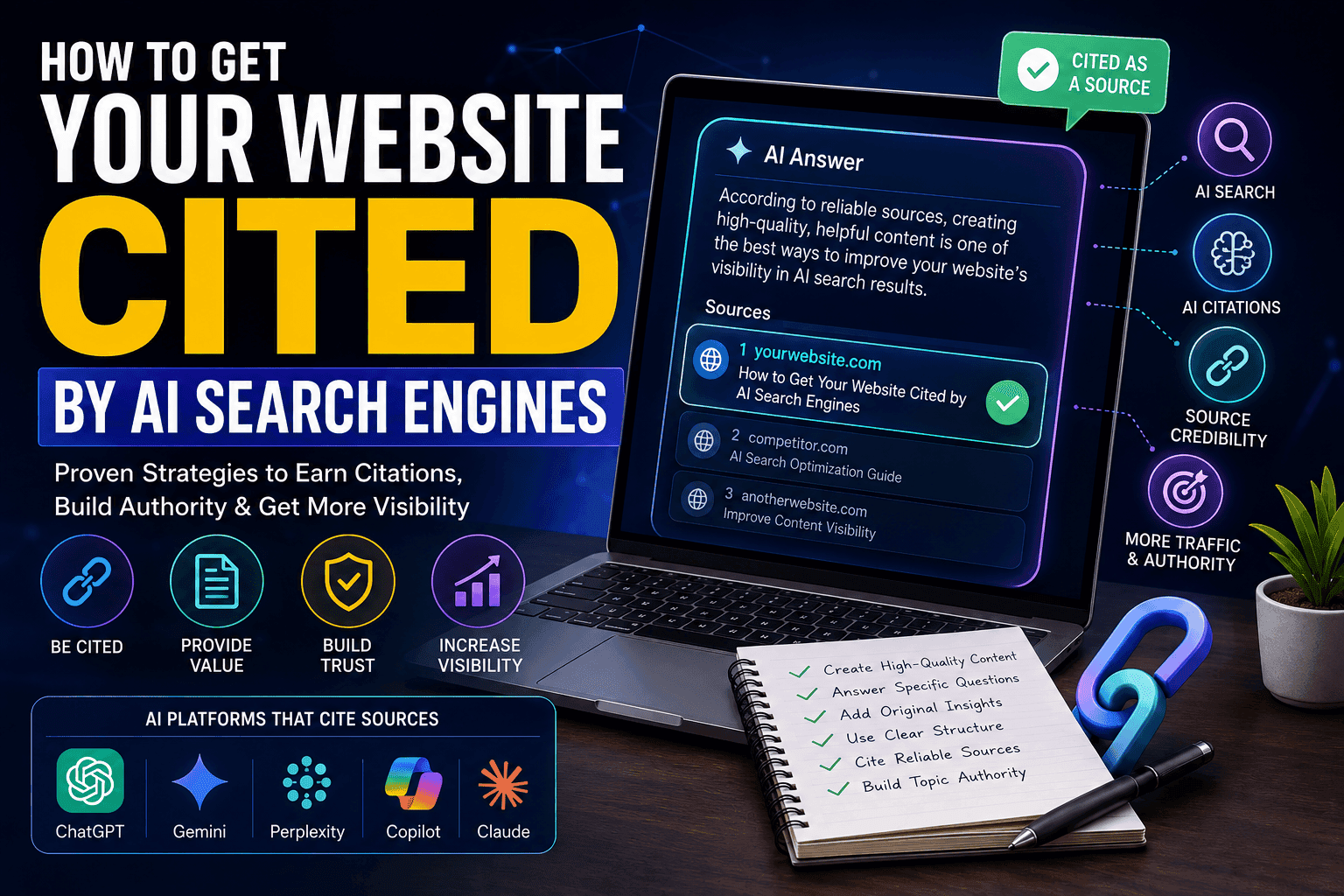
How to Get Your Website Cited by AI Search Engines is becoming an important question for website owners who want their content to be discovered through modern search.
Traditional SEO has always focused on getting pages ranked in Google’s organic results. But search behavior is changing. People are increasingly asking questions directly to AI-powered platforms and expecting a complete answer instead of a long list of links.
When an AI system answers a question, it may use information from several websites. In many cases, it can also provide links or references to the sources used to create the answer.
This creates a new opportunity for publishers and businesses.
Your website doesn’t necessarily need to be the number-one Google result to become a useful source for an AI-generated answer. A highly relevant page with clear information, original insights, strong evidence, and good topical coverage can potentially become a cited source.
For example, imagine someone asks:
“What are the best ways to improve website visibility in AI search?”
An AI platform may provide a summary and reference several websites that contain useful information.
If your article is one of those sources, you have earned an AI citation.
But getting cited isn’t as simple as adding keywords to a page.
AI systems need to understand what your content is about, determine whether it is relevant to the question, evaluate the information available on the page, and decide whether the source is useful enough to reference.
In this guide, you’ll learn what AI citations are, why they matter, how AI systems select sources, and what you can do to make your content more likely to become a useful reference.
If you want to build visibility before focusing on citations, start with our guide on How to Rank in AI Search Engines.
2. What Is an AI Citation?
An AI citation occurs when an AI-powered search or answer system references your website as a source when generating an answer.
The reference may appear as:
A clickable link
A source card
A citation beside a statement
A referenced webpage
A list of supporting sources
For example, a user could ask:
“How does structured data help search engines understand a website?”
The AI-generated response might explain the concept and provide several links to websites that support the explanation.
If your webpage is included as one of those sources, your website has received an AI citation.
This is different from simply receiving a visitor from Google.
The important point is that your content has been recognized as a source of information.
Why Does This Matter?
A citation can put your website in front of users at the exact moment they are looking for an answer.
Even if your page isn’t ranking first in traditional search, being referenced inside an AI-generated answer can introduce your brand to a highly relevant audience.
For informational websites, this can become another source of discovery.
For businesses, it can also strengthen brand recognition and credibility.
3. Mention vs Citation: What’s the Difference?
These two terms are often confused.
An AI system may mention your brand without linking to your website.
For example:
“Hafeez Digital Studio provides digital marketing and SEO services.”
That’s a brand mention.
A citation is stronger because the AI response also references a specific source.
For example:
“According to Hafeez Digital Studio’s guide on AI search, websites can improve their visibility by…”
followed by a link to the relevant article.
That’s an AI citation.
Think of It This Way
Mention = AI knows your brand.
Citation = AI uses your content as a source.
This distinction becomes important when measuring your progress.
If your brand is mentioned frequently but your webpages are rarely cited, you may have good brand recognition but weaker source-level visibility.
If specific articles are repeatedly cited, those pages can provide valuable clues about what type of content AI systems find useful.
Once you understand the difference between mentions and citations, learn How to Track AI Search Visibility and measure your website’s progress.
4. Why AI Citations Matter for Your Website
AI citations are valuable for several reasons.
Increased Discovery
AI-generated answers can appear before traditional search results or inside conversational search experiences.
When your website is cited, users have another path to discover your content.
Qualified Traffic
Someone who clicks a citation has already asked a question related to your content.
This can make citation-driven visitors highly relevant.
For example, if your article explains how to track AI search visibility and an AI platform cites that article in response to a question about AI tracking, the person clicking the source already has a relevant interest. Google’s guidance on AI features
Brand Authority
Repeated citations can help establish your website as a recognized source within a particular subject area.
Imagine your website repeatedly being referenced for questions about:
AI search
SEO
website visibility
content optimization
search analytics
That pattern indicates that your content is becoming associated with those subjects.
More Opportunities Beyond Traditional Rankings
Traditional SEO and AI citations are not competing strategies.
They can work together.
A page that performs well in organic search may also have useful qualities that make it valuable to AI systems.
At the same time, an article that doesn’t rank at the top for a broad keyword may still contain a highly specific answer that an AI system finds useful.
This is why website owners should think beyond traditional ranking positions.
5. How AI Search Engines Select Sources
There isn’t a single public formula that guarantees that a webpage will be cited.
Different AI platforms use different systems, and their results can change over time.
However, several characteristics can make content more useful as a source.
Relevance
The page needs to directly address the user’s question.
If someone asks:
“How do I track AI search visibility?”
a page about general web design may not be the best source.
A detailed article specifically explaining AI visibility tracking is much more relevant.
Clear Answers
AI systems need to identify useful information within your content.
Make important answers easy to find.
Use:
Clear headings
Short paragraphs
Lists
Step-by-step instructions
Definitions
Examples
Don’t hide the main answer beneath several paragraphs of unnecessary introduction.
Original Information
Original information can make a page more valuable.
Consider including:
Your own testing
Original examples
First-hand observations
Screenshots
Case studies
Data
Comparisons
For example, instead of simply saying:
“Track your AI visibility regularly.”
Explain how you actually tested it and what you discovered. Google’s AI Search optimization guidance
Evidence and Sources
Supporting claims with reliable evidence can increase the usefulness and credibility of your content.
When making factual claims, link to appropriate authoritative sources.
This also gives AI systems clearer information about where important facts originate.
Topical Depth
One isolated article doesn’t always demonstrate strong expertise.
Suppose your website publishes one article about AI citations.
Another website has 20 useful articles covering:
AI citations
AI search visibility
AI search tracking
Google AI Overviews
AI content
Search entities
Technical optimization
The second website provides much stronger topical coverage.
This is one reason your existing related articles should be connected through natural internal links.Before trying to improve your citations, you can learn How to Check If Your Website Appears in AI Search Results.
6. Real-Life Example: Two Articles, One AI Citation Opportunity
Imagine two websites publish articles targeting the same question:
“How can I track AI search visibility?”
Website A
Its article contains:
700 words
Basic definitions
Generic SEO advice
No examples
No original data
Few references
Website B
Its article contains:
A clear definition
Step-by-step tracking instructions
A sample tracking spreadsheet
Real testing examples
Competitor comparisons
Original observations
Supporting references
Related internal articles
Both pages may target similar keywords.
However, Website B provides substantially more useful information for someone trying to solve the problem.
If an AI system needs a source explaining how to track AI visibility, Website B gives it more specific information to work with.
The lesson isn’t that longer content automatically gets cited.
The lesson is that useful, specific, evidence-supported information gives AI systems more reasons to reference a page.
Key Takeaways
An AI citation means that an AI-powered system references your website as a source when answering a user’s question.
Remember the difference:
Mention → Your brand is named.
Citation → Your webpage is referenced as a source.
To increase your chances of becoming a cited source:
Answer specific questions.
Make important information easy to find.
Provide original insights.
Support factual claims with reliable sources.
Build depth around your main topics.
Connect related articles with meaningful internal links.
Focus on solving the user’s problem rather than simply inserting keywords.
There is no guaranteed formula for earning AI citations.
The goal is to build webpages that are genuinely useful enough to become reliable sources.
In Part 1, we explained what AI citations are and why they matter. Now it’s time to focus on the practical side: what can you actually change on your website to increase the chances of your content being referenced by AI search systems?
There is no guaranteed formula, but the following strategies can make your pages clearer, more useful, and easier to understand.
7. 10 Ways to Make Your Content More Citable
1. Answer the Main Question Immediately
One of the biggest mistakes in online content is making readers wait too long for the actual answer.
If your article targets:
“How to track AI search visibility?”
don’t spend the first 500 words discussing the history of search engines.
Give the reader a direct answer first.
Then explain the details.
For example:
AI search visibility can be tracked by monitoring brand mentions, website citations, referenced pages, competitor appearances, and changes across a consistent set of AI prompts.
After providing the direct answer, you can expand on each point.
This structure makes the content useful for humans and easier to interpret by automated systems.
2. Create Question-Based Headings
Think about the questions your target audience actually asks.
Instead of using generic headings such as:
“Important Considerations”
use:
“How Do AI Search Engines Choose Sources?”
Instead of:
“Measurement Methods”
use:
“How Can You Track AI Citations?”
Question-based headings clearly define the subject of each section.
They also help you organize an article around user intent.
3. Write Clear, Self-Contained Answers
A strong webpage should contain individual sections that make sense on their own.
Imagine an AI system needs to answer:
“What is an AI citation?”
If one section of your article provides a clear definition in two or three sentences, that information is easier to understand than an answer spread across ten paragraphs.
Try to make important sections self-contained.
A good structure is:
Question → Direct answer → Explanation → Example → Evidence
For example:
What Is an AI Citation?
An AI citation occurs when an AI-powered search system references a webpage as a source for information included in its generated answer.
Then explain how citations work and provide examples.
4. Add Original Examples
Generic information is everywhere.
Original examples make your content more distinctive.
Instead of writing:
“Internal links are important.”
Show exactly how you would use them.
For example:
An article about AI citations could link naturally to a related guide about tracking AI visibility. The first article explains how citations work, while the second explains how to measure them.
You can also create:
Before-and-after examples
Screenshots
Mini experiments
Content comparisons
Practical demonstrations
The more directly your content demonstrates something, the more useful it becomes.
5. Include First-Hand Experience
First-hand experience can make an article significantly more valuable.
If you personally test something, explain what happened.
For example:
We tested the same 20 prompts across multiple AI platforms and recorded whether our website was mentioned or cited.
Then explain:
What you tested
When you tested it
What changed
What you learned
This is much stronger than simply repeating information found on other websites.
Even a small experiment can become original content.
6. Support Important Claims With Evidence
If you make a factual claim, consider supporting it with a reliable source.
For example, if you’re discussing how Google’s search systems work, reference Google’s official documentation.
For statistics, use the original research or a reputable source.
For technical topics, link to official documentation whenever possible.
This gives readers a way to verify important information.
It also creates a clearer information trail around your claims.
7. Build Topic Clusters Around Important Subjects
Don’t create one article and expect it to establish complete authority.
Instead, build a group of related pages.
For example:
AI Search Content Cluster
Pillar Article
→ How to Rank in AI Search Engines
Supporting Articles
→ How to Track AI Search Visibility
→ How to Get Your Website Cited by AI Search Engines
→ How to Get Your Website Mentioned in Google AI Overviews
→ How to Check If Your Website Appears in AI Search Results
→ Why AI Search Isn’t Showing Your Website
These pages should link naturally to one another when the connection is genuinely useful.
This creates a clearer topical structure for both users and search systems.Building connected content around AI search is also an important part of Generative Engine Optimization (GEO)
8. Keep Important Pages Updated
Information can become outdated quickly, especially in technology and AI.
A page published two years ago may contain:
Old screenshots
Outdated tools
Incorrect recommendations
Broken links
Old statistics
Deprecated features
Review your important articles periodically.
When updating a page, don’t just change the publication date.
Actually improve the content.
Add new information, replace outdated examples, verify claims, and remove information that is no longer accurate.
9. Make Your Content Easy to Extract and Understand
AI systems need to process large amounts of information.
You can make your content easier to understand by using a logical structure.
Use:
H2 and H3 headings
Short paragraphs
Numbered steps
Bullet points
Tables when appropriate
Definitions
Examples
FAQs
For example:
How to Improve AI Citation Potential
Answer specific questions.
Add original information.
Support claims with evidence.
Build related content.
Keep important pages updated.
Simple structures make complicated topics easier to navigate.
10. Strengthen Your Website’s Trust Signals
Your content isn’t the only thing that matters.
Your website should clearly communicate who is behind the information.
Consider adding:
Author pages
About page
Contact information
Business information
Editorial guidelines
Publication dates
Updated dates
Sources and references
If you’re publishing professional advice, explain your experience where relevant.
For example, instead of simply saying:
“We know SEO.”
show readers:
“Our team has worked on websites in technical SEO, content optimization, and AI search.”
Specific information is more meaningful than vague claims.
8. How to Structure a Page for Better Citability
Now let’s combine the strategies into a practical article structure.
Suppose you’re writing an article titled:
“How to Improve Website Visibility in AI Search.”
A strong structure could look like this:
Introduction
Give a short explanation of the problem.
Quick Answer
Provide the direct answer in two or three sentences.
What Is AI Search Visibility?
Define the concept.
Why Does It Matter?
Explain the benefits.
Step-by-Step Strategy
Provide actionable instructions.
Real Example
Show how the strategy works in practice.
Common Mistakes
Explain what readers should avoid.
Checklist
Give readers a quick way to implement the advice.
FAQs
Answer related questions.
Sources
Link to authoritative references.
This structure creates a logical information hierarchy.
9. Build Evidence Around Your Content
One of the strongest ways to differentiate your content is to create evidence rather than simply repeating existing information.
You can conduct small experiments.
For example:
Experiment:
Test 15 AI-related prompts across three AI platforms.
Record:
Brand mentions
Citations
Competitors
Referenced pages
Then publish the findings.
You now have something that other websites may not have:
Original data.
Other publishers may eventually reference your findings, creating another potential source of authority.
Case Study: Improving an Existing Article
Consider a website that published a 1,000-word article about AI search.
The article wasn’t receiving much visibility.
Instead of immediately publishing another article, the owner audited the existing page.
They discovered:
The introduction was too long.
Important answers were buried.
There were no original examples.
Several claims had no supporting sources.
Internal links were weak.
The article hadn’t been updated for months.
They rebuilt the page.
The new version included:
A quick answer near the beginning
Question-based headings
Original examples
Supporting references
A practical checklist
Better internal links
Updated information
The goal wasn’t simply to make the article longer.
The goal was to make it more useful and easier to understand.
This is an important distinction.
Adding 1,000 extra words doesn’t automatically make content more citable.
Improving the quality and usefulness of those words is what matters.
10. Don’t Confuse Citability With Keyword Density
It’s tempting to think:
“If I repeat my keyword more often, AI will cite my page.”
That’s not a reliable strategy.
Keyword relevance still matters, but excessive repetition can make content unnatural and difficult to read.
Instead, use natural variations and related concepts.
For example, an article about AI citations can naturally discuss:
AI-generated answers
Source references
Website citations
Referenced pages
AI search platforms
Source selection
Content credibility
Write for the question being answered, not for a keyword counter.
Key Takeaways
To make your content more citable:
Answer questions directly.
Use descriptive headings.
Make important sections self-contained.
Add original examples.
Share first-hand observations.
Support important claims with reliable sources.
Build connected topic clusters.
Keep important pages updated.
Use clear content structures.
Strengthen website trust signals.
Create original data when possible.
Avoid relying on keyword repetition.
The goal is simple:
Create content that is useful enough for a human to trust and clear enough for an AI system to understand.
11. How to Find AI Citation Gaps
A citation gap exists when AI platforms frequently reference competitors for a topic but rarely reference your website.
For example, imagine you search several AI platforms for:
“Best ways to improve technical SEO for a small business website.”
You notice that three competitors are repeatedly cited, but your website never appears.
That’s a citation gap.
Instead of simply trying to copy those competitors, analyze why their pages might be useful.
Look at:
- What questions they answer
- How clearly they explain the topic
- Whether they provide original information
- How recent their content is
- Whether they use examples
- Whether they cite reliable sources
- How comprehensively they cover the subject
Then compare their content with your own.
Create a Simple Citation Gap Table
| Topic | Your Website | Competitor | Opportunity |
|---|---|---|---|
| AI Search Tracking | Cited | Cited | Maintain |
| AI Citations | Not cited | Frequently cited | Improve |
| Technical SEO | Mentioned | Cited | Improve |
| AI Content | Not mentioned | Mentioned | Create content |
This turns AI search results into actionable SEO information.
12. How to Improve a Page That Isn’t Being Cited
If an important page isn’t being cited, don’t immediately delete it.
First, perform a content audit.
Step 1: Check Search Intent
Ask:
Does this page actually answer the question users are asking?
If the answer is unclear, restructure the article.
Step 2: Improve the Introduction
Tell readers immediately what the page is about.
Avoid extremely long introductions.
Give a concise answer first, then provide supporting details.
Step 3: Add Missing Information
Search for questions related to your main topic.
If competing pages answer important questions that your article ignores, consider adding those topics where they genuinely belong.
Step 4: Add Original Value
Don’t simply rewrite information from competitors.
Add something they don’t have:
- Your own examples
- Original research
- Testing results
- Screenshots
- Expert observations
- Case studies
- Data
This gives your page a reason to exist.
Step 5: Strengthen Internal Links
Connect the page to your strongest related resources.
For example, an article about AI citations could naturally link to your articles about:
- Ranking in AI search
- Tracking AI visibility
- Google AI Overviews
- GEO
- AI-friendly content
Internal linking helps users navigate between related resources and gives search systems additional context about your site’s content relationships.If your content isn’t appearing in AI-generated answers, our guide on Why AI Search Isn’t Showing Your Website can help you identify possible problems.
13. Technical Factors That Can Affect Citability
Content quality is the priority, but technical problems can prevent search systems from accessing or understanding your pages properly.
Check the basics.
Make Sure Important Pages Are Crawlable
A page can’t become a useful source if search systems can’t access it properly.
Check:
- Robots.txt
- Meta robots directives
- Canonical URLs
- XML sitemap
- HTTP status codes
Use HTTPS
Your website should use a secure HTTPS connection.
This is basic website hygiene and important for user trust.
Make Your Website Mobile-Friendly
A large percentage of web users access websites through mobile devices.
Your pages should work properly on:
- Smartphones
- Tablets
- Desktop computers
Improve Page Speed
Slow pages can create a poor user experience.
Review:
- Large images
- Unnecessary scripts
- Excessive plugins
- Server response time
- Caching
Tools such as Google PageSpeed Insights can help identify performance problems. Google SEO best practices
Use Structured Data Where Appropriate
Structured data can provide additional context about your content.
Depending on the page, relevant structured data may include:
- Article
- Organization
- Person
- Breadcrumb
- Product
- LocalBusiness
Don’t add schema simply because you can. Google’s structured data documentation
Use the appropriate structured data for the actual content on the page and follow the relevant guidelines.You can also learn more about How Structured Data Helps AI Understand Your Website before implementing structured data on important pages
14. Build a Strong Source Page
Some webpages are more suitable for citation than others.
If you want a particular article to become a strong reference, make it a genuine resource.
For example, instead of creating:
AI Search Tips
create a comprehensive resource such as:
The Complete Guide to Tracking AI Search Visibility
A strong source page can include:
- A clear definition
- Quick answer
- Detailed explanation
- Step-by-step instructions
- Original examples
- Data or evidence
- Expert insights
- Common mistakes
- Checklist
- FAQs
- References
This doesn’t mean every article needs to be thousands of words.
The goal is completeness for the specific search intent, not maximum word count.
15. Keep Your Citation Targets Updated
AI and search technology change quickly.
An article that was accurate six months ago may now contain outdated information.
Review your most important citation targets regularly.
Check:
- Statistics
- Platform features
- Screenshots
- Links
- Examples
- Recommendations
- Technical instructions
When you make a meaningful update, ensure the content itself has actually improved.
Don’t change the date without updating the information.
16. Common AI Citation Mistakes
Mistake 1: Trying to Force Citations
You cannot guarantee that an AI platform will cite your page.
Avoid claims such as:
“Use this exact format and ChatGPT will cite you.”
AI systems are dynamic, and different platforms use different systems.
Mistake 2: Copying Competitors
If competitors are being cited, copying their content doesn’t make your website more authoritative.
Instead, identify what information users need and provide a better, more useful resource.
Mistake 3: Creating Content Only for AI
Don’t write unnatural content simply because you think an AI system might use it.
Your primary audience is still people.
Clear, helpful content benefits both readers and search systems.
Mistake 4: Ignoring Accuracy
Incorrect information can damage trust.
Verify important claims and use reputable sources when appropriate.
Mistake 5: Publishing Too Many Similar Articles
Creating ten pages that answer almost the same question can make your website unnecessarily repetitive.
Build one strong resource when possible and use supporting articles for genuinely different search intents.
17. Complete AI Citation Optimization Checklist
Before publishing an article that you want to become a useful AI source, check the following:
Content
☐ Does the article answer a specific question?
☐ Is the main answer easy to find?
☐ Does every section have a clear purpose?
☐ Are the headings descriptive?
☐ Are examples included?
☐ Does the article provide original value?
Trust
☐ Are important claims supported?
☐ Are reliable sources referenced?
☐ Is the author clearly identified?
☐ Is the website’s purpose clear?
☐ Is contact information available?
Technical SEO
☐ Is the page indexable?
☐ Is the URL canonicalized correctly?
☐ Is the page mobile-friendly?
☐ Does it load efficiently?
☐ Is appropriate structured data implemented?
Internal Linking
☐ Does the page link to relevant supporting articles?
☐ Do relevant supporting articles link back?
☐ Is the anchor text descriptive and natural?
Freshness
☐ Are statistics current?
☐ Are examples still relevant?
☐ Are external links working?
☐ Have outdated recommendations been removed?
18. Case Study: Turning a Non-Cited Article Into a Stronger Resource
Consider a small SEO website that published an article titled:
“How to Optimize Content for AI Search.”
The page received some organic traffic but was rarely referenced in AI-generated answers.
The owner compared the article with several competing resources.
The audit revealed several problems.
The article:
- Had a generic introduction.
- Provided mostly general advice.
- Had no original examples.
- Contained few supporting references.
- Had weak internal linking.
- Hadn’t been updated recently.
Instead of starting from scratch, the owner rebuilt the page.
They added:
- A direct answer at the beginning
- Question-based headings
- Practical examples
- Original observations
- Supporting sources
- A step-by-step process
- Internal links to related guides
- An FAQ section
They also improved the technical implementation and updated outdated information.
After the update, the owner continued monitoring the page across different AI platforms.
The important point is not that the update guarantees citations.
It doesn’t.
The value came from turning a generic article into a specific, useful, evidence-supported resource.
That gives AI systems more meaningful information to work with and gives users a better experience.
19. Your AI Citation Strategy for the Next 90 Days
If you’re serious about increasing your chances of being cited, don’t try to change your entire website overnight.
Use a 90-day process.
Month 1: Audit
Identify:
- Your most important pages
- Pages already receiving mentions
- Pages receiving citations
- Competitor pages frequently referenced
- Content gaps
Month 2: Improve
Choose your most important pages and improve them.
Focus on:
- Search intent
- Clear answers
- Original information
- Evidence
- Internal linking
- Technical quality
Month 3: Measure
Repeat your AI visibility tests.
Compare:
- Mentions
- Citations
- Referenced URLs
- Competitor visibility
- Topic coverage
Then decide what to improve next.
This creates a continuous cycle:
Publish → Test → Analyze → Improve → Test Again
Conclusion
Getting your website cited by AI search engines isn’t about finding a secret trick.
There is no guaranteed prompt, keyword density, schema type, or backlink strategy that can force an AI platform to cite your website.
Instead, think about the problem from the perspective of the user.
When an AI system needs to answer a question, it needs useful information from sources that are relevant, understandable, trustworthy, and accessible.
Your goal is to make your website one of those useful sources.
Start by answering specific questions clearly.
Add original examples and first-hand insights.
Support important claims with reliable evidence.
Build connected topic clusters.
Keep important pages updated.
Make sure your website is technically accessible.
Then track which pages are being mentioned or cited and use that information to improve your strategy.
Most importantly, don’t focus only on getting cited.
Focus on becoming worth citing.
That’s a much more sustainable approach to AI search visibility.
Frequently Asked Questions
Create highly relevant, accurate, useful, and well-structured content. Answer specific questions directly, provide original information, support important claims, and build strong topical coverage.
No. AI systems control which sources they use, and their responses can change. You can optimize your content, but you cannot guarantee a citation.
A mention means the AI names your brand or website. A citation generally means the AI references a specific source or webpage, often with a link.
No. Traditional rankings and AI citations are related but not identical. A page can rank highly without being cited, while another highly relevant page may be referenced for a specific question.
No. Traditional rankings and AI citations are related but not identical. A page can rank highly without being cited, while another highly relevant page may be referenced for a specific question.
There is no fixed timeline. It depends on factors such as content quality, relevance, website authority, competition, indexing, and the AI platform being tested.
Don’t create low-quality content solely for AI systems. Create useful content for people first, while using clear structure, evidence, and relevant technical practices that also make the information easier for search systems to understand.
Test important topics and prompts across relevant AI platforms and record the URLs that appear as sources. Over time, you can build a citation log showing which pages receive the most references.
Final Takeaway
The future of search isn’t simply about getting your webpage to rank.
It’s also about becoming a trusted source that AI systems can confidently reference.
Build useful content, provide original value, measure your citations, learn from the results, and continuously improve.
Don’t just try to get cited. Build a website worth citing.