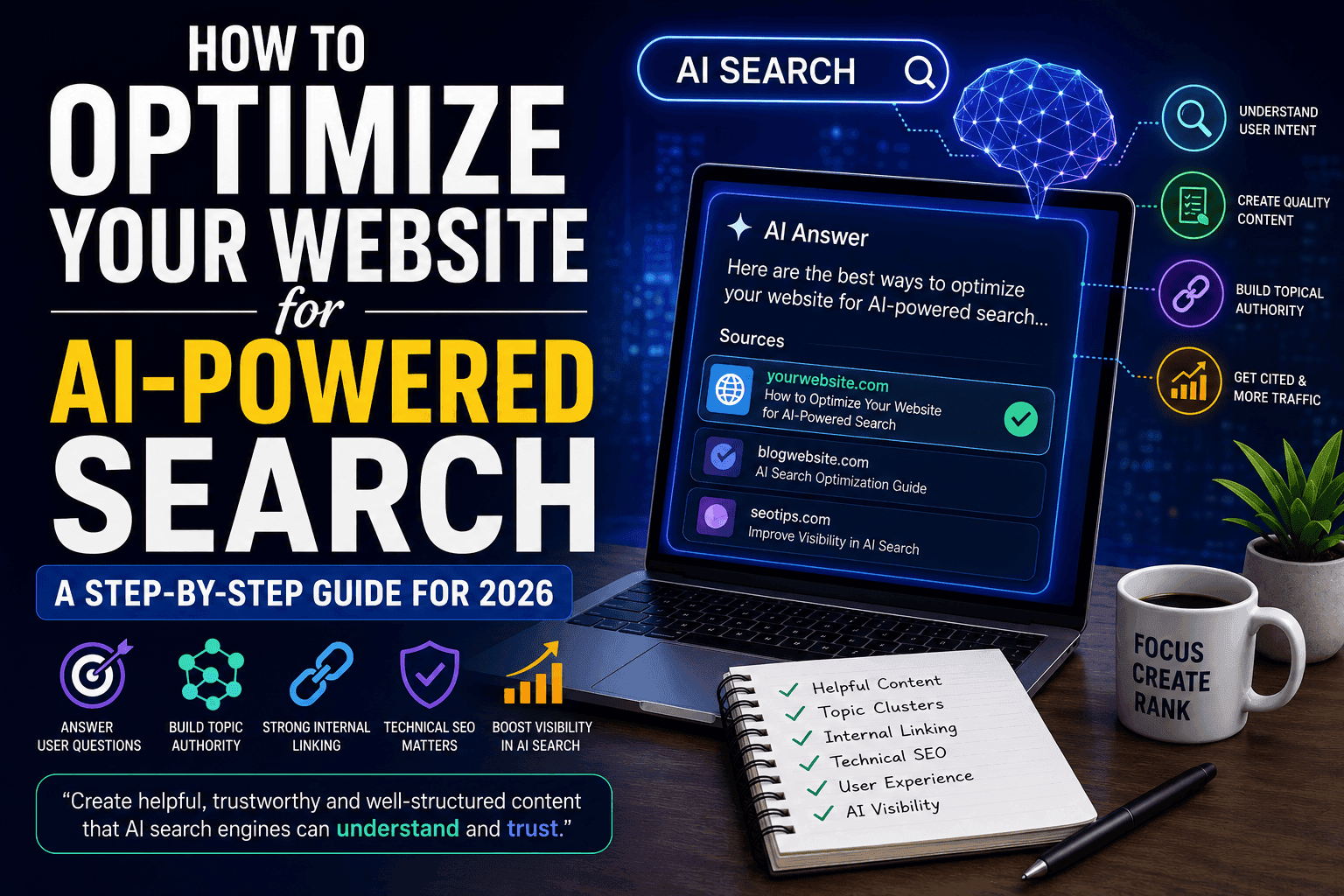
How to Optimize Your Website for AI-Powered Search: A Step-by-Step Guide
How to Optimize Your Website for AI-Powered Search in 2026
Part 1: Understanding AI-Powered Search Optimization
1. What Is AI-Powered Search Optimization?
How to optimize your website for AI-powered search is becoming an important question for website owners, bloggers, freelancers, and businesses in 2026.
Traditional SEO was mainly focused on helping webpages rank in search engine results. You would choose keywords, optimize your pages, build links, improve technical SEO, and try to reach the first page of Google.
AI-powered search adds another layer to this process.
Today, users can ask complex questions and receive conversational answers from platforms such as ChatGPT, Google AI Mode, Google Gemini, Microsoft Copilot, and Perplexity.
Instead of searching:
“AI SEO tips”
a user might ask:
“What should a small business website do to become more visible in AI-powered search?”
The AI system can understand the question, identify important concepts, combine information from different sources, and provide a direct response.
This means your website needs to do more than simply target keywords.
Your content should:
- Clearly answer real questions
- Demonstrate expertise
- Provide useful and original information
- Cover a topic comprehensively
- Use clear website structure
- Connect related content
- Provide trustworthy sources
- Make important information easy to understand
The goal isn’t to create content for AI instead of humans.
The goal is to create excellent human-focused content that AI-powered search systems can understand and use as a useful source.If you want to understand the broader ranking strategy, read our complete guide on How to Rank in AI Search Engines.
2. How AI Search Is Different From Traditional Search
Traditional Google search generally gives users a list of webpages.
For example, someone searching:
“How to improve website SEO”
may see several organic results and decide which page to visit.
AI-powered search can approach the same query differently.
Instead of simply displaying links, an AI system may generate a summarized answer and potentially provide supporting sources.
This changes what website owners should measure. Google’s guidance on generative AI features
Traditional SEO focuses heavily on:
- Keyword rankings
- Organic traffic
- Impressions
- Clicks
- Backlinks
- Click-through rate
AI-powered search adds considerations such as:
- Brand mentions
- Website citations
- Referenced webpages
- Topic relevance
- Content comprehensiveness
- Entity relationships
- Answer quality
- Source credibility
For example, your website might rank #5 for a keyword but still be referenced by an AI system when answering a highly specific question.
The opposite can also happen.
You might rank well for a traditional keyword but never appear in AI-generated answers for related questions.
That’s why AI-powered search optimization should be viewed as an extension of SEO rather than a complete replacement for it.Ranking is only one part of AI search performance; learn How to Track AI Search Visibility to understand how your website is appearing across AI search.
3. Understand What Your Audience Is Asking
Before changing your website, understand the questions your audience actually asks.
This is one of the most important steps.
People don’t always search using perfect keywords.
They use natural language.
For example, instead of searching:
“AI search optimization”
someone might ask:
“How can I make my website appear in ChatGPT answers?”
Or:
“Why isn’t my website showing up in AI search?”
Or:
“How can I get AI search engines to mention my business?”
These questions reveal search intent.
Start Building a Question List
Create a spreadsheet and record questions related to your main topic.
For an SEO website, your list could include:
- How does AI search work?
- How can I optimize my website for AI search?
- How can I get my website cited by AI?
- Why isn’t my website appearing in AI answers?
- How can I track AI search visibility?
- Does traditional SEO help with AI search?
- What makes content useful for AI search?
Then group similar questions together.
This gives you a foundation for creating content that addresses actual problems rather than simply chasing keywords.
4. Create Direct, Answer-Focused Content
One of the most effective ways to improve your content is to answer the main question early.
Imagine someone searches:
“How can I optimize my website for AI-powered search?”
Don’t make them read 800 words before finding the answer.
Give them a concise explanation near the beginning.
For example:
To optimize your website for AI-powered search, focus on clear answers, strong topical coverage, original information, trustworthy sources, logical internal linking, and a technically accessible website.
Then explain each part in detail.
This creates a better experience for the reader.
It also makes individual sections easier to understand.
Use a Question → Answer → Explanation Structure
A simple structure can work extremely well.
Question
How can you optimize content for AI-powered search?
Direct Answer
Create useful, well-structured content that directly answers user questions, demonstrates expertise, provides original value, and clearly connects related topics.
Explanation
Then explain:
- What this means
- Why it matters
- How to implement it
- What mistakes to avoid
- A real-world example
This structure works particularly well for informational content.
Real-Life Example: Changing a Generic Article
Imagine a website has an article called:
“AI SEO Tips.”
The article contains 1,200 words but provides mostly generic advice:
- Use keywords
- Build backlinks
- Write quality content
- Improve SEO
- Use headings
The owner wants the article to perform better in AI-powered search.
Instead of simply adding another 1,000 words, they restructure the article.
The new version begins with:
“AI-powered search optimization means creating content that clearly answers users’ questions and provides enough context, evidence, and expertise for modern search systems to understand and potentially reference.”
Then the article explains:
- What AI search is
- How users interact with it
- How to identify questions
- How to structure answers
- How to build topic clusters
- How to strengthen internal links
- How to demonstrate expertise
- How to measure visibility
The article has become more useful because it actually solves the reader’s problem.
The lesson: Don’t optimize an article merely by adding more keywords. Improve the information and structure.
5. Build Content Around Topics, Not Just Keywords
A common SEO mistake is creating one article for every slightly different keyword.
For example, a website might publish:
- AI search optimization
- AI search SEO
- Optimize for AI search
- AI search optimization tips
- AI search engine optimization
If all five pages answer essentially the same question, the website may end up with repetitive content.
A better approach is to build a topic cluster.
For example:
Main Topic
AI-Powered Search Optimization
Supporting Topics
- How to Rank in AI Search Engines
- How to Track AI Search Visibility
- How to Get Your Website Cited by AI Search Engines
- How to Check If Your Website Appears in AI Search Results
- Why AI Search Isn’t Showing Your Website
- How to Create Content for AI-Powered Search
Each article has a different purpose.
Together, they provide broader coverage of the subject.
This is much more useful than creating multiple pages that simply repeat the same information.Before optimizing your website, you can check if your website appears in AI search results for the questions your audience is asking.
Key Takeaways
To optimize your website for AI-powered search, start with the fundamentals.
Remember these five principles:
1. Understand the questions people ask.
Don’t focus only on short keywords.
2. Answer questions directly.
Give users the information they need without unnecessary delays.
3. Create useful, original content.
Don’t simply rewrite information already available everywhere.
4. Build topic depth.
Create related resources that cover different aspects of your main subject.
5. Think beyond traditional rankings.
AI-powered search introduces additional opportunities such as mentions, citations, and references.
Your goal should not be to manipulate AI systems.
Your goal should be to create a website that is useful, understandable, trustworthy, and genuinely valuable to its audience.
Part 2: Content Structure, Topic Clusters, Internal Linking & Original Value
In Part 1, we covered the fundamentals of AI-powered search optimization, including search intent, direct answers, and the difference between traditional SEO and AI-powered search.
Now we move into the practical strategies that can make your website easier to understand, navigate, and reference.
6. Build Topic-Based Content Clusters
One of the strongest ways to improve your website’s topical coverage is to create content clusters.
Instead of publishing unrelated articles, organize your content around a central subject.
For example, if your main topic is AI-powered search, your website could have a pillar article:
Pillar Topic:
AI-Powered Search Optimization
And supporting articles such as:
- How to Rank in AI Search Engines
- How to Track AI Search Visibility
- How to Get Your Website Cited by AI Search Engines
- How to Check If Your Website Appears in AI Search Results
- Why AI Search Isn’t Showing Your Website
- How to Create SEO Content That AI Search Engines Love
Each article answers a different question.
Together, they create a much stronger resource around the overall subject.Building topical content can also increase the opportunities for your pages to become useful sources; learn How to Get Your Website Cited by AI Search Engines.
Why Content Clusters Matter
Imagine a website has only one article about AI search.
Another website has 15 detailed articles covering different aspects of the same subject.
The second website gives users much more information to explore.
More importantly, its content demonstrates a deeper focus on the topic.
This doesn’t mean you should publish dozens of low-quality articles.
Topical depth is about covering a subject meaningfully, not simply producing more pages.If your content isn’t appearing in AI-generated answers, learn Why AI Search Isn’t Showing Your Website and identify potential problems.
7. Make Your Content Easy for AI Systems to Understand
AI systems need to process information from webpages and understand relationships between different pieces of information.
You can make this easier by creating a clear information structure.
Use Descriptive Headings
Instead of:
Important Things
Use:
How to Optimize Content for AI-Powered Search
Instead of:
More Information
Use:
How Original Content Can Improve Your Search Visibility
Descriptive headings tell both readers and automated systems what each section is about.
Keep Paragraphs Focused
Avoid putting five different ideas into one paragraph.
Instead, give each paragraph one main purpose.
For example:
Paragraph 1: Define AI-powered search.
Paragraph 2: Explain why it matters.
Paragraph 3: Explain what website owners should do.
This creates a much clearer information hierarchy.
Use Lists When Appropriate
Lists are useful when explaining:
- Steps
- Features
- Benefits
- Mistakes
- Checklists
- Examples
For example:
Basic AI Search Optimization Checklist
- Understand user questions.
- Create direct answers.
- Build topic clusters.
- Strengthen internal links.
- Add original information.
- Keep content updated.
- Monitor visibility.
Don’t turn every paragraph into a list, though.
Use lists where they genuinely improve readability.
8. Strengthen Internal Linking and Site Structure
Internal linking is one of the easiest improvements you can make to an existing website.
An internal link connects one page on your website to another page on the same website.
For example, while explaining AI visibility, you could naturally link to your article:
How to Track AI Search Visibility for Your Website
This helps readers find additional information.
It also creates relationships between related pages.
Example of an AI Search Content Cluster
Main Guide
→ How to Optimize Your Website for AI-Powered Search
Supporting Guides
→ How to Rank in AI Search Engines
→ How to Track AI Search Visibility
→ How to Get Your Website Cited by AI Search Engines
→ Why AI Search Isn’t Showing Your Website
→ How to Check If Your Website Appears in AI Search Results
These articles shouldn’t simply link to each other randomly.
The links should make sense within the context.
Use Descriptive Anchor Text
Avoid using:
Click here
when you could write:
Learn how to track AI search visibility
The second version gives the reader more information about the destination page.
For example:
After optimizing your website, you can learn how to track AI search visibility to measure whether your strategy is producing results.
That’s a natural internal link.
9. Add Original Information, Examples and Evidence
AI-powered search has access to enormous amounts of existing information.
That creates a major challenge for content creators.
If your article simply repeats information that hundreds of other websites already provide, it may offer little additional value.
One way to differentiate your content is to add original information.
Consider including:
Your Own Testing
For example:
We tested 20 AI-related questions across several AI platforms and recorded which websites were referenced.
You now have an original experiment.
Real Examples
Instead of saying:
“Internal links are important.”
show readers exactly how you used internal links on a website.
Case Studies
Explain:
- What the website looked like before
- What changes were made
- What happened afterward
- What was learned
Original Data
If you have access to your own website data, you can create useful insights from it.
For example:
After updating 15 older articles, we compared their impressions and clicks before and after the updates.
Your own data can make the article more useful than generic advice.
10. Demonstrate Experience and Expertise
People want to know whether the person behind an article actually understands the subject.
This is especially important when publishing professional advice.
Don’t simply make broad claims.
Show your reasoning.
Instead of:
“This strategy works.”
Explain:
“We used this approach because the original article wasn’t answering the user’s main question until several paragraphs into the page. We moved the answer near the beginning and reorganized the supporting sections.”
The second version gives the reader context.
Add Author Information
For important articles, consider providing:
- Author name
- Author bio
- Relevant experience
- Publication date
- Updated date
- Contact information
- Sources
This makes your website more transparent.
11. Create Content That Answers Follow-Up Questions
A strong article doesn’t only answer the first question.
It anticipates what the reader will ask next.
For example:
Main Question
How do I optimize my website for AI-powered search?
The reader may immediately wonder:
Does traditional SEO still matter?
Then:
How do I know whether AI systems are showing my website?
Then:
How can I get my pages cited?
Then:
How often should I update my content?
These related questions can become sections within the article or separate supporting articles.
This creates a natural content ecosystem.
Real-Life Example: Building an AI Search Content Cluster
Imagine a freelancer has a website with 30 blog posts.
The website has articles about:
- Web design
- WordPress
- SEO
- Social media
- Graphic design
- AI tools
The freelancer wants to become more visible for AI search-related topics.
Instead of publishing random AI articles, they choose one central topic:
AI-Powered Search
They then create a structured cluster:
Pillar
How to Optimize Your Website for AI-Powered Search
Supporting Content
How to Rank in AI Search Engines
This explains the overall ranking strategy.
↓
How to Track AI Search Visibility
This explains how to measure progress.
↓
How to Get Your Website Cited by AI Search Engines
This focuses specifically on citations.
↓
Why AI Search Isn’t Showing Your Website
This addresses common problems.
↓
How to Check If Your Website Appears in AI Search Results
This satisfies a practical user-intent query.
Now these articles can naturally link to one another.
The website has transformed from having several disconnected AI articles into a structured knowledge cluster.
12. Keep Your Content Fresh and Accurate
AI and search technology are changing quickly.
A strategy that was recommended several years ago may no longer be accurate.
This is especially important for articles discussing:
- AI platforms
- Search features
- SEO tools
- Algorithms
- Search Console
- AI models
- Content optimization
Review important pages regularly.
Check:
- Old statistics
- Broken links
- Outdated screenshots
- Old platform names
- Deprecated features
- Incorrect recommendations
- Missing developments
However, don’t update an article simply by changing the date.
Update the actual information.
Add useful new information and remove content that is no longer accurate.
Practical Optimization Checklist
Before publishing or updating an AI-search-focused article, ask:
Search Intent
☐ Does the article answer a real user question?
☐ Is the main answer clear?
☐ Does the article satisfy the reader’s likely follow-up questions?
Content
☐ Is the information useful?
☐ Are examples included?
☐ Is there original value?
☐ Are important claims supported?
Structure
☐ Are H2 and H3 headings descriptive?
☐ Are paragraphs easy to read?
☐ Are lists used where appropriate?
☐ Is the information logically organized?
Internal Linking
☐ Does the page link to relevant articles?
☐ Do supporting articles link back where appropriate?
☐ Is the anchor text descriptive?
Trust
☐ Is the author identified?
☐ Are reliable sources used?
☐ Is the content accurate and current?
Key Takeaways
Optimizing for AI-powered search isn’t about adding an “AI SEO trick” to your website.
It is about building a website that provides clear, connected, original, and trustworthy information.
Focus on:
- Topic clusters
- Clear content structure
- Natural internal linking
- Descriptive headings
- Original examples
- First-hand experience
- Evidence and sources
- Follow-up questions
- Regular content updates
And remember:
Don’t create content simply because AI search exists. Create content that solves real problems—and structure it so both people and modern search systems can understand it.
Part 3: Technical SEO, Content Optimization, Case Study & Complete Checklist
In Part 1, we covered the fundamentals of AI-powered search optimization. Part 2 focused on content clusters, structure, internal linking, and original information.
Now let’s bring everything together with technical optimization, content auditing, a practical case study, and a complete implementation plan.
13. Technical SEO Still Matters for AI-Powered Search
AI-powered search does not mean you should abandon traditional technical SEO.
Your website still needs to be accessible, crawlable, fast, and properly structured.
Before worrying about advanced AI strategies, make sure the fundamentals are working.
Check Your Indexing
Important pages should be accessible to search engines.
Review:
- Google Search Console
- Indexing status
- Robots.txt
- XML sitemap
- Canonical URLs
- HTTP status codes
- Noindex directives
If an important page isn’t properly accessible or indexed, don’t expect it to perform well in search.learn more on Google Search Central documentation
Improve Website Performance
A slow website creates a poor experience for users.
Review:
- Image sizes
- Unnecessary JavaScript
- CSS
- Plugins
- Caching
- Server performance
- Third-party scripts
Use tools such as Google PageSpeed Insights to identify performance problems.
However, don’t sacrifice useful content simply to achieve a perfect performance score.
The objective is a fast and usable website, not just a number on a testing tool.
14. Use Structured Data Correctly
Structured data can help search engines understand specific information on your webpages.
Depending on the type of content, you may use structured data for things such as:
- Articles
- Organizations
- People
- Breadcrumbs
- Products
- Local businesses
- Events
But there is an important point:
Structured data does not guarantee that your website will appear in AI-generated answers.
Don’t add irrelevant schema simply because you want to “optimize for AI.”
The structured data should accurately describe the visible content on the page and follow search engine guidelines.You can also explore What Is Generative Engine Optimization (GEO)? to understand how GEO fits into the broader evolution of search optimization
15. Optimize Your Existing Content Before Publishing More
One of the biggest opportunities for many websites is already sitting inside their existing content.
You don’t always need another 50 articles.
Sometimes your existing articles simply need improvement.
Start by identifying pages that:
- Already receive organic traffic
- Have impressions but few clicks
- Rank on the second page
- Cover important topics
- Have outdated information
- Are weakly internally linked
Then improve those pages.
Use the 7-Step Content Refresh Process
Step 1: Review Search Intent
Ask:
What does the person actually want to know?
Make sure your article answers that need.
Step 2: Improve the Introduction
Give the reader a clear explanation early.
Avoid unnecessary background information.
Step 3: Improve Headings
Make headings descriptive and useful.
Instead of:
Important Factors
use:
7 Factors That Can Improve AI Search Visibility
Step 4: Add Missing Questions
Look at related searches and questions.
Add genuinely useful information that your existing article doesn’t cover.
Step 5: Add Original Value
Include:
- Your own examples
- Screenshots
- Experiments
- Case studies
- Data
- First-hand observations
Step 6: Strengthen Internal Links
Link to relevant articles using natural descriptive anchor text.
Also review your older articles and add links back to the newly improved resource where relevant.
Step 7: Update Outdated Information
Check:
- Statistics
- Links
- Tools
- Screenshots
- Recommendations
- Platform features
Then publish the improved version.
16. Build Stronger Entity and Brand Signals
AI-powered search needs to understand not only individual pages but also the entities and concepts connected with those pages.
For a business website, make it clear:
- Who you are
- What you do
- Which services you provide
- Where you operate
- Who your content is written by
- What topics you specialize in
For example, a digital agency shouldn’t have dozens of unrelated pages with no clear connection.
Its website should communicate a consistent identity.
Example
A website specializing in:
SEO + Web Design + AI Search
could build supporting content around those subjects instead of publishing unrelated articles about everything from cooking to travel.
Consistency helps establish a clearer topical identity.
17. Make Your Important Pages Easy to Discover
Don’t hide your best content.
Your most important resources should be accessible through your website’s navigation and internal links.
For example:
Main Navigation
Home
Services
Blog
About
Contact
Blog Categories
SEO
AI Search
Web Design
WordPress
Then use internal links within articles to connect related resources.
Your strongest articles should receive meaningful internal links from other relevant pages.
18. Case Study: Optimizing a Small Website for AI-Powered Search
Let’s consider a realistic example.
Imagine a freelancer has a website offering:
- Website development
- SEO
- WordPress services
- AI search optimization
The website has around 40 blog posts.
However, most articles were written independently.
There was no clear content structure.
The Problems
The website owner discovers:
- AI articles aren’t connected.
- Several pages target similar questions.
- Some articles have outdated information.
- Internal linking is weak.
- Important answers are buried in long introductions.
- Author information is limited.
- Some articles contain generic advice.
Instead of publishing another 20 articles, the owner starts with an audit.
Month 1: Organization
They create an AI search content cluster.
The main guide becomes:
How to Optimize Your Website for AI-Powered Search
Supporting articles include:
- How to Rank in AI Search Engines
- How to Track AI Search Visibility
- How to Get Your Website Cited by AI Search Engines
- Why AI Search Isn’t Showing Your Website
- How to Check If Your Website Appears in AI Search Results
The articles are connected with relevant internal links.
Month 2: Content Improvement
The owner updates the weakest pages.
They add:
- Direct answers
- Better headings
- Original examples
- Case studies
- Updated information
- Relevant sources
- Better internal links
They also remove unnecessary repetition.
Month 3: Measurement
The owner checks:
- Google Search Console
- Organic traffic
- Search impressions
- Clicks
- AI mentions
- AI citations
- Referenced URLs
They compare the results with their previous baseline.
The objective isn’t to expect instant dramatic results.
The goal is to identify which improvements are producing useful signals and continue refining the strategy.
19. Common AI Search Optimization Mistakes
Mistake 1: Writing Only for AI
Content written purely to manipulate AI systems can become unnatural.
Always prioritize the human reader.
Mistake 2: Keyword Stuffing
Repeating the same phrase dozens of times doesn’t automatically make your content more relevant.
Use natural language and related concepts.
Mistake 3: Publishing Hundreds of Similar Articles
More content isn’t always better.
If ten articles answer essentially the same question, consider whether one comprehensive resource would be more useful.
Mistake 4: Ignoring Traditional SEO
AI search doesn’t eliminate:
- Crawlability
- Indexing
- Page quality
- Internal links
- Technical SEO
- User experience
These fundamentals still matter.
Mistake 5: Copying AI-Generated Content Without Adding Value
AI can help with brainstorming and drafting, but publishing generic content without human review can make your website less distinctive.
Add:
- Experience
- Examples
- Original research
- Opinions where appropriate
- Real-world testing
Mistake 6: Chasing Every New AI Platform
You don’t need to change your strategy every time a new AI tool appears.
Focus on fundamental principles:
Useful content + strong structure + technical accessibility + trust + topical depth.
These principles are more durable.
20. Complete AI-Powered Search Optimization Checklist
Use this checklist when auditing your website.
Content
☐ Does every important page satisfy a clear search intent?
☐ Does the article answer the main question early?
☐ Are the headings descriptive?
☐ Are examples included?
☐ Is there original information?
☐ Are important claims accurate?
☐ Are outdated sections removed?
Topical Coverage
☐ Do you have a clear main topic?
☐ Do related articles cover different user questions?
☐ Are supporting articles connected?
☐ Are there unnecessary duplicate articles?
Internal Linking
☐ Do related pages link to each other?
☐ Are anchor texts descriptive?
☐ Are important pages receiving internal links?
☐ Can users easily discover your best content?
Technical SEO
☐ Is your website crawlable?
☐ Are important pages indexable?
☐ Is your XML sitemap working?
☐ Are canonical URLs correct?
☐ Is your website mobile-friendly?
☐ Are important pages loading efficiently?
Trust & Expertise
☐ Is the author identified?
☐ Is there an About page?
☐ Is your business information clear?
☐ Are reliable sources used?
☐ Do you demonstrate real experience?
AI Visibility
☐ Are your important topics being tested?
☐ Are you monitoring AI mentions?
☐ Are you tracking citations?
☐ Are you recording referenced URLs?
☐ Are you comparing competitors?
☐ Are you reviewing changes over time?For Google’s latest recommendations, see its official guide to optimizing for generative AI features in Search
Conclusion
AI-powered search optimization is not a replacement for SEO. It is an evolution of how we think about search visibility.
The fundamentals remain important.
Your website still needs to be technically accessible.
Your content still needs to satisfy search intent.
Your pages still need clear structure.
Your website still benefits from strong internal linking and trustworthy information.
But the search environment is becoming more conversational.
Users are asking complete questions rather than entering only a few keywords.
AI systems are generating answers instead of simply presenting lists of links.
And websites have an opportunity to become sources within those answers.
The best strategy is therefore not to chase every AI platform or look for a secret optimization trick.
Instead:
Understand your audience.
Answer their questions clearly.
Build meaningful topical coverage.
Provide original value.
Strengthen your website structure.
Keep your information accurate and current.
Measure what happens and improve continuously.
Frequently Asked Questions
AI-powered search optimization is the process of creating and improving website content so that it is useful, understandable, accessible, and relevant within modern AI-assisted search experiences.
Yes. Technical SEO, crawlability, indexing, useful content, internal linking, and good user experience remain important foundations.
There isn’t a separate “AI SEO” trick that guarantees visibility. Google has stated that its existing SEO fundamentals remain relevant for AI features.
No. Structured data can help search engines understand specific information, but it does not guarantee that a page will appear in an AI-generated answer.
Not necessarily. Focus on creating high-quality content that satisfies users. Strong fundamentals are generally more sustainable than creating separate strategies for every
Create a list of important questions related to your business and test them regularly across relevant AI search platforms. Record mentions, citations, referenced pages, and competitors.
There is no universal schedule. Review important pages whenever the underlying information changes, and periodically check statistics, links, examples, and platform-specific information.
There isn’t one single tactic. The strongest foundation is helpful, accurate, original content organized around real user needs and supported by a technically sound website.
Final Takeaway
The future of search isn’t simply about ranking for a keyword.
It’s about becoming a useful source of information wherever your audience searches.
Build content people genuinely want to read, organize it so relationships between topics are clear, demonstrate real expertise, and continuously improve based on evidence.
Optimize for people first. Make your information easy to understand. Let the search systems follow.