Introduction
Search is evolving faster than ever. A few years ago, ranking on Google mainly depended on keywords, backlinks, and technical optimization. Today, artificial intelligence has transformed the way search engines understand and present information.
Platforms like ChatGPT, Google AI Mode, AI Overviews, Microsoft Copilot, Google Gemini, and Perplexity AI are changing how users discover content. Instead of showing only a list of web pages, these AI-powered systems analyze multiple sources, understand context, and generate direct answers.
This shift has made one technical SEO element more important than ever: schema markup.
The Future of SEO: AI, Entities, Answer Engines & Google AI Mode
Schema helps search engines understand what your content actually means—not just what it says. It provides additional information about your articles, products, services, FAQs, organizations, authors, and much more.
For website owners, bloggers, freelancers, and businesses, implementing this data format is no longer just a technical enhancement. It has become an important part of modern SEO and Answer Engine Optimization (AEO).
In this guide, you’ll learn how this markup works, why AI systems rely on it, and how it can improve your website’s visibility across both traditional search engines and AI-powered search experiences.
2. What Is Structured Data?
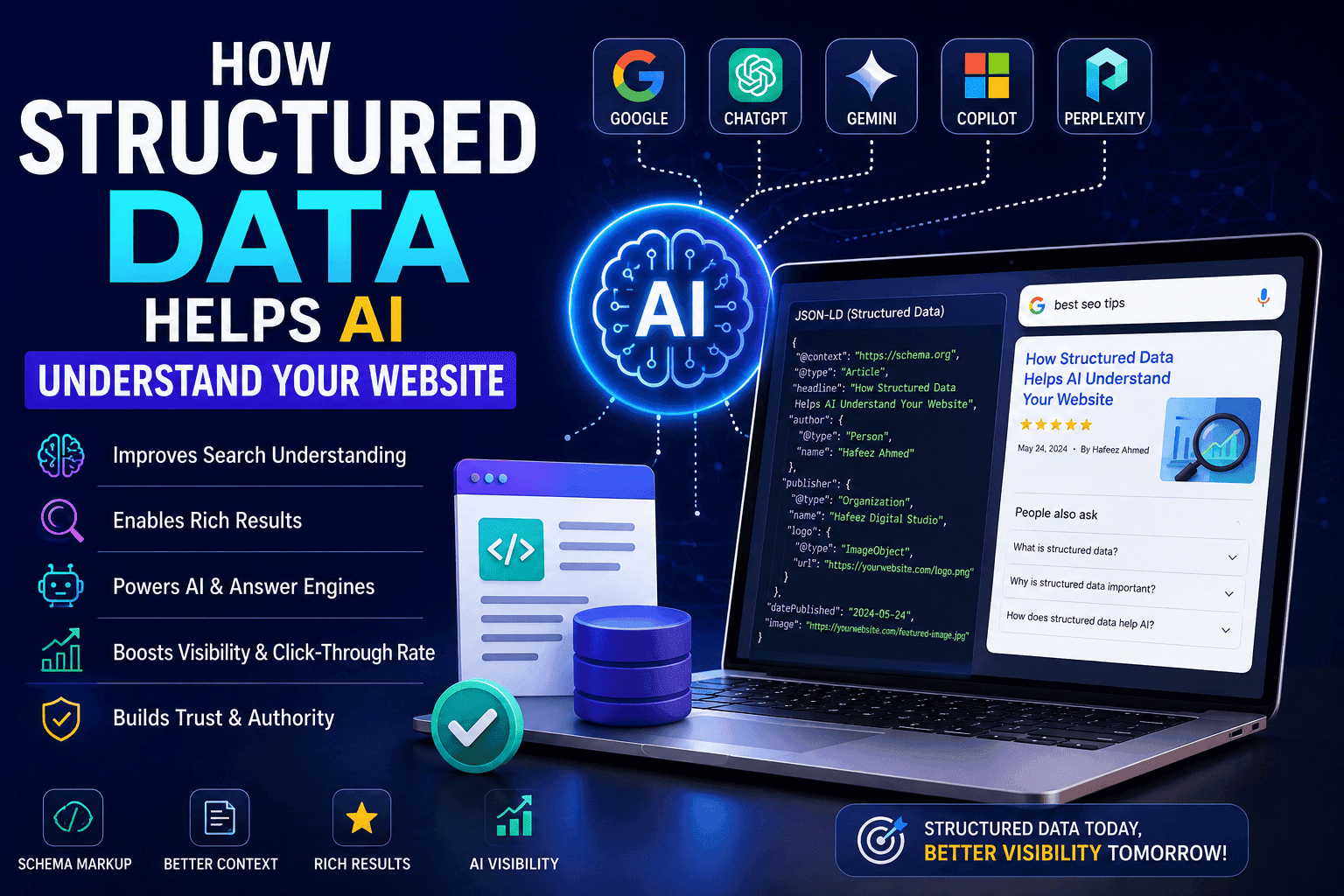
Structured Data is a standardized format used to describe the content on a webpage in a way that search engines can easily understand.
While visitors can naturally recognize that a page contains a blog post, product, recipe, or business information, search engines need extra context. This markup provides that context.
Think of schema as labels attached to your content.
Instead of simply seeing text, Google can understand:
- This page is a blog article.
- This person is the author.
- This business offers SEO services.
- This page contains frequently asked questions.
- This product has customer reviews.
- This event takes place on a specific date.
These additional details help search engines organize information more accurately.
Most websites implement this using Schema Markup, which follows standards developed by Schema.org.
Why Structured Data Matters
Without schema markup, search engines must guess what different parts of your content represent.
With proper data markup, you clearly tell search engines what every important element means.
10 Common SEO Mistakes That Are Hurting Your Rankings
This improves:
- Content understanding
- Rich search results
- Search relevance
- Knowledge Graph connections
- AI-generated answers
- Voice search performance
Although schema is not a direct ranking factor, it helps search engines interpret your content more accurately, which can improve overall visibility.
Real-Life Example
Bakery A
The website contains beautiful photos, pricing, and descriptions, but no schema markup.
Google understands the page only through visible text.
Bakery B
The website includes Product Schema, Organization Schema, Review Schema, and Local Business Schema.
Google immediately understands:
- Business name
- Product information
- Customer ratings
- Business location
- Opening hours
- Contact details
When someone searches for “birthday cake near me,” Bakery B has a much better chance of appearing with enhanced listings because Google understands exactly what the website offers.
Both websites sell similar products, but the one providing clearer information through schema gives search engines far more confidence.
3. What Is Schema Markup?
Schema Markup is the code used to implement structured data on a webpage.
It acts like a translator between your website and search engines.
Visitors usually never see this code, but Google, Bing, and AI-powered search systems use it to better understand your content.
Schema.org currently supports hundreds of schema types for different kinds of websites.
Some of the most common include:
- Article Schema
- Organization Schema
- Local Business Schema
- Product Schema
- FAQ Schema
- Review Schema
- Person Schema
- Breadcrumb Schema
- Video Schema
Choosing the correct schema helps search engines classify your content more accurately. To explore all available schema types and their properties, visit the official Schema.org documentation
Example
Imagine publishing a blog titled: “How to Improve Website Speed.”
Without Schema, Google simply sees a webpage containing text.
With Article Schema, Google understands:
- This is an article.
- The publication date.
- The author.
- The featured image.
- The headline.
- The publisher.
This additional information improves content understanding and may increase eligibility for enhanced search features.
4. How Google Understands Structured Data
Google uses advanced algorithms to crawl webpages and analyze their content.
However, even the most advanced AI systems benefit from structured information.
This markup acts as a roadmap that explains how different pieces of information relate to one another.
For example, on a service page, schema can identify:
- Business Name
- Services Offered
- Website URL
- Business Logo
- Contact Information
- Customer Reviews
- Social Profiles
Instead of making assumptions, Google receives clear signals about your website.
This reduces ambiguity and helps Google’s systems connect your content with relevant search queries.
As Google’s AI becomes more sophisticated, providing clean and well-structured information becomes increasingly valuable. Google officially recommends implementing schema correctly to help search engines better understand your content. Learn more in the Google Search Central documentation.
Case Study: A Local Digital Marketing Agency
A small digital marketing agency published high-quality SEO articles for nearly a year but struggled to earn rich snippets.
After conducting a technical audit, they implemented:
- Organization Schema
- Article Schema
- Breadcrumb Schema
- FAQ Schema
They also corrected missing author information and improved their internal linking.
Over the following months, Google began displaying richer search snippets for several blog posts. The website also experienced higher click-through rates because users could immediately see additional information directly in search results.
The quality of the content remained the same—the key improvement was helping search engines understand it more effectively.
This demonstrates an important lesson: great content becomes even more valuable when search engines can clearly interpret its meaning.
5. How AI Search Uses Structured Data
Artificial intelligence is changing the way search engines process information. Instead of simply matching keywords, AI systems try to understand the meaning, context, and relationships behind your content.
This is where schema becomes extremely valuable.
Platforms like Google AI Mode, AI Overviews, ChatGPT, Google Gemini, Microsoft Copilot, and Perplexity AI analyze vast amounts of online information to generate accurate answers. While these systems also rely on the visible content of your website, this markup provides additional context that makes interpretation easier.
How to Rank in AI Search Engines
Think of schema as an identification card for your webpage. It tells AI:
- Who created this content?
- What type of page is this?
- Is it an article, product, service, or FAQ?
- When was it published?
- Which organization owns the website?
- What topic does this page cover?
The clearer these signals are, the easier it becomes for AI systems to understand your website.
Although schema alone does not guarantee inclusion in AI-generated responses, it strengthens your website’s overall semantic clarity and trustworthiness.
Real-Life Example
Imagine two websites publish an article titled: “Best WordPress SEO Plugins.”
Website A
The page contains useful content but has no schema markup.
Website B
The page includes:
- Article Schema
- Author Schema
- Organization Schema
- FAQ Schema
- Breadcrumb Schema
Both articles are well written, but Website B provides additional context that helps search engines and AI understand exactly what the page contains.
This improves the website’s eligibility for enhanced features and increases confidence in its content.
6. Types of Schema Every Website Should Use
Not every website needs every type of Schema Markup. The best approach is to implement the schemas that match your content and business.
Article Schema
Ideal for blogs, news websites, and educational content.
It helps search engines identify:
- Headline
- Author
- Featured image
- Publication date
- Publisher
Organization Schema
Every business website should implement Organization Schema.
It provides information such as:
- Company name
- Logo
- Website
- Contact details
- Social media profiles
This helps strengthen your brand identity across search engines.
Local Business Schema
Perfect for businesses serving specific locations.
It can include:
- Address
- Phone number
- Business hours
- Reviews
- Geographic location
This improves local SEO and helps customers find your business more easily.
FAQ Schema
If your article answers common questions, FAQ Schema can help search engines understand that content more effectively.
Well-written FAQs also improve user experience and support conversational AI searches.
Breadcrumb Schema
Breadcrumbs help both users and search engines understand where a page fits within your website structure.
They improve navigation and reinforce your site’s hierarchy.
Person Schema
This schema identifies the author of your content.
Including author information supports Google’s emphasis on Experience, Expertise, Authoritativeness, and Trustworthiness (E-E-A-T).
7. JSON-LD vs. Microdata
There are several methods for implementing schema, but the two most common are JSON-LD and Microdata.
JSON-LD
JSON-LD is Google’s recommended format.
It is added separately from your webpage content, making it easier to create, update, and maintain.
Most modern SEO plugins automatically generate JSON-LD for WordPress websites.
Microdata
Microdata is embedded directly within HTML elements.
While it still works, it can make your code more complex and harder to manage.
Which One Should You Use?
For most websites, JSON format is the best choice because it is:
- Easier to implement
- Easier to maintain
- Recommended by Google
- Supported by most SEO plugins
If you’re using WordPress with plugins like Rank Math or Yoast SEO, JSON-LD is typically generated automatically.
8. Common Structured Data Mistakes
Simply adding Schema Markup is not enough. Incorrect implementation can confuse search engines and reduce its effectiveness.
Using the Wrong Schema Type
Applying Product Schema to a blog article or Article Schema to a service page can create misleading signals.
Always choose the schema that accurately matches your content.
Missing Required Properties
Some schema types require specific information such as the headline, author, publication date, or image.
Incomplete schema may not qualify for enhanced search features.
Providing Inaccurate Information
Your schema should always match the visible content on the page.
For example, don’t mark a page as containing FAQs if no FAQs are actually displayed.
Consistency is essential.
Forgetting to Update Schema
If you update an article with a new author, publication date, or featured image, make sure your schema reflects those changes.
Outdated markup can reduce trust signals.
Ignoring Validation
Before publishing, validate your schema using Google’s Rich Results Test or Schema Markup Validator to identify any errors.
Regular testing helps ensure your implementation remains accurate.
Case Study: An Online Electronics Store
A growing e-commerce business selling laptops and computer accessories struggled to attract clicks despite ranking on the first page for several product searches.
After reviewing the website, the SEO team implemented:
- Product Schema
- Review Schema
- Organization Schema
- Breadcrumb Schema
They also ensured that prices, availability, ratings, and product images were correctly included in the markup.
Within a few months, many product pages became eligible for enhanced listings featuring star ratings, pricing, and availability information.
Although rankings changed only slightly, the website experienced a noticeable increase in click-through rate because users could see richer information directly in search results.
This case study highlights an important principle: schema doesn’t just help search engines—it helps users make better decisions before they even visit your website.
9. Best Practices for Using Structured Data
Adding schema is only the first step. To get the maximum SEO and AI visibility benefits, it should be implemented correctly and maintained over time.
Use the Right Schema Type
Always choose schema that accurately matches your content.
For example:
- Blog posts → Article Schema
- Service pages → Service Schema
- Local businesses → Local Business Schema
- Products → Product Schema
- FAQ sections → FAQ Schema
Using incorrect schema can confuse search engines and reduce your eligibility for enhanced features.
Keep Your Structured Data Accurate
Everything in your schema should match the visible content on the page.
If your markup says an article was updated yesterday but the page hasn’t changed in months, it creates inconsistent signals.
Always keep:
- Author information
- Images
- Dates
- Business details
- Contact details
up to date.
Build Strong Entity Signals
Schema works even better when it supports a strong overall entity.
Include:
- Organization Schema
- Person Schema
- Logo
- Social profile links
- Contact details
- About page
These signals help search engines better understand who owns your website and why your content deserves trust.
Validate Before Publishing
Never assume your schema is perfect.
Always test it using Google’s Rich Results Test and the Schema Markup Validator to identify errors before publishing.
Small implementation mistakes can prevent search engines from fully understanding your content.
Continue Publishing High-Quality Content
Schema enhances great content—it cannot replace it.
Without useful, trustworthy, and comprehensive information, markup alone will not improve your SEO performance.
The best results come from combining excellent content with proper technical implementation.
10. The Future of Structured Data in AI Search
Artificial intelligence is reshaping search at an incredible pace.
Modern search engines no longer rely only on keywords. They combine machine learning, natural language processing, semantic search, and schema to better understand webpages.
As Google AI Mode and other AI-powered platforms continue to evolve, schema will likely play an even greater role in helping AI systems identify trustworthy information.
Future search experiences may become increasingly personalized, conversational, and context-aware.
Instead of simply searching for “best SEO tools,” users may ask:
“Which SEO tools are best for a freelance WordPress developer with a limited budget?”
AI systems will need reliable, well-structured information to answer complex questions like these.
Websites that consistently publish high-quality content while implementing accurate schema will be better positioned to benefit from these advancements.
The future of SEO is no longer just about ranking—it is about becoming a trusted source that AI systems confidently understand and recommend.
Case Study: How Structured Data Improved AI Visibility
A small digital marketing agency published helpful SEO articles for over a year but received limited visibility outside traditional Google search results.
The agency decided to strengthen its technical SEO by implementing:
- Organization Schema
- Article Schema
- Person Schema
- FAQ Schema
- Breadcrumb Schema
At the same time, the team updated older articles, improved internal linking, added author biographies, and refreshed outdated content.
Over the following months, the website became eligible for more rich snippets and saw improved click-through rates on several key pages.
More importantly, the agency noticed that its content was increasingly aligned with AI-friendly search practices. While no website can guarantee inclusion in AI-generated answers, providing clear structure, strong entity signals, and high-quality content positioned the site much better for future AI-powered search experiences.
The lesson is simple: Schema works best when it supports valuable content, technical SEO, and genuine expertise.
Final Checklist
- Is the correct Schema type implemented?
- Does the schema match the visible content?
- Have you added Organization and Person Schema?
- Are images, dates, and author details accurate?
- Is the page internally linked to related content?
- Does the content answer user questions clearly?
- Have you tested the schema for errors?
- Is the page mobile-friendly and fast?
Following this checklist will help your website communicate more effectively with both search engines and AI-powered platforms.
Conclusion
Schema markup has become an essential part of modern SEO. While it may not directly increase rankings, it provides search engines and AI systems with valuable context that helps them understand your content more accurately.
As AI-powered search continues to grow through platforms like Google AI Mode, ChatGPT, Gemini, Copilot, and Perplexity, websites that provide clear, structured, and trustworthy information will have a stronger opportunity to stand out.
However, schema should never be viewed as a shortcut. It works best when combined with excellent content, technical SEO, topical authority, and a positive user experience.
Whether you run a blog, an eCommerce store, or a business website, implementing schema today is an investment in the future of your online visibility. The websites that make it easier for AI to understand their content will be better prepared for the next generation of search.
Final Thoughts
The future of search belongs to websites that are easy for both people and AI systems to understand.
By combining high-quality content, strong technical SEO, entity optimization, and accurate schema markup, you can build a website that is not only optimized for today’s search engines but also prepared for the AI-driven future of search.
Frequently Asked Questions:
Structured data is a standardized format that helps search engines understand the meaning and context of your webpage. It provides additional information about articles, products, businesses, authors, FAQs, and other content.
Structured data is not a direct ranking factor, but it helps search engines better understand your content, making it eligible for rich results and improving overall search visibility.
Structured data is the information format, while Schema Markup is the vocabulary used to define that information on a webpage.
Article Schema is the recommended choice for blog posts. It identifies the headline, author, publication date, featured image, and publisher.
Yes. While AI systems analyze many signals, structured data helps provide additional context, making it easier for AI-powered search engines to understand your website and its content accurately.