1. Introduction
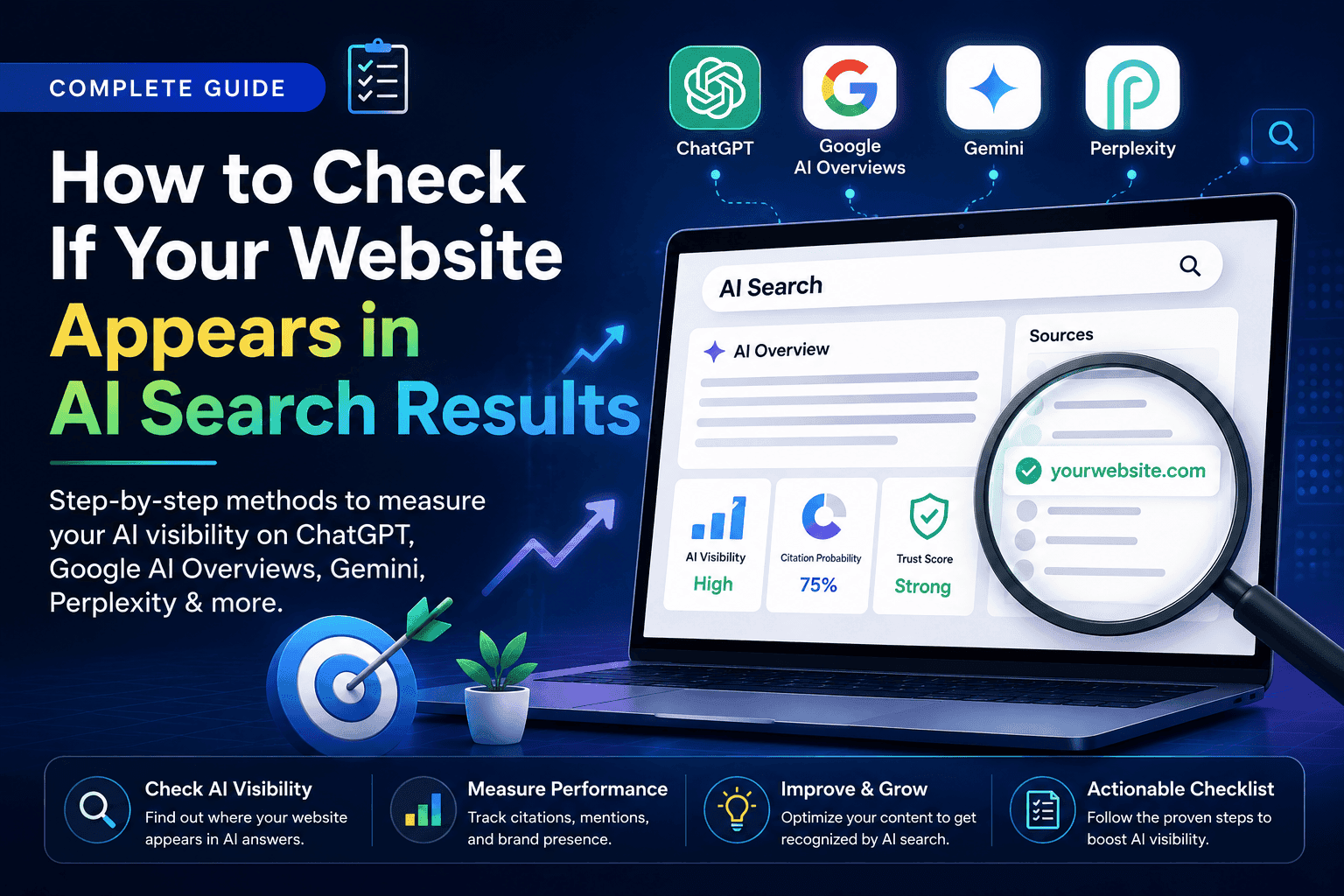
How to Check If Your Website Appears in AI Search Results is becoming one of the most important questions for website owners, bloggers, SEO professionals, and digital marketers.
For years, measuring SEO success was simple. You could track keyword rankings, monitor organic traffic, and analyze clicks using tools like Google Search Console.
Today, search is evolving.
Millions of users are asking questions directly to AI-powered platforms like ChatGPT, Google AI Mode, Google AI Overviews, Google Gemini, Microsoft Copilot, and Perplexity AI instead of browsing traditional search results.
This shift creates a new challenge.
Your website may rank well on Google, but that doesn’t necessarily mean AI platforms are using or referencing your content when answering users’ questions.
That’s why understanding how to check if your website appears in AI search results has become an essential skill for anyone who wants to stay competitive in the era of AI-powered search.
In this guide, you’ll learn practical methods to evaluate your AI visibility, identify potential issues, and improve your chances of being recognized by modern AI search engines.
If you’re new to AI Search Optimization, start with our complete guide on How to Rank in AI Search Engines to understand the fundamentals before measuring your AI visibility
2. What Are AI Search Results?
AI search results are answers generated by artificial intelligence rather than a traditional list of blue links.
Instead of displaying ten websites, AI systems analyze information from multiple trusted sources and generate a conversational response.
Some of today’s most popular AI-powered search experiences include:
ChatGPT
Google AI Mode
Google AI Overviews
Google Gemini
Microsoft Copilot
Perplexity AI
For example, instead of searching:
Best SEO tools
Users now ask:
What are the best SEO tools for small businesses with a limited budget?
Rather than showing dozens of links, AI platforms summarize information and recommend solutions directly.
If your website contributes to those answers, your brand gains valuable visibility—even when users never visit a traditional search results page.
This is why AI visibility is becoming just as important as traditional search rankings.
AI visibility is closely connected with Generative Engine Optimization (GEO), which focuses on helping AI-powered search engines understand and reference your content.
3. Why Checking AI Visibility Matters
Many website owners assume that if they rank well on Google, AI platforms will automatically recommend their content.
Unfortunately, that isn’t always true.
AI systems evaluate additional signals such as:
Topical authority
Entity recognition
Structured data
Content quality
User intent
Trustworthiness
Semantic relevance
As a result, two websites with similar Google rankings may perform very differently in AI-generated responses.
Checking your AI visibility helps you answer important questions like:
Is my website mentioned in AI answers?
Which pages are most visible?
Which topics does AI associate with my brand?
What improvements should I make?
Without testing your visibility, you’re essentially optimizing without feedback.
Regular monitoring allows you to measure progress as AI search continues to evolve.
If your website isn’t appearing in AI-generated answers, read our guide on Why AI Search Isn’t Showing Your Website (10 Common Reasons) to identify and fix the most common issues
4. Method #1: Search for Your Brand in AI Platforms
The easiest way to check your AI visibility is to ask AI platforms about your business.
Try prompts like:
What is Hafeez Digital Studio?
Tell me about Hafeez Digital Studio.
Who provides AI Search Optimization services?
Recommend websites that teach AI SEO.
Observe the response carefully.
Ask yourself:
Is your website mentioned?
Is your brand described accurately?
Are your services explained correctly?
Does AI reference your content?
Are competitors mentioned instead?
Repeat this test across different AI platforms because each system may generate different answers.
Keep a simple spreadsheet to record:
Date
Platform tested
Prompt used
Whether your website appeared
Accuracy of the response
Over time, these records will help you measure improvements in AI visibility.
5. Method #2: Ask Real User Questions
One common mistake is testing only branded searches.
Real users don’t always search for your business name.
Instead, they ask questions.
For example, if your website focuses on AI SEO, test prompts such as:
How do I rank in AI search engines?
What is Generative Engine Optimization?
How does structured data help AI search?
Why isn’t my website appearing in AI search?
How can I improve AI visibility?
These prompts better reflect actual user behavior.
If AI platforms consistently recommend your content or mention your brand when answering these questions, it’s a strong sign that your website is gaining authority.
Testing informational queries also reveals which topics AI associates with your website.
This information can guide your future content strategy.
Real-Life Example
Imagine two digital marketing agencies.
Agency A
Publishes articles about SEO, AI Search, structured data, and Google AI Mode.
Every article links naturally to related content, includes detailed author information, and is updated regularly.
Agency B
Publishes occasional SEO articles with little topical focus, weak internal linking, and outdated information.
When someone asks an AI platform:
“How can I optimize my website for AI search?”
Agency A is much more likely to be recognized because it has consistently built topical authority around AI search.
Agency B may still rank for some keywords in traditional search, but AI platforms have fewer reasons to consider it a trusted source.
This example shows that AI visibility depends on more than rankings—it depends on expertise, consistency, and content quality.
Key Takeaways
By now, you should understand:
AI search results are different from traditional search results.
Ranking on Google doesn’t guarantee AI visibility.
Testing your brand across multiple AI platforms is the first step.
Asking real user questions provides more accurate insights than branded searches.
Regular monitoring helps you measure progress and identify opportunities for improvement.
I
Advanced Methods to Measure AI Visibility
6. Method #3: Check Google AI Overviews
One of the easiest ways to determine whether your website is gaining AI visibility is by checking Google AI Overviews.
Google AI Overviews appear at the top of search results for many informational queries. Instead of showing only a list of links, Google generates an AI-powered summary and often references websites that helped create the answer.
To test your visibility:
Open Google Search.
Search for topics related to your website.
Look for searches that trigger an AI Overview.
Expand the AI-generated answer.
Review the cited websites.
Ask yourself:
Is your website listed as a source?
Are your competitors mentioned instead?
Which websites appear repeatedly?
If your competitors consistently appear while your website does not, analyze what they are doing differently. Compare:
Content depth
Content freshness
Structured data
Internal linking
Topic coverage
Author information
This comparison often reveals opportunities to improve your own content.
7. Method #4: Monitor Google Search Console
Although Google Search Console doesn’t currently provide a dedicated report for AI-generated citations, it remains one of the best tools for measuring your website’s overall search performance.
Pay attention to metrics such as:
Organic impressions
Clicks
Average position
Queries
Indexed pages
Look for informational search queries that are growing over time.
If pages optimized for AI Search begin receiving more impressions, it may indicate that Google increasingly recognizes them as authoritative resources.
You should also monitor:
Crawling issues
Mobile usability
Page indexing
Core Web Vitals
Structured data enhancements
A technically healthy website provides a stronger foundation for both traditional and AI-powered search.
8. Method #5: Analyze Brand Mentions Across AI Platforms
Another effective way to measure AI visibility is by checking whether AI systems recognize your brand.
Instead of asking only about your business, try prompts such as:
Which websites provide AI SEO tutorials?
Who are trusted experts in AI Search Optimization?
What are the best resources for learning Generative Engine Optimization?
If your brand appears naturally in these responses, it suggests that AI systems associate your website with those topics.
If your brand is missing, don’t panic.
Instead, focus on strengthening:
Brand authority
Topical authority
Entity SEO
High-quality educational content
Consistent publishing
Over time, these improvements can increase your brand’s visibility in AI-generated responses.
9. Common Mistakes When Testing AI Visibility
Many website owners incorrectly assume that one successful AI response means they have achieved strong AI visibility.
In reality, AI systems continuously evolve, and responses can vary depending on:
User location
Search history
Query wording
AI model updates
Available information
Here are some common testing mistakes to avoid.
Testing Only One Platform
Don’t rely on a single AI assistant.
Compare results across:
ChatGPT
Google AI Mode
Google AI Overviews
Google Gemini
Microsoft Copilot
Perplexity AI
Each platform retrieves and presents information differently.
Using Only Branded Queries
Searching only for your company name doesn’t provide a complete picture.
Real users ask problem-solving questions.
Test the same types of questions your audience asks every day.
Ignoring Competitor Analysis
Always compare your visibility with competitors.
If another website consistently appears in AI-generated answers, study:
Their content structure
Publishing frequency
Internal linking
Author profiles
Schema implementation
Learning from competitors is often faster than guessing what AI prefers.
Expecting Immediate Results
Generative Engine Optimization is a long-term strategy.
Building trust takes time.
Consistency usually produces better results than publishing dozens of articles in a short period.
Case Study: Measuring AI Visibility for an SEO Blog
A digital marketing blog had published more than 60 articles focused on SEO and AI Search.
The owner believed the website should already appear in AI-generated answers.
Instead of making assumptions, they tested their visibility.
They:
Asked more than 50 AI-related questions across multiple AI platforms.
Compared responses with three competing websites.
Checked Google AI Overviews for important keywords.
Reviewed Google Search Console performance.
Identified which pages were most frequently associated with AI Search topics.
The audit revealed that only a small number of articles consistently aligned with user intent.
The team then:
Updated older content.
Improved internal linking.
Added FAQ sections.
Expanded topic clusters.
Published supporting articles around AI Search and GEO.
After several months, the website demonstrated stronger topical authority and noticeably better visibility for AI-related searches.
The biggest lesson was simple:
You can’t improve what you don’t measure. Regular testing helps you understand where your website stands and where you should focus your optimization efforts.
Key Takeaways
By now, you have learned how to:
Check Google AI Overviews for citations.
Use Google Search Console to monitor search performance.
Analyze brand mentions across AI platforms.
Avoid common AI visibility testing mistakes.
Measure progress through consistent testing rather than assumptions.
10. What to Do If Your Website Doesn’t Appear in AI Search Results
If you’ve tested multiple AI platforms and your website doesn’t appear in their responses, don’t assume you’ve failed.
AI visibility is built over time. Most websites that perform well in AI-powered search have spent months—or even years—building trust, authority, and comprehensive content.
Instead of looking for quick fixes, focus on improving the signals that AI systems value most.
Publish Comprehensive Content
Thin content rarely performs well in AI search.
Create in-depth articles that fully answer users’ questions.
Instead of writing several short posts, publish comprehensive guides supported by examples, screenshots, and practical recommendations.
Build Topical Authority
AI platforms trust websites that consistently cover a subject.
If your niche is AI SEO, publish related articles such as:
- Generative Engine Optimization (GEO)
- AI Search Optimization
- Google AI Mode
- Google AI Overviews
- Structured Data
- Entity SEO
- Technical SEO
- Helpful Content
- AI Visibility
When these articles are connected through internal links, AI gains a clearer understanding of your expertise.
Strengthen Your Entity
AI systems evaluate brands, not just webpages.
Improve your entity by adding:
- A detailed About page
- Author biographies
- Contact information
- Organization Schema
- Consistent branding across platforms
The more consistent your online identity is, the easier it becomes for AI to recognize your website.
Improve Technical SEO
A technically optimized website is easier for search engines and AI systems to crawl and understand.
Regularly check:
- XML Sitemap
- Robots.txt
- HTTPS security
- Mobile usability
- Page speed
- Core Web Vitals
- Broken links
Technical SEO remains an essential foundation for AI visibility.
ا Technical SEO Checklist for 2026
11. AI Visibility Checklist
Before publishing your next article, ask yourself these questions.
. Does the content answer a real user question?
. Is the article more comprehensive than competing content?
Have I included original examples or case studies?
Does the page demonstrate experience and expertise?
. Have I used proper headings?
. Is structured data implemented?
. Does the article link to related content?
. Is the content up to date?
. Is the website fast and mobile-friendly?
. Would an AI assistant consider this article a trustworthy source?
If you can confidently answer “Yes” to these questions, your content is moving in the right direction.
12. Useful Tools to Monitor AI Visibility
While no tool can perfectly measure AI citations today, several tools can help you evaluate and improve your visibility.
Google Search Console
Monitor:
- Search impressions
- Organic clicks
- Indexed pages
- Performance trends
Google Analytics 4
Track:
- Organic traffic
- User engagement
- Landing pages
- Session duration
Google Rich Results Test
Validate your structured data and ensure your pages are eligible for rich results.
Schema Markup Validator
Check whether your schema markup is correctly implemented.
PageSpeed Insights
Measure loading speed and identify technical improvements that enhance user experience.
AI Platforms
Regularly test your content using:
- ChatGPT
- Google AI Mode
- Google Gemini
- Microsoft Copilot
- Perplexity AI
Record your findings in a spreadsheet each month to identify trends over time.
Case Study: From Zero AI Visibility to Growing Recognition
A content creator launched a new website focused on AI Search and SEO. During the first few months, the site published quality articles but rarely appeared in AI-generated responses.
Rather than producing random content, the creator adopted a structured strategy.
They:
- Built topic clusters around AI Search and GEO.
- Updated older articles with fresh examples.
- Added FAQ and Organization Schema.
- Improved internal linking.
- Enhanced author profiles and the About page.
- Published detailed tutorials based on real testing.
After several months of consistent improvements, the website experienced stronger organic growth and increased recognition for AI-related topics.
Although there was no guarantee of appearing in every AI response, the site established itself as a more trustworthy and authoritative resource.
The lesson is simple:
AI visibility is earned through consistency, quality, and credibility—not shortcuts.
Conclusion
Checking whether your website appears in AI search results is no longer optional—it’s becoming an essential part of modern SEO.
As platforms like ChatGPT, Google AI Mode, Google AI Overviews, Gemini, Microsoft Copilot, and Perplexity AI continue to shape how people discover information, website owners must monitor not only rankings but also AI visibility.
Start by testing your brand, asking real user questions, reviewing AI-generated responses, and comparing your results with competitors.
If your website isn’t appearing yet, don’t be discouraged.
Focus on publishing helpful content, strengthening your topical authority, implementing structured data, and improving your technical SEO. Over time, these efforts can significantly increase the likelihood that AI systems recognize and reference your website.
The future of search isn’t just about ranking on Google—it’s about becoming a trusted source that both people and AI systems rely on.
To prepare for the next generation of search, explore our guide on The Future of SEO: AI, Entities, and Answer Engines.
Frequently Asked Questions
Test your website by asking relevant questions in ChatGPT, Google AI Mode, Google AI Overviews, Gemini, Copilot, and Perplexity AI. Also monitor Google Search Console for improvements in search visibility.
No. A high Google ranking does not automatically mean AI platforms will reference your content. AI systems also consider topical authority, trust, content quality, and semantic relevance.
A monthly review is usually sufficient. Track the same prompts over time so you can measure changes and identify patterns.
Create high-quality, experience-based content, build topical authority, strengthen your entity signals, implement structured data, and maintain strong technical SEO
Yes. While established websites often have an advantage, new websites can also gain AI visibility by consistently publishing accurate, comprehensive, and user-focused content that demonstrates expertise and trustworthiness.
Final Thoughts
AI-powered search is transforming how users discover information online. The sooner you begin measuring your AI visibility and optimizing your content for AI understanding, the stronger your long-term digital presence can become.
Instead of chasing algorithms, focus on becoming the most helpful resource in your niche. That approach benefits your readers today and positions your website for the future of AI-powered search.