Introduction
Search Engine Optimization (SEO) has never stood still. Over the years, it has evolved from simple keyword optimization and link building to a sophisticated strategy focused on user intent, content quality, technical excellence, and trust.Today, the search landscape is undergoing another major transformation. Artificial intelligence is changing how people search, how search engines understand content, and how websites gain visibility online. Instead of relying only on traditional search results, users are increasingly turning to AI-powered platforms that provide direct, conversational answers.Google’s AI Mode, AI Overviews, ChatGPT, Google Gemini, Microsoft Copilot, and Perplexity AI are redefining how information is discovered. These platforms don’t simply display a list of websites—they analyze multiple sources, understand context, and generate answers that help users solve their problems faster.At the same time, Google has become much better at understanding entities rather than just keywords. Search engines now recognize the relationships between people, businesses, brands, products, locations, and concepts, making search results more intelligent than ever before.For website owners, bloggers, freelancers, and businesses, this shift presents both new opportunities and new challenges. Traditional SEO techniques are still important, but they are no longer enough to achieve sustainable visibility in modern search.In this guide, you’ll discover how AI, entities, answer engines, and Google AI Mode are shaping the future of SEO and learn practical strategies to help your website remain competitive in the evolving search ecosystem.How to Rank in AI search
Why SEO Is Entering a New Era ?
The way people search online has changed dramatically.In the past, users searched using short phrases such as:- Best WordPress plugins
- SEO tips
- Website speed
- How can I improve my website’s visibility in AI search?
- What is the best SEO strategy for small businesses?
- How does Google AI Mode choose websites?
The Rise of AI Search
Artificial intelligence has become one of the biggest drivers of change in search.Millions of users now rely on AI assistants to find answers quickly. Rather than visiting multiple websites, they ask conversational questions and expect complete responses within seconds.AI-powered platforms such as ChatGPT, Google Gemini, Microsoft Copilot, and Perplexity AI analyze information from trusted sources and generate summarized answers that are easy to understand.This change has introduced a new concept known as AI Search Optimization, where content is created not only for traditional search engines but also for AI systems that interpret and recommend information.For website owners, this means creating content that is:- Helpful and accurate
- Well-structured
- Easy to understand
- Backed by expertise
- Regularly updated
Understanding Google AI Mode
Google AI Mode represents one of the most significant developments in the history of search.Unlike traditional search results that display a list of web pages, Google AI Mode is designed to understand complex questions and generate conversational responses by analyzing multiple reliable sources.Users can ask follow-up questions, explore topics in greater depth, and receive personalized answers without starting a new search each time.For businesses, this changes the way visibility is earned.Success is no longer determined solely by keyword rankings. Instead, Google evaluates whether your content demonstrates expertise, answers user questions effectively, and provides trustworthy information.Websites that prioritize quality, clarity, and topical authority are more likely to benefit from this new search experience.Why This Matters for Website Owners
Many website owners worry that AI-powered search will reduce organic traffic.While search behavior is certainly evolving, the reality is more encouraging. AI is changing how websites are discovered—not eliminating the need for them.Businesses that adapt to these changes by publishing valuable content, improving technical SEO, and building authority within their niche will continue to attract qualified visitors.Instead of focusing only on ranking for individual keywords, successful websites will focus on becoming trusted resources that both users and AI systems can rely on.This is why the future of SEO belongs to websites that combine traditional optimization techniques with AI-friendly content strategies.Key Changes Driving the Future of SEO
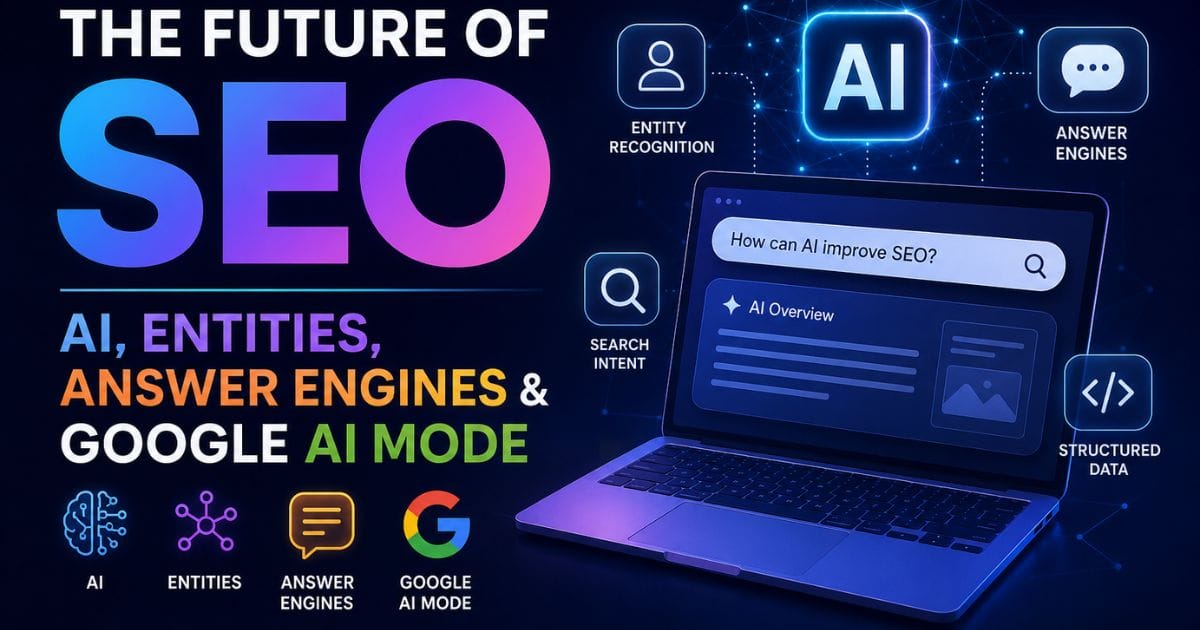
Several major trends are shaping the future of search:- Artificial Intelligence is delivering direct answers instead of only displaying links.
- Entity-based search helps Google understand meaning rather than matching exact keywords.
- Answer engines prioritize clear, reliable, and well-structured information.
- User experience and content quality are becoming stronger ranking signals.
- Topical authority is becoming more valuable than publishing isolated articles.
- Trust, expertise, and credibility continue to play a crucial role in search visibility.
What Is Entity SEO?
For many years, SEO revolved around keywords. Website owners focused on finding high-volume keywords and using them throughout their pages to improve rankings.Today, search engines have become much smarter.Google now understands entities—real-world people, businesses, products, places, organizations, and concepts—and the relationships between them. Instead of simply matching keywords, Google tries to understand what users actually mean.For example, when someone searches for “Apple”, Google can recognize whether the user is referring to the technology company or the fruit based on the search context.This is why modern SEO is becoming more semantic rather than keyword-focused.Common SEO mistakesWhy Entity SEO Matters ?
Entity-based SEO helps search engines understand your website more accurately.When Google clearly understands your business, services, expertise, and the topics you consistently publish about, it becomes easier to connect your content with relevant searches.Strong entity signals can also improve your chances of appearing in:- Google Knowledge Panels
- AI-generated answers
- Featured Snippets
- AI Overviews
- Voice Search results
What Are Answer Engines?
Traditional search engines provide users with a list of websites.Answer engines take a different approach.Instead of asking users to visit multiple websites, they generate direct answers by analyzing information from trusted sources.Examples include:- ChatGPT
- Google AI Mode
- Google AI Overviews
- Google Gemini
- Microsoft Copilot
- Perplexity AI
Answer Engine Optimization (AEO)
As answer engines become more popular, a new optimization strategy has emerged: Answer Engine Optimization (AEO).AEO focuses on creating content that AI systems can easily understand, summarize, and reference.Unlike traditional SEO, which primarily aims to improve rankings, AEO aims to increase the likelihood that your content will be selected as part of an AI-generated answer.Best Practices for AEO
- Answer questions clearly and directly.
- Use descriptive H2 and H3 headings.
- Add FAQ sections.
- Publish comprehensive guides.
- Implement structured data (Schema Markup).
- Keep content accurate and regularly updated.
- Demonstrate real expertise through examples and practical insights.
Building Topical Authority
Publishing one excellent article is helpful, but it is no longer enough.Search engines increasingly reward websites that consistently cover a subject in depth.This is known as topical authority.For example, instead of publishing only one article about SEO, a strong website creates an entire content cluster covering topics such as:- Technical SEO
- On-Page SEO
- Local SEO
- AI Search Optimization
- Entity SEO
- Google Search Console
- Website Speed Optimization
- Structured Data
- Content Marketing
The Role of Structured Data
Structured data, also known as Schema Markup, helps search engines understand the meaning of your content.It provides additional context about:- Articles
- Businesses
- Products
- Services
- Reviews
- FAQs
- Authors
- Organizations
Real-World Example
Imagine two digital marketing agencies offering identical SEO services.Agency A
- Publishes one blog every few months.
- Targets random keywords.
- Has no internal linking strategy.
- Uses little structured data.
- Covers many unrelated topics.
Agency B
- Publishes comprehensive SEO guides every week.
- Covers technical SEO, AI SEO, local SEO, and content marketing in depth.
- Uses internal links to connect related articles.
- Implements Schema Markup.
- Regularly updates existing content.
- Demonstrates expertise through case studies and practical examples.
Practical Strategies to Prepare for the Future of SEO
If you want your website to remain competitive, start implementing these strategies today:- Focus on creating helpful, people-first content.
- Build topical authority instead of targeting isolated keywords.
- Strengthen your internal linking strategy.
- Improve your website’s technical SEO.
- Add structured data wherever appropriate.
- Update existing content regularly.
- Publish content that directly answers user questions.
- Build trust by demonstrating real expertise and experience.
Will Traditional SEO Disappear?
One of the biggest questions in digital marketing today is whether AI will replace traditional SEO.The answer is No—but SEO is evolving.Traditional SEO remains the foundation of online visibility. Technical optimization, high-quality content, page experience, backlinks, and user satisfaction will continue to influence search performance.However, AI is changing how search engines interpret information and how users consume it.Instead of optimizing only for rankings, businesses must now optimize for visibility across multiple search experiences, including Google Search, Google AI Mode, AI Overviews, ChatGPT, Gemini, Microsoft Copilot, and Perplexity AI.The future belongs to websites that combine traditional SEO with AI-friendly optimization strategies.The Role of Human Experience
Artificial intelligence can generate content quickly, but it cannot replace genuine human experience.Search engines increasingly prioritize content that demonstrates real expertise, practical knowledge, and first-hand experience.For example, a web designer explaining how they improved a client’s Core Web Vitals provides more value than generic advice copied from multiple sources.Likewise, an SEO consultant sharing actual ranking improvements and lessons learned offers insights that AI-generated content alone cannot replicate.Adding real-world examples, case studies, screenshots, and personal observations strengthens your credibility and improves your content’s overall quality.Future SEO Trends Every Website Owner Should Watch
Search technology will continue evolving rapidly over the next few years.Some of the most important trends include:1. AI-First Search Experiences
AI-generated answers will become increasingly common, making content clarity and topical authority even more important.2. Entity-Based Search
Google will continue improving its understanding of entities and their relationships rather than relying solely on keywords.3. Greater Focus on E-E-A-T
Experience, Expertise, Authoritativeness, and Trustworthiness will remain essential for building long-term visibility.4. More Conversational Search Queries
Users are increasingly asking detailed questions instead of typing short keyword phrases.5. Stronger Technical SEO Requirements
Fast-loading websites, mobile optimization, structured data, and Core Web Vitals will continue to influence performance.6. Content Depth Over Content Quantity
Publishing fewer high-quality articles is becoming more valuable than producing large volumes of thin content.Action Plan: How to Future-Proof Your Website
 Focus on solving user problems instead of chasing keywords.
Build topical authority by publishing related content consistently.
Improve website speed and Core Web Vitals.
Use Schema Markup to help search engines understand your content.
Strengthen your internal linking strategy.
Keep your content updated with fresh examples and current information.
Publish expert insights and practical case studies.
Optimize for both traditional search engines and AI-powered answer engines.
Focus on solving user problems instead of chasing keywords.
Build topical authority by publishing related content consistently.
Improve website speed and Core Web Vitals.
Use Schema Markup to help search engines understand your content.
Strengthen your internal linking strategy.
Keep your content updated with fresh examples and current information.
Publish expert insights and practical case studies.
Optimize for both traditional search engines and AI-powered answer engines.Conclusion
SEO is entering one of the most exciting periods in its history.Artificial intelligence, entity-based search, answer engines, and Google AI Mode are transforming how users discover information online. Rather than replacing traditional SEO, these innovations are expanding it into a more intelligent, user-focused discipline.Success in this new era will depend on far more than keyword optimization. Businesses that create helpful content, build topical authority, demonstrate genuine expertise, and provide outstanding user experiences will be best positioned to succeed.The future of SEO belongs to websites that people trust and AI systems understand.Instead of trying to keep up with every algorithm update, focus on creating content that answers real questions, solves real problems, and delivers genuine value. That strategy will remain effective regardless of how search technology evolves.If you start adapting today, your website will be better prepared for both traditional search results and the next generation of AI-powered search experiences.Frequently Asked Questions
1. What is the future of SEO?
The future of SEO combines traditional optimization with AI-driven search experiences, entity-based understanding, Answer Engine Optimization (AEO), and user-focused content.2. What is Google AI Mode?
Google AI Mode is an AI-powered search experience that provides conversational answers by analyzing multiple trusted sources instead of displaying only traditional search results.3. What is Entity SEO?
Entity SEO is the practice of helping search engines understand the people, businesses, products, places, and concepts mentioned in your content instead of relying only on keywords.4. What is Answer Engine Optimization (AEO)?
Answer Engine Optimization is the process of structuring content so AI-powered platforms can easily understand, summarize, and recommend it in response to user questions.5. Will AI replace SEO?
No. AI is changing how search works, but SEO remains essential. Businesses that combine traditional SEO with AI-friendly content strategies will be better positioned for long-term success.Final ThoughtsSearch will continue to evolve, but one principle is unlikely to change: the websites that consistently provide accurate, trustworthy, and valuable information will continue to earn visibility.Whether your audience finds you through Google Search, Google AI Mode, ChatGPT, Gemini, or another AI-powered platform, your goal should remain the same—create exceptional content that deserves to be discovered, shared, and trusted.