How to Optimize Content for AI Search Without Keyword Stuffing
If you are wondering how to optimize content for AI search without keyword stuffing, the answer is simpler than it sounds: stop writing for a machine and start writing for the person asking the question.
A few years ago, SEO advice often sounded like this: find a keyword, put it in the title, repeat it throughout the article, add it to headings, and make sure it appears enough times.
That approach can easily turn a useful article into something that feels robotic.
Today, search systems are much better at understanding the meaning behind a page. A person might search for “how can I make my website appear in AI answers?” while your article uses phrases such as “content visibility,” “search presence,” or “AI-powered search.” The wording is different, but the underlying topic can still be clear.
Google’s current guidance makes an important point: there isn’t a separate writing formula you need to follow just because content may appear in AI-powered search experiences. The same fundamental SEO principles still matter, particularly useful, reliable and people-first content.
So instead of asking:
“How many times should I repeat my keyword?”
ask:
“After reading this page, will the visitor actually have their problem solved?”
That change in thinking can completely improve the way you write.
1. What Does Content Optimized for AI Search Actually Mean?
Let’s clear up one common misunderstanding first.
Content optimized for AI search does not mean writing strange sentences packed with keywords so an AI system can understand them.
It means creating a page that is:
easy for people to understand
focused on a clear topic
organized logically
useful enough to answer real questions
supported by examples or evidence where appropriate
connected to other relevant pages on your website
written with natural language instead of repetitive phrases
Think about a normal conversation.
If someone asks you:
“Why isn’t my website appearing in AI-generated answers?”
You wouldn’t answer:
“AI search visibility is important for AI search visibility because AI search visibility helps websites achieve AI search visibility.”
You would probably say something like:
“There could be several reasons. Your page may not be indexed, the content may not answer the question clearly, or your competitors may provide more useful information.”
That’s how your website content should feel too.
The goal is not to make every sentence contain your target phrase. The goal is to make the meaning of the page unmistakably clear.
If you’re still working on the broader foundation of your website, you can also read our guide on how to make your website AI-friendly in 2026, which covers the technical and content-side improvements together.
Think in topics, not repetitions
Suppose your target topic is AI-friendly website content.
You naturally have many related ideas available:
clear answers
search intent
helpful content
headings
examples
internal links
original research
user experience
website structure
relevant questions
You don’t need to repeat one phrase twenty times when these concepts already make the subject obvious.
In fact, forcing the same keyword into every paragraph can make your writing worse.
And that’s exactly the kind of problem you want to avoid.
2. Why Keyword Stuffing Doesn’t Work
Keyword stuffing is one of those SEO habits that refuses to disappear.
A website owner finds a valuable keyword and thinks:
“If using it five times is good, using it twenty times must be better.”
It isn’t.
Google defines keyword stuffing as filling a page with keywords or numbers in an attempt to manipulate rankings. Its examples include repeating words or phrases so frequently that the writing becomes unnatural.
Imagine a web design company writing this:
“We provide the best WordPress website design. Our WordPress website design services include professional WordPress website design. If you need WordPress website design, our WordPress website design team can provide WordPress website design for your business.”
Technically, the phrase is everywhere.
But would a real customer enjoy reading it?
Probably not.
Now compare it with:
“A good business website should do more than look attractive. It should load quickly, work properly on mobile devices and make it easy for visitors to understand what you offer. Our WordPress development approach focuses on combining design, usability and search visibility.”
The second version doesn’t keep repeating one phrase, but the subject is still obvious.
A simple rule
If removing a keyword makes your sentence sound better, remove it.
Your reader should never feel that you are writing a sentence specifically to satisfy a keyword counter.
This is particularly important when using AI tools to help produce content. Generating hundreds of pages that contain similar wording but little original value can create the exact kind of low-value content Google warns about in its spam policies.
AI can help you research, organize or improve an article.
But your website still needs to give people a reason to read it.
3. Understand Search Intent Before You Start Writing
Here’s where content optimization becomes much more interesting.
Before writing an article, don’t just ask:
“What keyword should I target?”
Ask:
“Why would somebody search this?”
That is search intent.
For example, consider these three searches:
“What is AI search?”
The person probably wants an explanation.
“How do I check whether my website appears in AI search results?”
The person wants a practical process.
“Best tools to monitor AI search visibility”
The person may be comparing tools before making a decision.
All three are related, but they don’t need the same article.
If someone searches for a how-to question, giving them five paragraphs of history before explaining how to do it is frustrating.
For example, if you’re writing about checking whether a website appears in AI-generated search results, the reader probably wants actual steps, not a 1,000-word explanation of artificial intelligence first.
That’s why our guide on how to check if your website appears in AI search results focuses on the practical side of the problem.
Use the question as your starting point
Before writing, make a quick list:
What is the reader trying to accomplish?
What problem brought them here?
What would make them leave the page satisfied?
Then build the article around those answers.
This also helps you avoid keyword stuffing because you’re no longer trying to write around a single phrase.
You’re writing around a real problem.
4. Give the Direct Answer Early
One of the easiest improvements you can make to an article is also one of the most overlooked:
Answer the question early.
Don’t make your reader fight through eight paragraphs just to find the information promised by the title.
For example, if the question is:
“Should I repeat my main keyword throughout the article?”
A strong opening answer could be:
“No. Use your main phrase where it makes sense, but focus more on covering the topic naturally and answering the reader’s questions clearly.”
Then explain why.
Then provide an example.
Then go deeper.
A useful structure is:
Direct answer → explanation → example → deeper detail
This works well for human readers because they can quickly find what they need while still having the option to continue reading.
It also makes long articles easier to scan.
For example
Instead of starting a section with:
“Content optimization for AI search is an important part of content optimization for AI search because content optimization for AI search…”
Start with:
The easiest way to improve this article is to make every section answer a real question your reader might have.
Then explain the reasoning.
Then show the reader how to do it.
That’s a much better reading experience.
And if the reader wants to explore the larger subject, you can naturally guide them to another useful article, such as how to rank in AI search engines, instead of forcing several keyword variations into the same paragraph.
The Main Lesson From Part 1
You don’t need to choose between SEO content and good human writing.
Good content can do both.
The key is to stop treating keywords as the article itself.
A keyword is simply a clue about what people are interested in.
Your job is to turn that clue into something genuinely useful.
Before publishing your next article, ask yourself:
“If Google disappeared completely, would a real person still find this page useful?”
If the answer is yes, you’re probably heading in the right direction.
In Part 2, we’ll go one step further and look at how to cover a topic naturally, use related concepts without stuffing keywords, structure headings properly, and add original examples that make your content more valuable than another generic article on the same subject.
How to Optimize Content for AI Search Without Keyword Stuffing — Part 2
In Part 1, we looked at why repeating the same keyword isn’t the secret to getting your content discovered.
Now let’s move to the part that actually makes a difference: how to cover a topic deeply without making the article feel repetitive.
A good article should feel like a conversation with someone who knows the subject—not like a page created by copying a keyword into every sentence.
5. Cover a Topic Naturally Instead of Repeating the Same Keyword
Imagine you’re writing an article about improving a website’s visibility in AI-powered search.
You could mention your main phrase in every paragraph.
Or you could talk about the things that naturally belong to the subject:
answering questions clearly
understanding search intent
creating useful sections
adding examples
improving internal linking
keeping important information easy to find
updating outdated content
demonstrating first-hand experience
The second approach gives the reader much more value.
Think about the topic as a circle
Your main keyword is only the center.
Around it are all the questions, problems, examples and related concepts that a person would naturally expect to find.
For example:
Main topic: Improving content for AI-powered search
Related questions:
How does search intent affect content?
Should I use exact-match keywords?
How long should an article be?
Should I update old posts?
How should headings be written?
Are internal links important?
Should I include original examples?
How can I make an article easier to understand?
Now you have an article that actually teaches something.
And notice what happened: you didn’t need to repeat the main keyword twenty times.
Don’t try to say the same thing five different ways
This is another common problem with SEO writing.
A writer makes one point:
“Clear content helps users understand a topic.”
Then repeats it:
“Easy-to-understand content improves comprehension.”
Then again:
“Readable content makes information easier for visitors to understand.”
All three sentences are basically saying the same thing.
Instead, use the space to add something new:
“Keep important answers near the beginning of a section. If someone has to scroll through several paragraphs before finding the answer, the page becomes harder to use—especially on mobile.”
Now you’re adding practical information instead of padding the article.
That’s the difference between making an article longer and making it better.
6. Use Related Terms and Concepts
You don’t have to force yourself to use a particular keyword variation.
Instead, write naturally about the concepts connected to your subject.
For example, suppose your article is about optimizing content for AI search.
A natural article might mention:
search intent, questions, answers, topic coverage, examples, context, website content, internal links, headings, user experience, original research, and helpful information.
These aren’t just alternative keywords.
They are parts of the same subject.
Think like your reader
Suppose someone searches:
“How can I make my article easier for search engines to understand?”
They probably don’t care whether your article contains the exact phrase “make article easier for search engines to understand” ten times.
They want an answer.
You could explain:
Start by making the purpose of the page obvious. Use a descriptive title, introduce the topic clearly, organize the article with useful headings, answer related questions and avoid unnecessary repetition.
That paragraph covers several related concepts naturally.
And it sounds like something a person would actually say.
This also gives you more opportunities for useful internal links
For example, if you’re discussing website structure, you might naturally point readers toward your article about how structured data helps AI understand website information.
If you’re discussing broader changes in search, you could reference the future of SEO, AI and entities.
The important thing is that the link should help the reader, not simply exist because you’re trying to increase the number of internal links.
A useful question to ask is:
“Would I click this link if I were reading this article?”
If the answer is no, don’t add it.
7. Build Strong Content Sections and Headings
Good headings do more than divide an article into pieces.
They tell the reader what they’re about to get.
Compare these two structures.
Weak structure
Introduction
Important Things
More Information
Other Things to Know
Conclusion
These headings don’t tell the reader much.
Now compare them with:
Why Keyword Stuffing Doesn’t Work
How to Understand Search Intent
How to Answer Questions Clearly
How to Use Related Topics Naturally
The second structure is much easier to scan.
A visitor can quickly decide which section is relevant to their problem.
Your heading should promise something useful
Before writing a heading, ask:
“Can the reader predict what they’ll learn here?”
If yes, keep it.
If not, rewrite it.
For example:
❌ Content Strategy
Better:
✅ How to Build a Content Strategy Around Real Customer Questions
The second heading tells the reader exactly what they are going to learn.
Don’t turn every sentence into a heading
There is another extreme to avoid.
Some articles have a heading every few lines:
What Is Content?
paragraph
Why Content Matters?
paragraph
What About Keywords?
paragraph
What About Search?
paragraph
It makes the page feel fragmented.
Use headings when the subject genuinely changes.
Within a section, normal paragraphs, bullet points, examples and short explanations are often enough.
8. Add Original Examples, Data and First-Hand Insights
This is one of the most powerful ways to make an article stand out.
There are thousands of articles online explaining the same basic SEO concepts.
If you write another article that simply repeats information already available everywhere, why should someone remember yours?
Give them something they haven’t seen in exactly the same way.
Use before-and-after examples
For example, imagine a website selling WordPress services.
A weak paragraph might say:
“We offer professional WordPress website design services for businesses looking for high-quality websites.”
There’s nothing technically wrong with it.
But it is generic.
A more useful version might say:
“A local business owner doesn’t usually need a website with dozens of complicated features. They may need five well-structured pages, a fast mobile layout, a clear contact option, service-specific information and a simple way for customers to request a quote.”
The second example feels more realistic because it describes an actual situation.
Add your own experience when you have it
If you have personally worked on a website, tested a tool, fixed a problem or analyzed a ranking issue, that experience can make your content more useful.
For example:
“When reviewing service pages, one issue I frequently see is that the homepage receives most of the attention while individual service pages contain only a few generic paragraphs.”
That’s much more interesting than:
“Service pages are important for SEO.”
Why?
Because the first statement sounds like it came from someone who has actually looked at websites.
Case studies don’t need to be huge
You don’t need a 20-page case study.
Even a small example can work.
Before:
A service page explains what the company offers but gives visitors no clear reason to choose the service.
Change:
The page is reorganized around customer problems, services, examples and frequently asked questions.
Result:
Visitors can understand the service more quickly, and the page becomes much more useful as a landing page.
If you have actual performance data, include it.
If you don’t, don’t invent numbers.
That’s an important distinction.
Never manufacture results
Avoid claims such as:
“This technique increased traffic by 347% in seven days.”
unless you genuinely have evidence.
A believable article doesn’t need dramatic numbers.
Sometimes the most useful insight is simply:
“After reviewing the page, we discovered that the content was answering the wrong question.”
That’s something a reader can learn from.
Make the Article Feel Written by a Human
There’s a simple test you can use after drafting an article.
Read it aloud.
You’ll notice things that are difficult to see on screen.
For example:
“It is important to understand that optimizing your content is important because content optimization is important for improving content quality.”
You will probably hear the problem immediately.
Rewrite it:
“Good optimization isn’t about adding more words. It’s about making the useful information easier to find.”
Much better.
Mix sentence lengths
Human writing isn’t perfectly uniform.
Sometimes a short sentence works.
Sometimes you need three sentences to explain an idea.
For example:
Don’t overcomplicate it.
If your reader has to reread a paragraph three times to understand what you’re saying, the paragraph needs work.
A simpler explanation is usually more useful than a collection of impressive-sounding SEO terminology.
That feels more natural than making every sentence the same length.
Write for the person first
Google’s guidance for AI-powered search features still emphasizes the importance of creating useful content for people rather than trying to follow a secret “AI writing formula.”
That’s why your best strategy is not to guess what an AI system wants to read.
Write something a human would want to recommend to another human.
A Simple Content Test
Before publishing an article, look at each section and ask:
Does this section introduce a new idea?
If yes, keep it.
Does it answer a question the reader might actually have?
Good.
Does it provide an example, explanation or useful detail?
Even better.
Does it simply repeat something I already said?
Cut it or combine it.
That last question can dramatically improve the quality of a long article.
Part 2 in One Sentence
Don’t make your article longer by repeating the same keyword; make it better by covering the subject from the reader’s point of view.
Use related concepts naturally.
Create clear sections.
Give real examples.
Add your own experience where appropriate.
Link to genuinely useful supporting resources.
And most importantly, make every section earn its place.
In Part 3, we’ll bring everything together: how to improve older articles without destroying their natural writing, a practical before-and-after example, the mistakes that commonly make SEO content look artificial, and a complete checklist you can use before publishing.
In Part 1, we looked at why repeating the same keyword isn’t the secret to getting your content discovered.
Now let’s move to the part that actually makes a difference: how to cover a topic deeply without making the article feel repetitive.
A good article should feel like a conversation with someone who knows the subject—not like a page created by copying a keyword into every sentence.
5. Cover a Topic Naturally Instead of Repeating the Same Keyword
Imagine you’re writing an article about improving a website’s visibility in AI-powered search.
You could mention your main phrase in every paragraph.
Or you could talk about the things that naturally belong to the subject:
answering questions clearly
understanding search intent
creating useful sections
adding examples
improving internal linking
keeping important information easy to find
updating outdated content
demonstrating first-hand experience
The second approach gives the reader much more value.
Think about the topic as a circle
Your main keyword is only the center.
Around it are all the questions, problems, examples and related concepts that a person would naturally expect to find.
For example:
Main topic: Improving content for AI-powered search
Related questions:
How does search intent affect content?
Should I use exact-match keywords?
How long should an article be?
Should I update old posts?
How should headings be written?
Are internal links important?
Should I include original examples?
How can I make an article easier to understand?
Now you have an article that actually teaches something.
And notice what happened: you didn’t need to repeat the main keyword twenty times.
Don’t try to say the same thing five different ways
This is another common problem with SEO writing.
A writer makes one point:
“Clear content helps users understand a topic.”
Then repeats it:
“Easy-to-understand content improves comprehension.”
Then again:
“Readable content makes information easier for visitors to understand.”
All three sentences are basically saying the same thing.
Instead, use the space to add something new:
“Keep important answers near the beginning of a section. If someone has to scroll through several paragraphs before finding the answer, the page becomes harder to use—especially on mobile.”
Now you’re adding practical information instead of padding the article.
That’s the difference between making an article longer and making it better.
6. Use Related Terms and Concepts
You don’t have to force yourself to use a particular keyword variation.
Instead, write naturally about the concepts connected to your subject.
For example, suppose your article is about optimizing content for AI search.
A natural article might mention:
search intent, questions, answers, topic coverage, examples, context, website content, internal links, headings, user experience, original research, and helpful information.
These aren’t just alternative keywords.
They are parts of the same subject.
Think like your reader
Suppose someone searches:
“How can I make my article easier for search engines to understand?”
They probably don’t care whether your article contains the exact phrase “make article easier for search engines to understand” ten times.
They want an answer.
You could explain:
Start by making the purpose of the page obvious. Use a descriptive title, introduce the topic clearly, organize the article with useful headings, answer related questions and avoid unnecessary repetition.
That paragraph covers several related concepts naturally.
And it sounds like something a person would actually say.
This also gives you more opportunities for useful internal links
For example, if you’re discussing website structure, you might naturally point readers toward your article about how structured data helps AI understand website information.
If you’re discussing broader changes in search, you could reference the future of SEO, AI and entities.
The important thing is that the link should help the reader, not simply exist because you’re trying to increase the number of internal links.
A useful question to ask is:
“Would I click this link if I were reading this article?”
If the answer is no, don’t add it.
7. Build Strong Content Sections and Headings
Good headings do more than divide an article into pieces.
They tell the reader what they’re about to get.
Compare these two structures.
Weak structure
Introduction
Important Things
More Information
Other Things to Know
Conclusion
These headings don’t tell the reader much.
Now compare them with:
Why Keyword Stuffing Doesn’t Work
How to Understand Search Intent
How to Answer Questions Clearly
How to Use Related Topics Naturally
The second structure is much easier to scan.
A visitor can quickly decide which section is relevant to their problem.
Your heading should promise something useful
Before writing a heading, ask:
“Can the reader predict what they’ll learn here?”
If yes, keep it.
If not, rewrite it.
For example:
❌ Content Strategy
Better:
✅ How to Build a Content Strategy Around Real Customer Questions
The second heading tells the reader exactly what they are going to learn.
Don’t turn every sentence into a heading
There is another extreme to avoid.
Some articles have a heading every few lines:
What Is Content?
paragraph
Why Content Matters?
paragraph
What About Keywords?
paragraph
What About Search?
paragraph
It makes the page feel fragmented.
Use headings when the subject genuinely changes.
Within a section, normal paragraphs, bullet points, examples and short explanations are often enough.
8. Add Original Examples, Data and First-Hand Insights
This is one of the most powerful ways to make an article stand out.
There are thousands of articles online explaining the same basic SEO concepts.
If you write another article that simply repeats information already available everywhere, why should someone remember yours?
Give them something they haven’t seen in exactly the same way.
Use before-and-after examples
For example, imagine a website selling WordPress services.
A weak paragraph might say:
“We offer professional WordPress website design services for businesses looking for high-quality websites.”
There’s nothing technically wrong with it.
But it is generic.
A more useful version might say:
“A local business owner doesn’t usually need a website with dozens of complicated features. They may need five well-structured pages, a fast mobile layout, a clear contact option, service-specific information and a simple way for customers to request a quote.”
The second example feels more realistic because it describes an actual situation.
Add your own experience when you have it
If you have personally worked on a website, tested a tool, fixed a problem or analyzed a ranking issue, that experience can make your content more useful.
For example:
“When reviewing service pages, one issue I frequently see is that the homepage receives most of the attention while individual service pages contain only a few generic paragraphs.”
That’s much more interesting than:
“Service pages are important for SEO.”
Why?
Because the first statement sounds like it came from someone who has actually looked at websites.
Case studies don’t need to be huge
You don’t need a 20-page case study.
Even a small example can work.
Before:
A service page explains what the company offers but gives visitors no clear reason to choose the service.
Change:
The page is reorganized around customer problems, services, examples and frequently asked questions.
Result:
Visitors can understand the service more quickly, and the page becomes much more useful as a landing page.
If you have actual performance data, include it.
If you don’t, don’t invent numbers.
That’s an important distinction.
Never manufacture results
Avoid claims such as:
“This technique increased traffic by 347% in seven days.”
unless you genuinely have evidence.
A believable article doesn’t need dramatic numbers.
Sometimes the most useful insight is simply:
“After reviewing the page, we discovered that the content was answering the wrong question.”
That’s something a reader can learn from.
Make the Article Feel Written by a Human
There’s a simple test you can use after drafting an article.
Read it aloud.
You’ll notice things that are difficult to see on screen.
For example:
“It is important to understand that optimizing your content is important because content optimization is important for improving content quality.”
You will probably hear the problem immediately.
Rewrite it:
“Good optimization isn’t about adding more words. It’s about making the useful information easier to find.”
Much better.
Mix sentence lengths
Human writing isn’t perfectly uniform.
Sometimes a short sentence works.
Sometimes you need three sentences to explain an idea.
For example:
Don’t overcomplicate it.
If your reader has to reread a paragraph three times to understand what you’re saying, the paragraph needs work.
A simpler explanation is usually more useful than a collection of impressive-sounding SEO terminology.
That feels more natural than making every sentence the same length.
Write for the person first
Google’s guidance for AI-powered search features still emphasizes the importance of creating useful content for people rather than trying to follow a secret “AI writing formula.”
That’s why your best strategy is not to guess what an AI system wants to read.
Write something a human would want to recommend to another human.
A Simple Content Test
Before publishing an article, look at each section and ask:
Does this section introduce a new idea?
If yes, keep it.
Does it answer a question the reader might actually have?
Good.
Does it provide an example, explanation or useful detail?
Even better.
Does it simply repeat something I already said?
Cut it or combine it.
That last question can dramatically improve the quality of a long article.
Part 2 in One Sentence
Don’t make your article longer by repeating the same keyword; make it better by covering the subject from the reader’s point of view.
Use related concepts naturally.
Create clear sections.
Give real examples.
Add your own experience where appropriate.
Link to genuinely useful supporting resources.
And most importantly, make every section earn its place.
In Part 3, we’ll bring everything together: how to improve older articles without destroying their natural writing, a practical before-and-after example, the mistakes that commonly make SEO content look artificial, and a complete checklist you can use before publishing.
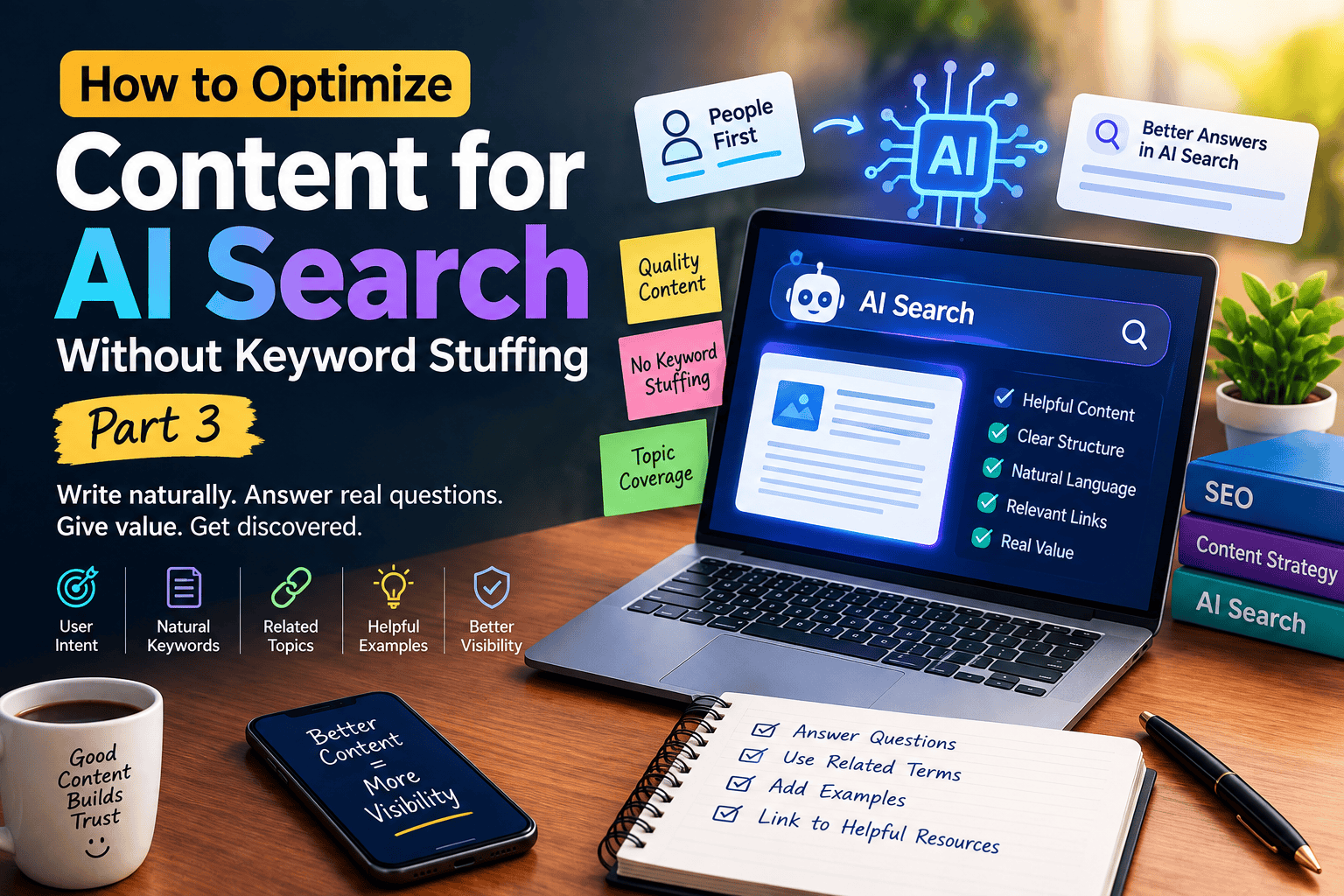
So far, we’ve covered the two biggest ideas behind natural content optimization:
Don’t write for a keyword counter. Write for the person behind the search.
But what about articles you’ve already published?
Should you rewrite them completely?
Should you add more keywords?
Should you make every article longer?
Not necessarily.
Sometimes, the best improvement is much simpler: find what is missing, make the useful information easier to find, and remove anything that doesn’t help the reader.
9. Optimize Existing Articles Without Over-Editing
If you have been publishing content for several months or years, you probably have older articles that could perform better.
The first mistake is opening an old article and immediately adding keywords everywhere.
Don’t do that.
Start by reading the article as if you’ve never seen it before.
Ask yourself:
Does the introduction clearly explain what the article is about?
Does the article actually answer the question in the title?
Are there outdated examples or statistics?
Are important questions missing?
Are some sections unnecessarily repetitive?
Can the reader easily find the main answer?
Are there relevant internal links?
Does the conclusion actually help the reader decide what to do next?
Fix the biggest problem first
Suppose you have an article titled:
How to Check If Your Website Appears in AI Search Results
But the first 700 words explain the history of AI search before telling the reader how to check their website.
That’s a usability problem.
The solution isn’t necessarily adding another 1,000 words.
Move the practical answer closer to the beginning.
Then provide the background for readers who want more detail.
This approach also makes your existing content more useful as part of a larger topic cluster.
For example, your article about tracking AI search visibility can naturally support a related article about checking whether a site appears in AI-generated answers.
Each page has its own purpose, while internal links help readers move between related topics.
Don’t change everything just because you can
There’s another common mistake:
over-editing.
An article already gets traffic, answers the question well and has a natural writing style.
Then someone decides to “optimize” it and changes every heading, rewrites every paragraph and inserts keywords throughout the page.
The result may actually be worse.
Before making major changes, identify the specific problem you’re trying to solve.
If the article is already useful, improve it carefully.
10. A Realistic Before-and-After Example
Let’s take a simple example.
Imagine a small web design company has a page targeting business owners who need a website.
Before
The page says:
“We provide professional website design services. Our website design services are designed for businesses that need professional website design. Our experienced website designers provide high-quality website design solutions.”
The target phrase appears repeatedly.
But what does the customer actually learn?
Very little.
They still don’t know:
What type of websites are offered
Who the service is designed for
What the process looks like
What makes the service different
What happens after contacting the company
Whether mobile optimization is included
Whether SEO is considered
What kind of business the service is suitable for
After
Now imagine the same section is rewritten:
Need a website that actually helps your business?
A good business website should do more than look professional. It should make your services easy to understand, work smoothly on mobile devices and give visitors a clear next step.
For a small business, that might mean a focused five-page website with service information, an about page, contact options, fast-loading layouts and clear calls to action. For a larger company, the structure may need to be more detailed.
The right approach depends on what the business is trying to achieve—not simply on how many pages the website has.
Notice what changed.
The main phrase isn’t repeated over and over.
Instead, the content explains the customer’s actual problem.
That’s what makes the second version more useful.
Now add supporting information
The page could then explain:
Who is this service for?
What is included?
How does the process work?
How long does it take?
What does the client need to provide?
How can they get started?
Now the page isn’t just “optimized.”
It’s genuinely more useful.
11. Common Content Optimization Mistakes
Even when you understand the basic principles, there are several traps that can make otherwise good content feel artificial.
Mistake 1: Repeating the main keyword in every heading
If every heading contains the same phrase, the article starts looking mechanical.
Use descriptive headings instead.
Your headings should help the reader navigate the article—not demonstrate how many times you can use a keyword.
Mistake 2: Writing unnecessarily long introductions
Some articles spend 500 words explaining why the topic is important before answering the actual question.
Don’t make people wait.
Get to the point.
You can provide context afterward.
Mistake 3: Adding filler to reach a word count
A 2,500-word article isn’t automatically better than a 1,200-word article.
If 1,200 words completely solve the reader’s problem, that’s enough.
Google’s guidance around creating helpful content is much more useful than chasing an arbitrary word count.
Mistake 4: Using every related keyword you find
Keyword research tools can produce hundreds of variations.
That doesn’t mean every variation belongs in your article.
If a phrase sounds unnatural in a sentence, don’t force it.
Write normally.
Mistake 5: Making every paragraph sound identical
If every paragraph has the same structure, the content can feel machine-produced.
Vary your writing naturally.
Use:
short paragraphs
longer explanations when needed
bullet lists
examples
questions
comparisons
practical steps
occasional emphasis
The goal isn’t to make the writing artificially “human.”
The goal is simply to make it easy and pleasant to read.
Mistake 6: Linking to unrelated pages
Internal links are useful when they help the reader continue learning.
They’re not useful when every paragraph contains a link just because you want more internal links.
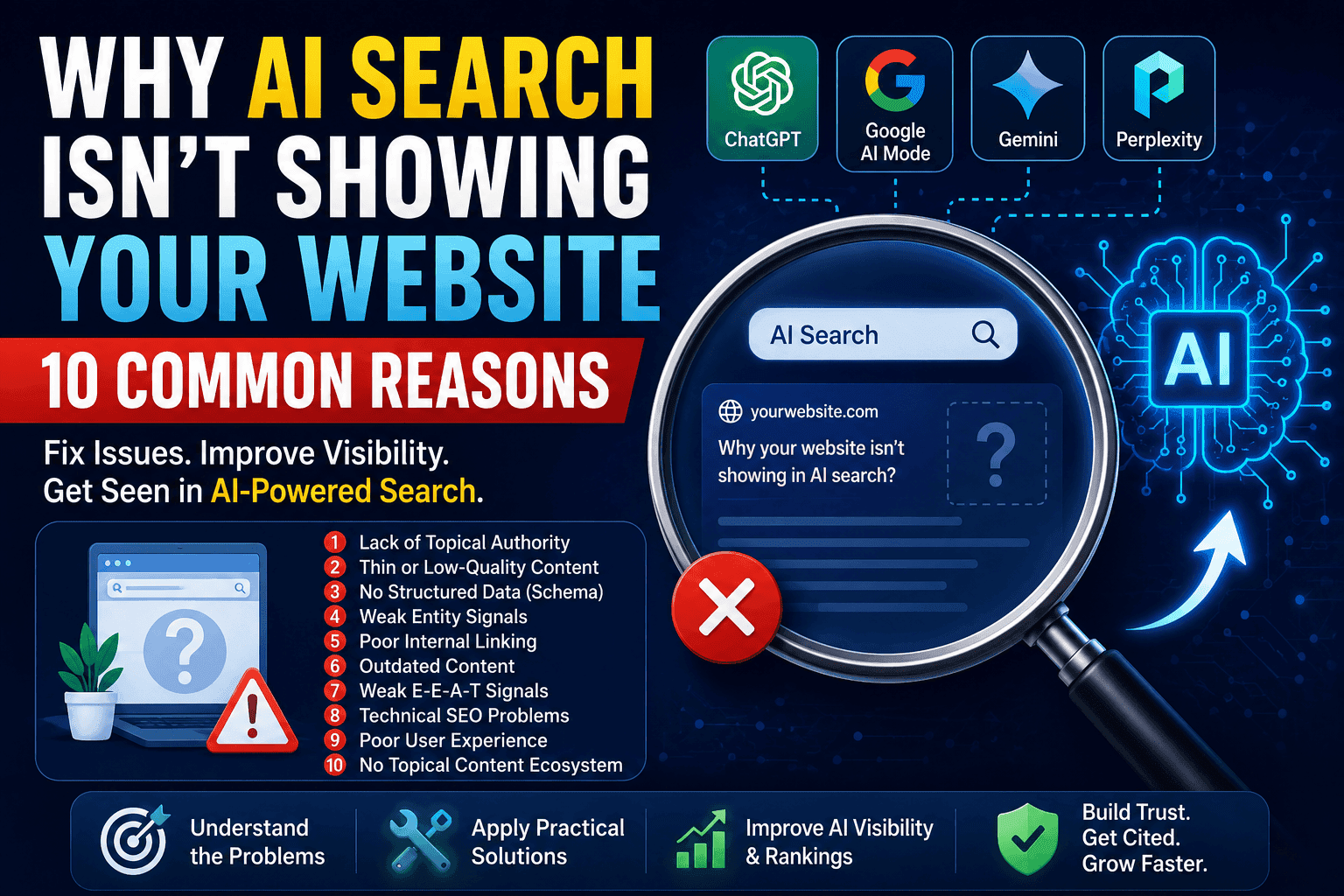
For example, if you’re discussing why a website isn’t appearing in AI-generated answers, linking to your article about why AI search isn’t showing your website makes sense.
But adding a link to an unrelated topic simply to increase the number of internal links doesn’t improve the reading experience.
Relevance comes first.
Mistake 7: Making claims without evidence
Be careful with statements such as:
“This method guarantees higher rankings.”
or:
“AI systems always prefer websites with longer content.”
Search systems are complex, and many SEO claims online are presented with far more certainty than the evidence supports.
When you have reliable evidence, cite it.
When something is your personal observation, say so.
That small difference makes your content more trustworthy.
12. The Complete Content Optimization Checklist
Before publishing your next article, run through this checklist.
Topic & Intent
☐ Is the main topic clear?
☐ Do I understand what the reader is trying to accomplish?
☐ Does the article satisfy the search intent?
☐ Does it answer the main question rather than simply discussing it?
Introduction
☐ Does the introduction get to the point?
☐ Is the main problem clear?
☐ Does the reader know what they will learn?
☐ Have I avoided unnecessary filler?
Keywords
☐ Is the main phrase used naturally?
☐ Have I avoided repeating it unnecessarily?
☐ Do related terms appear naturally?
☐ Have I removed awkward keyword insertions?
Content Quality
☐ Does every major section add something new?
☐ Are there useful examples?
☐ Have I included first-hand experience where appropriate?
☐ Have I avoided making up statistics or results?
☐ Does the article provide information beyond the obvious?
Structure
☐ Are headings descriptive?
☐ Can someone scan the article easily?
☐ Are paragraphs reasonably short?
☐ Are lists used where they improve readability?
☐ Does information appear in a logical order?
Internal Links
☐ Have I linked to relevant existing articles?
☐ Does each link genuinely help the reader?
☐ Is the anchor text descriptive?
☐ Have I avoided linking the same page repeatedly without a reason?
For example, readers who want to go deeper into the subject can naturally move from this article to how to get your website cited by AI search engines.
External References
☐ Have I cited reliable sources when making important factual claims?
☐ Are external links relevant?
☐ Am I relying on primary or authoritative sources where possible?
Final Reading Test
And finally, do something that SEO tools can’t do for you:
Read the article like a normal person.
Ask yourself:
“Would I actually enjoy reading this?”
If you find yourself getting bored, confused or annoyed by repetition, your reader probably will too.
What About AI-Assisted Writing?
Using AI to help with content doesn’t automatically make an article bad.
The problem starts when the tool becomes a substitute for thinking.
For example, you can use AI to:
brainstorm questions
organize an outline
find gaps in an article
simplify complicated explanations
suggest examples
proofread grammar
create alternative headings
But you should still check the facts, add your own experience and make sure the final article actually helps the intended reader.
That’s particularly important when you’re writing about your own services or experience.
A generic AI-generated paragraph can describe “professional web design services.”
But you know what your clients actually ask about.
You know which problems repeatedly appear.
You know which mistakes you’ve seen on real websites.
Those details are what can turn generic content into something worth reading.
The Bigger Picture
Search is changing, but one principle remains remarkably simple:
Useful information has value.
You don’t need to fill every paragraph with the same keyword.
You don’t need to make every article 5,000 words.
You don’t need to create dozens of pages saying almost the same thing.
Instead, understand the question.
Answer it clearly.
Explain the reasoning.
Show an example.
Add useful details.
Connect the reader with related information.
And remove anything that exists only to make the article look “optimized.”
That is a much more sustainable approach to content creation.
If you’re building a website around AI-related search topics, don’t think of each article as an isolated page. Build a useful collection where one article naturally leads to another—for example, from how to optimize your website for AI-powered search to practical guides about checking visibility, tracking results and improving content.
The reader should feel that your website is helping them move forward, not simply trying to keep them on one page.
Final Takeaway
The best way to optimize content for AI search without keyword stuffing is to stop treating keyword repetition as the goal.
Use the language your readers naturally use.
Cover the topic thoroughly.
Answer questions directly.
Give real examples.
Add your own experience.
Keep your headings useful.
Link to genuinely relevant resources.
Update old content when there is a real reason to do so.
And above all, make the article worth reading even if the visitor never thinks about SEO.
Because when you create something that genuinely helps a person solve a problem, you’re not just optimizing a page.
You’re creating a resource people can understand, use, remember and recommend.
Frequently Asked Questions
There is no universal number you need to hit. Use the phrase naturally where it helps clarify the topic, but don’t repeat it simply to increase its frequency.
Yes. Unnatural repetition intended to manipulate search systems can fall under Google’s spam policies. More importantly, excessive repetition makes content unpleasant for people to read.
Use relevant terms and concepts naturally when they help explain the subject. Don’t insert them just because a keyword tool suggested them.
Not automatically. The appropriate length depends on the question and how much information is genuinely needed to answer it.
No. First identify what is actually wrong with the article. If it already satisfies the reader’s needs, make targeted improvements instead of rewriting everything.
AI can be useful for research, outlining, editing and brainstorming. But the finished content should be checked for accuracy, usefulness, originality and relevance to your audience.
Yes, when they help readers discover relevant information and understand how different pages on your website relate to each other. The goal should be useful navigation, not simply increasing the number of links.
Keywords can help you understand what people search for, but search intent tells you what they actually want. A useful article should satisfy that underlying need rather than simply repeat the search phrase.