

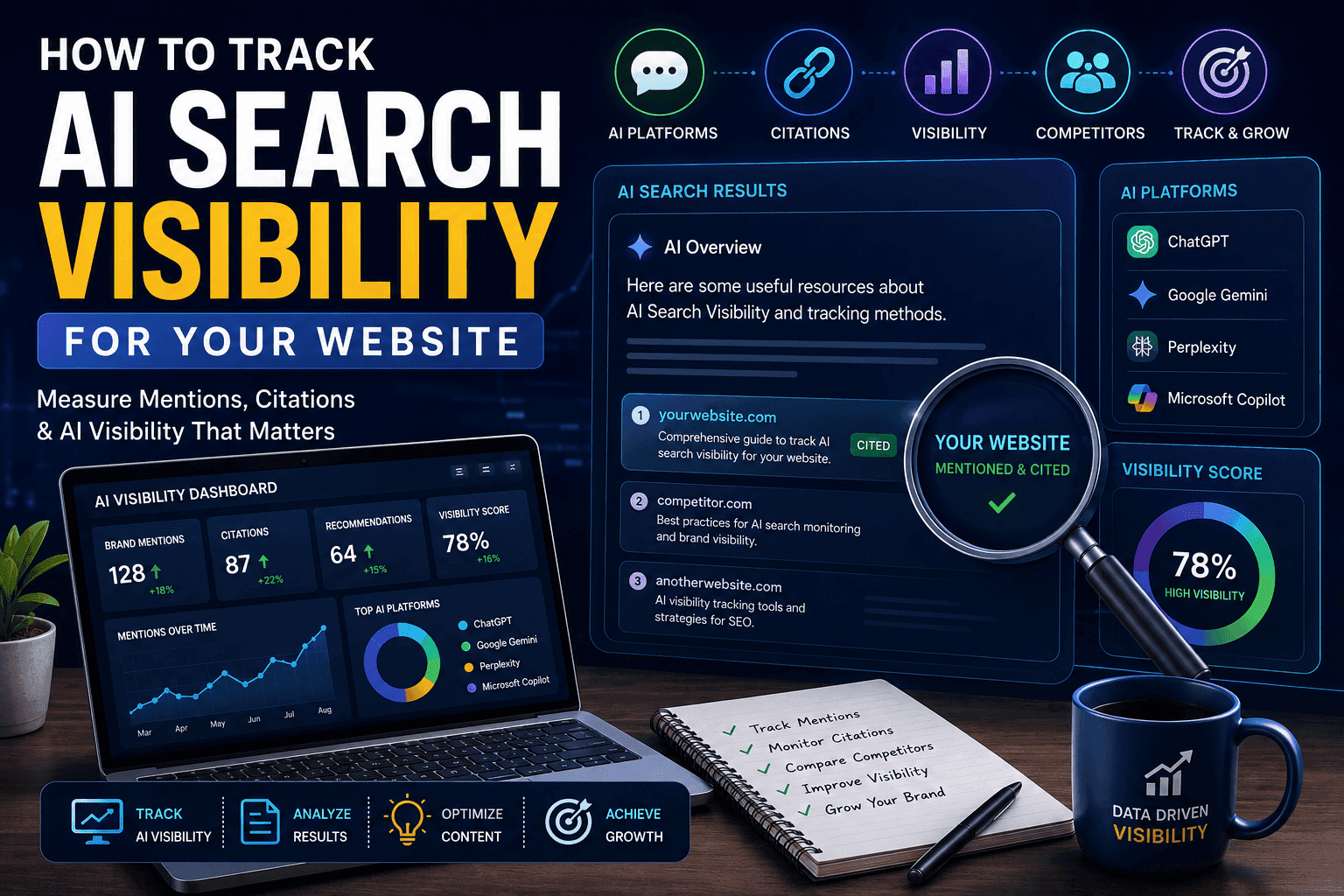
How to Track AI Search Visibility for Your Website
A complete, practical guide to measuring brand mentions, citations, and recommendations across ChatGPT, Gemini, Perplexity, and Google AI Overviews — without buying expensive software.
- 01 Introduction
- 02 What Is AI Search Visibility?
- 03 Why AI Visibility Tracking Matters
- 04 AI Visibility vs Traditional SEO
- 05 What Should You Track?
- 06 Real-Life Example
- 07 Tracking Brand Mentions
- 08 Tracking AI Citations
- 09 Tracking Recommendations
- 10 Tracking Competitors
- 11 Topics AI Associates With You
- 12 The Tracking Spreadsheet
- 13 How Often to Track
- 14 Best Tools
- 15 Monthly Tracking Process
- 16 Common Mistakes
- 17 Full Checklist
- 18 Building a Dashboard
- 19 What To Do With the Data
Introduction
Tracking AI search visibility is becoming an essential part of modern digital marketing.
For years, website owners measured SEO success by checking Google rankings, organic traffic, impressions, clicks, and backlinks. These metrics are still important, but search behavior is changing.
People are increasingly asking questions directly to AI-powered platforms instead of visiting traditional search results first. A user might ask:
"What is the best SEO strategy for a small business?"
Instead of clicking through ten search results, an AI platform may provide a complete answer and recommend several websites, brands, or resources.
This creates a new challenge for website owners. Your website might rank well on Google but still be missing from AI-generated answers — you can start by learning how to check if your website appears in AI search results. On the other hand, a smaller website might not rank at the top for a traditional keyword but could still be mentioned or cited by an AI platform.
That is why tracking AI search visibility is becoming an important part of an effective content strategy. The goal isn't simply to ask, "Does my website rank?" The better question is:
"Does AI recognize my website as a useful source for the topics I want to be known for?"
In this guide, you'll learn how to track that visibility, what metrics matter, how to monitor mentions and citations, and how to compare your progress with competitors.
What Is AI Search Visibility?
AI search visibility refers to how often and how prominently your website, brand, products, or content appear in AI-generated answers. Depending on the platform, your website might appear in several different ways.
Brand Mention
An AI assistant may mention your company or website while answering a user's question — even without a direct link. For example: "Hafeez Digital Studio provides resources about AI search and SEO."
Website Citation
An AI platform may use information from your webpage and provide a link to the source. A citation is particularly valuable because it can introduce your website directly to someone looking for information.
Brand Recommendation
AI may recommend your business when a user asks for a service or solution. If your website appears among the recommendations, your brand has achieved a higher level of visibility.
Content Reference
Sometimes an AI system references a specific article rather than your homepage. This is why tracking only your domain name isn't enough — you should also monitor important pages and topics.
Why AI Visibility Tracking Matters
If you don't measure your visibility, you won't know whether your efforts are working. Imagine that you publish 20 articles about AI-related topics over six months. Your Google traffic increases, but you don't know whether AI platforms recognize your website. Without tracking, you are missing an important part of the picture.
Tracking Helps You Identify Opportunities
Suppose you discover that AI platforms frequently mention your website when users ask about technical SEO, but rarely mention it for GEO-related questions. That's useful information — you can create more detailed GEO content and strengthen your existing topic cluster.
Tracking Helps You Measure Progress
AI visibility can change over time. A website might receive very few mentions initially and gradually become more visible as its content library and authority grow. By recording your results every month, you can see whether your visibility is improving.
Tracking Helps You Understand Your Brand
AI-generated answers can reveal how platforms understand your business. For example, you may discover that AI associates your website with SEO, WordPress, AI search, digital marketing, or website development. This can help you determine whether your content is communicating the right expertise.
Tracking Helps You Monitor Competitors
You can also ask AI platforms the same questions about your competitors. If your competitors appear frequently while your website doesn't, you have an opportunity to investigate what makes their content more useful or authoritative.
AI Visibility vs Traditional SEO Rankings
One of the biggest mistakes website owners make is treating AI visibility and traditional SEO rankings as exactly the same thing. They aren't.
Traditional SEO typically focuses on metrics such as keyword rankings, organic impressions, organic clicks, click-through rate, backlinks, and search traffic.
AI visibility adds another layer. You may want to track brand mentions, website citations, AI recommendations, referenced pages, mention frequency, topics associated with your brand, competitor mentions, and the accuracy of AI-generated descriptions.
For example, imagine your website ranks at position #4 for a keyword — a good result. But when you ask an AI platform the same question, three competitors are mentioned and your website isn't. Your traditional SEO visibility is strong, but your AI visibility is weak — worth reviewing why AI search may not be showing your website.
This difference is exactly why AI visibility deserves its own tracking process.
What Should You Track?
You don't need a complicated system when you're starting. A simple spreadsheet can be enough. Create columns for the following:
| Metric | What to Record |
|---|---|
| Date | When you performed the test |
| AI Platform | ChatGPT, Gemini, Perplexity, etc. |
| Prompt | Exact question you asked |
| Brand Mention | Yes / No |
| Website Citation | Yes / No |
| Cited Page | Which URL appeared |
| Competitors | Which competitors appeared |
| Position in Answer | Early / Middle / Late |
| Accuracy | Accurate / Partially accurate / Incorrect |
The exact prompt is particularly important. Don't simply record "SEO question." Record the complete question: "What are the best ways for a small business website to improve its visibility in AI-powered search?" This allows you to repeat the same test later.
Real-Life Example: A Website Owner Starts Tracking
Imagine a freelance web developer who has been publishing SEO and AI-related content for the last year. Their Google Search Console shows increasing organic impressions, so they assume their overall visibility is improving. They decide to test AI visibility as well.
They create ten questions related to their niche, including: How can I improve my website's SEO? What is Generative Engine Optimization? How can a small business improve AI search visibility? What is structured data? How can I optimize content for AI-powered search?
They ask these questions across several AI platforms and record the results. The first month produces an interesting result — their website is not mentioned for most questions. However, it appears for a few highly specific queries related to topics they have covered extensively.
Instead of considering this a failure, they use the information to identify their strongest topic, then create additional supporting content around that subject and connect the articles through internal links.
Key Takeaways From Part 1
AI search visibility is broader than traditional keyword rankings. You should monitor brand mentions, website citations, AI recommendations, referenced pages, important topics, competitor visibility, and the accuracy of AI-generated information.
You also don't need expensive software to start. A simple spreadsheet and a consistent set of prompts can provide useful insights into how AI platforms perceive your website. The most important thing is consistency — use the same questions, test them regularly, and record the results.
How to Track AI Brand Mentions
One of the simplest ways to measure AI visibility is to check whether AI platforms mention your brand when answering relevant questions. Don't search only for your company name — instead, create a list of questions that potential customers might ask, such as:
- What are the best resources for learning AI SEO?
- Which websites provide practical SEO tutorials?
- What are the best websites for learning Generative Engine Optimization?
- How can a small business improve its search visibility?
- Which websites explain Google AI search?
Run the same questions across different AI platforms and record whether your brand appears.
Track Three Types of Mentions
Direct mention — the AI explicitly names your brand.
Indirect mention — the AI describes your business or expertise without clearly linking to your website.
Recommendation — the AI suggests your website as a resource or solution.
Recommendations are particularly useful because they indicate that the platform associates your brand with a specific topic or service.
How to Track AI Citations
A citation is different from a simple brand mention. When an AI platform provides a link to your website as a source, you can identify which specific page is being referenced — this information can be extremely valuable.
Suppose your website has 100 articles, but AI platforms repeatedly cite only five of them. Those five pages are worth studying carefully. Look for common characteristics: clear answers, strong topic relevance, detailed explanations, original examples, reliable references, good content structure, and strong internal links.
You can then use these successful pages as models for improving weaker content.
Create a Citation Log
| Date | Platform | Prompt | Cited URL | Topic |
|---|---|---|---|---|
| Aug 2026 | AI Platform | SEO question | /seo-guide | SEO |
| Aug 2026 | AI Platform | GEO question | /geo-guide | GEO |
| Aug 2026 | AI Platform | Schema question | /schema-guide | Structured Data |
Over several months, this log can reveal which topics generate the most citations. A well-structured page also helps — see how structured data helps AI understand and cite your content.
How to Track Brand Recommendations
Mentions are useful, but recommendations can provide even stronger insight into how AI systems perceive your brand. For example, ask: "What are some useful websites for learning SEO?" Then ask: "Which websites provide practical guides about AI-powered search?" Record the websites that appear.
Don't test only your own brand — run the same prompts for competitors. For each prompt, record:
- Which brands are mentioned?
- Which brands are cited?
- Which brands appear first?
- Which brands are repeatedly recommended?
- Is your website included?
Repeat these tests every month. This creates a basic AI visibility benchmark.
How to Track Competitors in AI Search
Competitor monitoring is one of the most useful parts of AI visibility tracking. Traditional SEO tools can show you which websites rank for specific keywords. AI platforms provide another perspective: which brands are considered useful answers to particular questions?
Create a list of five to ten competitors, then test the same questions across AI platforms and record every brand that appears. Compare the results:
| Metric | Your Website | Competitor A | Competitor B |
|---|---|---|---|
| Brand Mentions | 4 | 9 | 7 |
| Citations | 3 | 8 | 6 |
| Recommendations | 2 | 7 | 5 |
| Topics Covered | 5 | 9 | 8 |
The numbers above are only an example — your actual results will depend on the questions and platforms you test. The important thing is consistency: you want to discover patterns. If one competitor appears repeatedly for a topic where your website has only one article, that could be a signal to build a stronger content cluster around that subject.
Track the Topics AI Associates With Your Brand
AI visibility isn't only about how often your brand appears — it's also about why it appears. Suppose AI platforms consistently associate your website with website development, SEO, AI search, and WordPress. That's useful information.
But what if you want to become known specifically for AI search optimization, and the AI platforms still associate your brand mainly with web development? That suggests your content strategy needs stronger topical signals — you can strengthen those signals by publishing connected content around your target subject, and learn more about what Generative Engine Optimization actually is.
Each article should provide genuine value and link naturally to relevant supporting content. Over time, this creates a stronger topical relationship across your website.
Create an AI Visibility Tracking Spreadsheet
You don't need an expensive platform to start measuring AI visibility. A simple Google Sheet or Excel spreadsheet can work. Create columns for: Date, Platform, Prompt, Brand Mention, Citation, Cited URL, Competitors Mentioned, Topic, Answer Accuracy, and Notes. For example:
| Date | Platform | Brand Mention | Citation | Competitors | Topic |
|---|---|---|---|---|---|
| Aug 5 | ChatGPT | Yes | Yes | 2 | AI SEO |
| Aug 5 | Gemini | No | No | 3 | GEO |
| Aug 5 | Perplexity | Yes | Yes | 1 | AI Search |
Don't focus too much on a single result — AI-generated answers can change. Instead, look for patterns over several weeks or months.
Case Study: Turning AI Visibility Data Into a Content Strategy
Consider a small digital marketing website with approximately 50 published articles. The owner begins tracking AI visibility once a month. After three months, they notice their website is frequently mentioned when users ask about technical SEO, but rarely appears when users ask about AI search optimization.
The owner checks the content library and discovers the website has only two articles about AI search but more than ten articles about technical SEO. The data explains the difference.
Instead of randomly publishing more articles, the owner creates a focused AI search content cluster covering AI search optimization, generative engine optimization, AI visibility, Google AI Overviews, AI search tracking, AI-friendly content, and structured content for AI systems — then improves internal linking between these pages.
After several months, they repeat the same AI visibility tests. The website begins appearing more frequently for AI-related questions.
How Often Should You Track AI Visibility?
You don't need to check your AI visibility every day. Daily monitoring can actually make the data confusing because AI responses can change from one test to another.
For most small websites, a monthly review is a practical starting point. Larger websites or businesses operating in highly competitive markets may want to check more frequently.
Whatever schedule you choose, keep the process consistent — use the same platforms, the same prompts, similar testing conditions, and the same competitors. This makes comparisons much more meaningful.
Part 2: Key Takeaways
By now, you know how to move beyond simply asking whether your website appears in AI search. Track brand mentions, website citations, AI recommendations, competitor mentions, cited pages, topics associated with your brand, answer accuracy, and visibility trends over time.
The goal isn't to chase every AI response. Instead, use the data to understand how AI platforms perceive your website and where your content strategy can improve.
Best Tools for Tracking AI Search Visibility
As AI-powered search continues to grow, several tools and platforms can help website owners monitor their visibility. However, you don't need expensive software to get started — the best approach is to combine dedicated SEO tools with manual testing.
Google Search Console
Google Search Console remains useful for understanding your website's traditional search performance. Monitor search queries, impressions, clicks, average position, click-through rate, and indexed pages. Although it doesn't provide a complete AI visibility report, it helps you understand whether your overall search presence is improving.
Google Analytics
Google Analytics can help you understand what happens after visitors reach your website. Monitor organic traffic, landing pages, engagement, returning visitors, and referral traffic. Look for changes after updating content for AI-powered search.
AI Search Platforms
Manual testing remains one of the simplest ways to monitor AI visibility. Test your website across platforms such as ChatGPT, Google AI Mode, Google AI Overviews, Google Gemini, Microsoft Copilot, and Perplexity. Use the same questions every month and record the results — and read more about how to get your website mentioned in Google AI Overviews.
SEO and AI Visibility Platforms
As AI search develops, specialized tools are increasingly becoming available for monitoring brand mentions, citations, and AI-generated answers. These platforms can save time when you need to monitor a large number of prompts or competitors. However, automated tools should complement — not completely replace — manual testing, and following Google's own Search documentation is still a solid foundation for structured, crawlable content.
Create a Monthly AI Visibility Tracking Process
A simple monthly workflow can make AI visibility tracking much easier.
Step 1 — Select Your Important Topics
Choose 10–20 topics that are directly related to your business, such as AI search, SEO, GEO, website optimization, Google AI search, or technical SEO.
Step 2 — Create User-Focused Prompts
Turn each topic into realistic questions. Instead of "AI SEO," use "How can a small business improve its visibility in AI-powered search?" Real questions provide more useful insights than isolated keywords.
Step 3 — Test Multiple Platforms
Run your prompts through several AI platforms. Record whether your brand appeared, whether your website was cited, which page was cited, and which competitors appeared.
Step 4 — Compare With Previous Results
Don't judge your progress based on one test. Compare this month's results with previous months — for example, Month 1: 3 mentions, Month 2: 5 mentions, Month 3: 8 mentions. The exact numbers aren't as important as the overall trend.
Step 5 — Identify Content Gaps
If competitors consistently appear for a topic where your website has little or no useful content, investigate the gap. Ask: Do I have a page answering this question? Is my content comprehensive? Is it up to date? Does it provide original value? Is it connected to related content? Then improve the relevant page or create a new resource when necessary.
Common AI Visibility Tracking Mistakes
Tracking AI visibility sounds simple, but several mistakes can make your data unreliable.
- Testing only once. One AI response doesn't represent your overall visibility. AI-generated answers can change — always test consistently.
- Changing your questions every month. If your prompts change completely, you can't make a meaningful comparison. Keep a core group of recurring questions and add new prompts when necessary.
- Tracking only brand searches. Searching for your business name tells you whether AI knows your brand — it doesn't tell you whether AI considers your website useful for your target topics. Always include non-branded questions.
- Ignoring competitors. Your visibility is easier to understand when you have something to compare it with. Track several relevant competitors using the same prompts.
- Focusing only on mentions. A brand mention is useful, but a citation to a specific article can provide even more insight. Track both.
- Expecting exact rankings. Traditional search has relatively clear ranking positions. AI responses don't always work that way — your website might appear first in one answer, near the end in another, or not appear at all. Focus on visibility patterns rather than treating AI answers like traditional rankings.
Complete AI Visibility Tracking Checklist
Use this checklist every month:
Content
- Identify your most important topics.
- Create realistic user questions.
- Review your most important pages.
- Update outdated information.
AI Testing
- Test ChatGPT.
- Test Google AI Mode or AI Overviews when available for the query.
- Test Google Gemini.
- Test Perplexity.
- Test other relevant AI platforms.
Visibility
- Record brand mentions.
- Record website citations.
- Record cited URLs.
- Record recommendations.
- Track competitors.
- Record topics associated with your brand.
Website
- Check internal linking.
- Review technical SEO.
- Check indexing.
- Review structured content.
- Improve author and business information.
Analysis
- Compare results with previous months.
- Identify content gaps.
- Identify your strongest topics.
- Study frequently cited competitors.
- Update your content strategy.
Case Study: Building an AI Visibility Dashboard
Imagine a small website owner who wants a simple way to measure progress without purchasing expensive software. They create a spreadsheet containing 20 recurring prompts, 5 AI platforms, 5 competitors, and monthly results.
Every month, they record whether their website was mentioned, cited, or recommended. After six months, they notice that their website receives the most visibility for a small group of highly specific topics. Instead of trying to rank for everything, they focus their content strategy around those areas.
They expand successful topics, publish supporting articles, improve internal links, update older content, add original examples, and strengthen their About and author pages.
The dashboard doesn't guarantee better rankings or AI mentions. What it does provide is something equally valuable: data for making better content decisions. Instead of guessing what works, the website owner can identify patterns and prioritize the areas where the site already demonstrates authority.
What Should You Do With Your AI Visibility Data?
Collecting data is only useful if you act on it. After each monthly review, divide your findings into three categories.
Keep Doing
Topics where your website is already being mentioned or cited. Continue creating useful supporting content.
Improve
Topics where competitors appear more often than you. Review your content and identify weaknesses.
Explore
Topics related to your niche where your website currently has little visibility. Research the user intent and decide whether creating content would make sense.
This simple system prevents you from publishing content randomly.
Conclusion
How to track AI search visibility for your website is no longer just an advanced SEO concept. As users increasingly rely on AI-powered platforms to discover information, understanding how your website is represented in those answers is becoming an important part of digital strategy.
Traditional metrics such as rankings, impressions, clicks, and organic traffic still matter. But they don't tell the complete story. You should also pay attention to brand mentions, website citations, AI recommendations, referenced pages, competitor visibility, topic associations, and changes over time.
You don't need a complicated system to start. Choose your most important topics, create realistic user questions, test several AI platforms, record the results, and review the data every month.
Most importantly, don't treat one AI response as a final verdict. AI-generated answers can change, and different platforms may produce different results — look for patterns instead of isolated outcomes.
If your website isn't appearing yet, use the data to identify gaps rather than giving up. Improve your content, strengthen your topical coverage, build meaningful internal links, demonstrate real expertise, and make your website easier for search systems to understand.
The future of search will not be measured only by where your website ranks. It will also be measured by whether AI systems recognize your website as a useful, trustworthy source — a shift explored further in the future of SEO and AI entities.
Start tracking that visibility now, and you'll have a much clearer picture of where your website stands as AI-powered search continues to evolve.