What Is Generative Engine Optimization (GEO)? The Complete Guide
1. Introduction
The way people search for information is changing faster than ever before. For years, Search Engine Optimization (SEO) focused on helping websites rank higher on Google’s traditional search results. Businesses optimized their content with keywords, backlinks, technical SEO, and user experience to attract organic traffic.
Today, a new era of search has emerged.
Millions of users now rely on AI-powered platforms like ChatGPT, Google AI Mode, Google AI Overviews, Google Gemini, Microsoft Copilot, and Perplexity AI to find answers. Instead of browsing multiple websites, users ask conversational questions and receive AI-generated responses within seconds.
This shift has introduced a new optimization strategy known as Generative Engine Optimization (GEO).
Generative Engine Optimization helps websites improve their visibility in AI-powered search engines and increases the chances of being referenced in AI-generated answers. Rather than focusing only on ranking in traditional search results, GEO focuses on making content understandable, trustworthy, and valuable for artificial intelligence systems.
As AI search continues to evolve, businesses that understand GEO today will be better prepared for the future of digital visibility.
In this complete guide, you’ll learn what Generative Engine Optimization is, how it differs from traditional SEO, why it matters, and how you can start optimizing your website for the next generation of search.
2. What Is Generative Engine Optimization (GEO)?
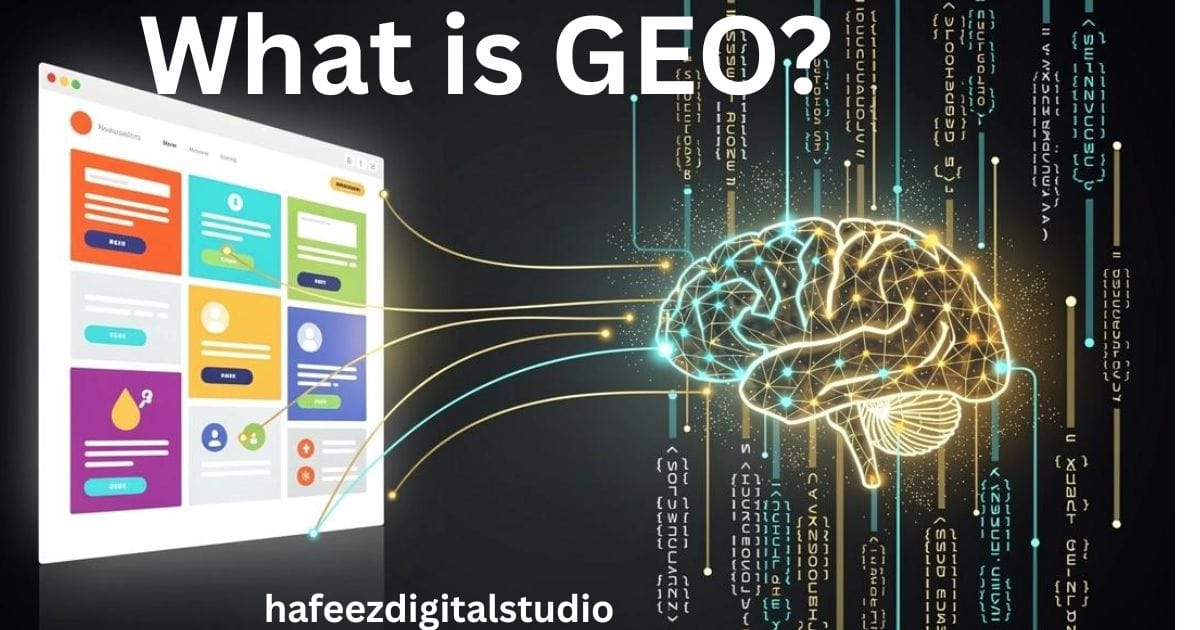
Generative Engine Optimization (GEO) is the process of optimizing your website and content so that AI-powered search engines can understand, trust, and reference your information when generating answers.
Unlike traditional SEO, which primarily aims to rank web pages on search engine results pages (SERPs), GEO focuses on improving your visibility within AI-generated responses.
When someone asks a question like:
“What is the best AI SEO strategy for a small business?”
An AI search engine doesn’t simply list websites. Instead, it analyzes information from multiple trusted sources and generates a single, conversational answer.
The goal of GEO is to increase the likelihood that your content contributes to those AI-generated responses.
GEO is becoming increasingly important because more users are interacting with AI assistants instead of performing traditional keyword-based searches.
Learn more: How to Rank in AI Search Engine
Why GEO Is Different from Traditional SEO
Traditional SEO is designed to help search engines discover, crawl, and rank webpages.
Generative Engine Optimization expands that goal.
Instead of optimizing only for rankings, GEO focuses on helping AI systems understand:
- What your content is about.
- Who created it.
- Whether it is trustworthy.
- Whether it provides complete and accurate answers.
- Whether it demonstrates real expertise.
In other words, SEO helps users find your content, while GEO helps AI systems understand and recommend your content.
The two strategies are complementary rather than competing.
3. How GEO Differs from Traditional SEO
Although SEO and GEO share many best practices, they have different objectives.
| Traditional SEO | Generative Engine Optimization |
|---|---|
| Focuses on ranking web pages | Focuses on AI-generated answers |
| Targets keywords | Targets topics, entities, and user intent |
| Measures rankings and clicks | Measures AI visibility and citations |
| Optimizes search snippets | Optimizes conversational responses |
| Depends heavily on search algorithms | Focuses on AI understanding and semantic relevance |
The future of digital marketing will require businesses to combine both SEO and GEO strategies. Ignoring either one could reduce long-term online visibility.
Read also: The Future of SEO: AI & Entities
4. Why GEO Matters in the Age of AI Search
Artificial intelligence is changing how people interact with information.
Instead of searching: Best WordPress SEO Plugin
Users increasingly ask: Which WordPress SEO plugin is best for beginners and why?
Instead of reading five different articles, AI systems summarize information into a single response.
This behavioral shift means website owners must think differently about optimization.
Success is no longer measured only by first-page rankings.
Businesses should also aim to become reliable information sources that AI systems trust.
Generative Engine Optimization helps achieve this by encouraging website owners to create:
- Comprehensive content
- Clear answers
- Strong topical authority
- Reliable entity signals
- Helpful user experiences
- Accurate structured data
Having trouble with AI visibility? Why AI Search Is Not Showing Your Website
Real-Life Example
Imagine two websites publish an article titled: “How to Improve Website Speed.”
Website A
- Focuses only on keywords.
- Contains 800 words.
- No author information.
- No structured data.
- Very few internal links.
- Generic advice copied from multiple websites.
Website B
- Provides a detailed 2,500-word guide.
- Includes real optimization examples.
- Shows before-and-after performance results.
- Uses Article Schema and FAQ Schema.
- Links to related technical SEO articles.
- Includes an experienced author profile.
Result: AI-powered search platforms are far more likely to trust Website B because it provides stronger signals of expertise, authority, and usefulness.
Principle: AI systems don’t simply reward content that exists—they reward content that demonstrates credibility, context, and genuine value.
Key Takeaways
- Generative Engine Optimization (GEO) is designed for AI-powered search.
- GEO complements traditional SEO rather than replacing it.
- AI search prioritizes trustworthy, well-structured, and comprehensive content.
- Websites with strong topical authority and clear entity signals are better positioned for AI visibility.
- The future of search requires optimizing for both humans and artificial intelligence.
Part 2: How GEO Works, GEO vs SEO vs AEO & Practical Strategies
5. How Do Generative AI Search Engines Work?
Before optimizing for GEO, it’s important to understand how AI-powered search engines generate answers.
Unlike traditional search engines that display a list of links, generative AI platforms analyze information from multiple trusted sources, identify patterns, understand context, and generate conversational responses.
When a user asks: “What are the best SEO strategies for AI search?”
An AI search engine doesn’t simply search for pages containing those exact words. Instead, it tries to understand:
- What the user actually wants.
- Which websites are trustworthy.
- Which sources provide the most complete answer.
- Whether the information is current.
- Whether multiple reliable sources support the same conclusion.
This process relies heavily on Natural Language Processing (NLP), semantic search, machine learning, and knowledge graphs.
Instead of matching keywords, AI attempts to understand meaning. That is why websites with strong topical authority often perform better than websites that simply target keywords.
6. The Core Principles of Generative Engine Optimization
1. Create Helpful Content
AI systems prioritize content that genuinely solves problems. Rather than writing for search engines, write for people. Your content should answer questions clearly, provide actionable advice, and cover topics comprehensively.
2. Build Topical Authority
Publishing one article about AI SEO isn’t enough. Instead, build an entire content ecosystem covering related topics such as: AI Search, Google AI Mode, AI Overviews, Structured Data, Entity SEO, Technical SEO, Content Strategy, Answer Engine Optimization. The more complete your coverage, the more likely AI systems are to recognize your expertise.
3. Strengthen Entity Signals
Generative AI doesn’t just understand pages. It understands organizations, authors, brands, products, and services. Help AI recognize your brand by: Creating detailed author profiles, Publishing an About page, Using Organization Schema, Maintaining consistent business information, Building your online reputation. Strong entity signals improve trust.
4. Use Structured Data
Schema Markup helps AI understand your content more accurately. Useful schema types include: Article, FAQ, Organization, Breadcrumb, Person, Local Business. Although structured data doesn’t guarantee AI citations, it makes your content easier to interpret.
Test your schema here: Google Rich Results Test | Schema.org Validator
Detailed guide: How Structured Data Helps AI
5. Prioritize User Experience
AI search engines increasingly favor websites that deliver a positive experience. Improve: Website speed, Mobile usability, Readability, Navigation, Accessibility. Helpful websites naturally earn more trust.
7. GEO vs SEO vs AEO
| SEO | AEO | GEO |
|---|---|---|
| Optimizes websites for search engines | Optimizes content for direct answers | Optimizes content for AI-generated responses |
| Focuses on rankings | Focuses on answering questions | Focuses on AI understanding and citations |
| Targets keywords | Targets user intent | Targets semantic understanding, entities, and authority |
| Measures clicks and rankings | Measures answer visibility | Measures AI visibility and citations |
The most successful websites don’t choose one over the others. They combine all three.
Think of it this way:
- SEO helps users discover your website.
- AEO helps answer specific questions.
- GEO helps AI trust and reference your content.
8. Practical GEO Strategies
Publish Comprehensive Content
Create in-depth articles instead of short posts. Cover each topic completely with examples, FAQs, and practical advice.
Answer Real Questions
Research the questions your audience asks. Then answer them naturally using clear language. AI systems often favor content that directly addresses user intent.
Connect Related Articles
Build topic clusters using internal links. For example: AI Search, GEO, Structured Data, Entity SEO, Technical SEO, Google AI Mode. These connections help AI understand your expertise.
Keep Content Updated
AI platforms prefer fresh, accurate information. Review older articles regularly. Update: Statistics, Screenshots, Examples, Best practices
Build Trust
Trust remains one of the strongest GEO signals. Add: Author biographies, Contact information, References to reputable sources, Customer testimonials, Secure HTTPS, Transparent business details.
Case Study: Building GEO for a Digital Marketing Agency
A small digital marketing agency noticed that although its articles ranked reasonably well in Google Search, they were rarely referenced by AI-powered platforms.
Over several months, the team:
- Built topic clusters around AI SEO.
- Improved internal linking.
- Added Organization and Article Schema.
- Expanded older articles with real examples.
- Added author biographies and an updated About page.
- Published detailed guides instead of short blog posts.
Six months later, the website had significantly improved topical authority, stronger user engagement, and better overall search visibility.
Key takeaway: Generative Engine Optimization is not about gaming AI systems—it’s about becoming the most trustworthy, complete, and useful source on your topic.
9. Common Generative Engine Optimization (GEO) Mistakes
1. Focusing Only on Keywords
AI systems evaluate: Context, User intent, Topical authority, Semantic relevance, Trustworthiness
2. Publishing Thin Content
AI platforms prefer comprehensive guides that include: Practical advice, Original insights, Examples, Case studies, FAQs, Actionable recommendations
3. Ignoring Entity SEO
Strengthen your entity by maintaining: A detailed About page, Author profiles, Organization Schema, Consistent business information, Social profile links
4. Weak Internal Linking
Instead, create topic clusters that naturally connect related content: AI Search, GEO, Structured Data, Entity SEO, Technical SEO, Google AI Mode
5. Never Updating Content
Review older articles regularly and update: Statistics, Examples, Screenshots, Best practices, Industry developments
10. GEO Best Practices
Create Topic Clusters
AI Search, GEO, AEO, Entity SEO, Structured Data, Technical SEO, Google AI Mode, AI Overviews, Helpful Content, Semantic SEO
Demonstrate Real Experience
Share: Personal insights, Client experiences, Testing results, Before-and-after examples, Original screenshots
Optimize for Humans First
Use: Clear headings, Short paragraphs, Simple language, Helpful examples, Practical recommendations
Improve Technical SEO
Maintain: Fast loading speed, Mobile responsiveness, Secure HTTPS, Clean site architecture, XML sitemap, Proper indexing
11. The Future of Generative Engine Optimization
Generative Engine Optimization is still evolving, but its importance will continue to grow.
As AI assistants become more integrated into everyday search, users will increasingly expect direct, personalized answers instead of browsing multiple websites.
Future GEO strategies will likely place greater emphasis on:
- Entity recognition
- Knowledge graphs
- Semantic relationships
- Author credibility
- First-hand experience
- Multimedia content
- Topical authority
- User satisfaction
Businesses that begin optimizing today will have a stronger foundation for tomorrow’s AI-driven search landscape.
Rather than replacing SEO, GEO represents the next stage in the evolution of search optimization.
GEO Optimization Checklist
- Does this content solve a real problem?
- Is it more helpful than competing articles?
- Have I included original examples?
- Is my author information visible?
- Have I added structured data?
- Is the article connected to related content?
- Is the information accurate and up to date?
- Is the page fast and mobile-friendly?
- Does the content demonstrate real expertise?
- Would I confidently recommend this article to someone asking the same question?
If the answer is “Yes” to all of these questions, you’re following the core principles of GEO.
Case Study: A Blog That Built AI Visibility Through GEO
A technology blog struggled to gain traffic despite publishing dozens of SEO-focused articles. Instead of creating more content, the editorial team changed its strategy.
They organized their articles into topic clusters covering: AI Search, GEO, Technical SEO, Structured Data, Google AI Mode, Entity SEO. Every article linked naturally to related content.
They also: Updated outdated posts, Added expert author profiles, Improved page speed, Implemented Article and Organization Schema, Included real-world examples and practical tutorials.
Within several months, the website experienced stronger organic performance, longer user engagement, and improved visibility for AI-related topics.
Conclusion
Generative Engine Optimization (GEO) is shaping the future of digital visibility.
As AI-powered search engines become more popular, businesses must move beyond traditional keyword optimization and focus on creating content that AI can understand, trust, and confidently reference.
Successful GEO combines multiple disciplines, including technical SEO, structured data, entity optimization, topical authority, and exceptional content quality.
There is no single tactic that guarantees AI citations. Instead, long-term success comes from consistently publishing valuable information, improving user experience, and demonstrating genuine expertise.
The future belongs to websites that are not only easy to find—but also easy for AI to understand.
Frequently Asked Questions
1. What is Generative Engine Optimization (GEO)?
Generative Engine Optimization (GEO) is the process of optimizing websites and content so AI-powered search engines can better understand, trust, and reference them in AI-generated responses.
2. Is GEO replacing traditional SEO?
No. GEO complements SEO rather than replacing it. Traditional SEO helps users discover your website, while GEO helps AI systems understand and recommend your content.
3. Which AI platforms are influenced by GEO?
GEO principles are relevant for AI-powered search experiences such as ChatGPT, Google AI Mode, Google AI Overviews, Google Gemini, Microsoft Copilot, and Perplexity AI.
4. Does structured data improve GEO?
Structured data helps AI and search engines understand your content more clearly. While it doesn’t guarantee AI citations, it supports better semantic understanding.
5. What is the most important GEO strategy?
The most effective GEO strategy is creating comprehensive, trustworthy, and experience-based content while building topical authority, strengthening entity signals, and maintaining strong technical SEO.
Final Thoughts
The future of search is no longer just about ranking on the first page of Google. It’s about becoming a trusted source that both people and AI systems rely on.
Businesses that embrace Generative Engine Optimization today will be better positioned to thrive as AI-powered search continues to evolve.
Start by creating helpful content, building authority in your niche, and continuously improving your website. Over time, these efforts can strengthen your visibility across both traditional search engines and the growing ecosystem of AI-powered search platforms.