How to Get Your Website Mentioned in Google AI Overviews (Step-by-Step Guide)
1. Introduction
How to Get Your Website Mentioned in Google AI Overviews is one of the biggest questions website owners, bloggers, and SEO professionals are asking today.
Google Search is changing rapidly. Instead of showing only a list of blue links, Google now uses AI to generate detailed answers for many informational searches through Google AI Overviews. These AI-generated summaries help users find answers quickly by combining information from multiple trusted sources.
For website owners, this creates both a challenge and an opportunity.
Ranking on the first page of Google is still valuable, but it doesn’t guarantee that your website will be featured in an AI Overview. Google now evaluates additional factors such as content quality, topical authority, user intent, expertise, and trust before selecting sources for AI-generated answers.
If your website is mentioned in Google AI Overviews, your brand can gain more visibility, build credibility, and reach users before they even scroll through traditional search results.
The good news is that you don’t need a huge website or thousands of backlinks to improve your chances. By following proven SEO and Generative Engine Optimization (GEO) practices, you can make your content more useful for both users and AI-powered search.
In this guide, you’ll learn how Google AI Overviews work, how Google selects websites, and the practical steps you can take to increase your chances of being mentioned in AI-generated answers.
Before optimizing for Google AI Overviews, it’s important to understand the fundamentals explained in our guide on How to Rank in AI Search Engines.
2. What Are Google AI Overviews?
Google AI Overviews are a major part of Generative Engine Optimization (GEO), which focuses on improving visibility in AI-powered search.Google AI Overviews are AI-generated summaries that appear at the top of Google Search for many informational queries.
Instead of displaying only a list of websites, Google analyzes information from multiple reliable sources and creates a concise answer that helps users understand the topic more quickly.
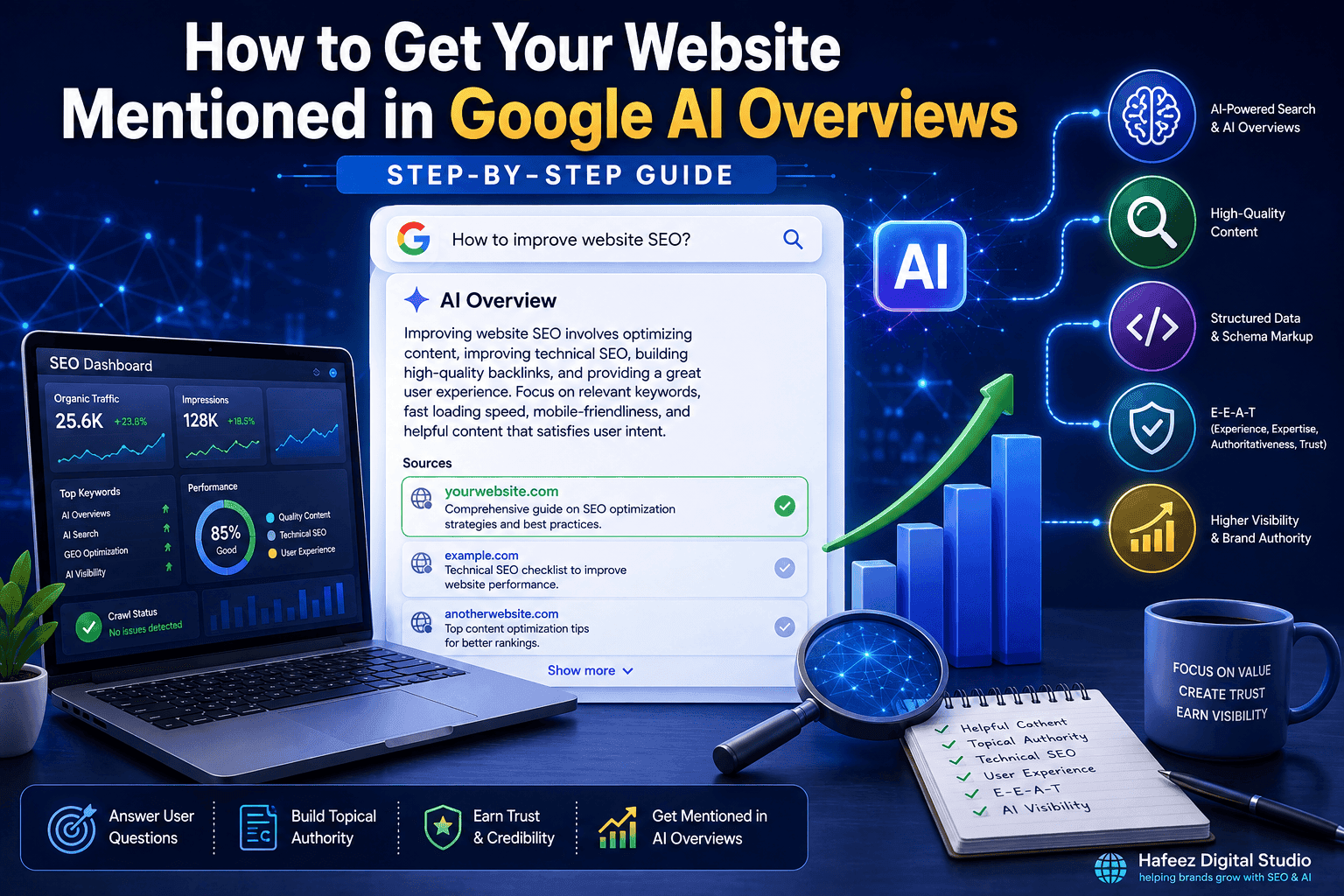
For example, instead of searching:
How can I improve my website’s SEO?
A user might instantly see an AI Overview summarizing key SEO strategies, along with links to websites that contributed useful information.
Unlike featured snippets, AI Overviews combine insights from multiple sources rather than relying on a single webpage.
This means your website has the opportunity to become one of several trusted references if your content provides clear, accurate, and valuable information.
Google AI Overviews are especially common for:
- Educational topics
- How-to guides
- Product comparisons
- Health and wellness questions
- Technology tutorials
- Travel information
- Business and marketing advice
As Google expands AI-powered search, appearing in these summaries is becoming an important part of modern SEO.
Google AI Overviews are a major part of Generative Engine Optimization (GEO), which focuses on improving visibility in AI-powered search.
3. Why Getting Mentioned in Google AI Overviews Matters
Being mentioned in Google AI Overviews offers benefits beyond traditional search rankings.
Increased Visibility
AI Overviews appear before standard organic listings for many searches. If your website is referenced, users may discover your brand before scrolling further down the page.
Higher Trust
Google typically selects information from websites that demonstrate expertise, accuracy, and authority.
Being referenced in an AI Overview can strengthen your brand’s credibility.
Better Brand Awareness
Even if users don’t immediately click your website, seeing your brand associated with trusted AI-generated answers increases recognition over time.
This is especially valuable for businesses building long-term authority in their industry.
Future-Proof SEO
Search behavior is evolving.
More users are relying on AI-generated answers to solve problems quickly.
Optimizing for Google AI Overviews helps prepare your website for the future of search instead of relying only on traditional ranking factors.
4. How Google Chooses Sources for AI Overviews
Google hasn’t published a fixed checklist explaining exactly how AI Overviews choose sources, but years of search quality guidance provide strong clues about the characteristics Google values.
Helpful, User-Focused Content
Google prefers content that directly answers users’ questions.
Instead of writing for search engines, focus on solving real problems using simple, well-organized language.
Topical Authority
A single article is rarely enough.
Websites that publish multiple high-quality articles around the same subject are more likely to be recognized as reliable sources.
For example, if your website covers:
- AI Search
- Google AI Overviews
- Generative Engine Optimization (GEO)
- Structured Data
- Technical SEO
- Entity SEO
Google can more easily understand that your website specializes in AI Search Optimization.
E-E-A-T Signals
Google looks for strong signals of:
- Experience
- Expertise
- Authoritativeness
- Trustworthiness
Strengthen these signals by including:
- Author biographies
- Accurate information
- Updated content
- Reliable references
- Clear contact details
- Secure HTTPS
Structured Content
AI systems can understand content more easily when it is well organized.
Use:
- Descriptive headings (H2 and H3)
- Bullet points
- Numbered steps
- Tables where appropriate
- FAQ sections
Well-structured articles improve readability for both users and AI systems.
Structured data helps Google understand your content more effectively and can improve AI visibility.
Technical Quality
A fast, mobile-friendly website with proper indexing and structured data gives Google more confidence when evaluating your content.
Technical SEO alone won’t get your website into AI Overviews, but it provides an essential foundation.
won’t get your website into AI Overviews, but it
provides an essential foundation.
Real-Life Example
Imagine two websites publish an article titled:
“How to Improve Local SEO.”
Website A
- 700-word article
- Generic advice
- No author profile
- No internal links
- Outdated information
- No FAQ section
Website B
- 2,200-word comprehensive guide
- Step-by-step instructions
- Original screenshots
- Real business example
- FAQ section
- Strong internal linking
- Updated information
- Clear author biography
When Google generates an AI Overview for “How to improve local SEO,” Website B is much more likely to be considered because it provides a richer, more trustworthy resource that better satisfies user intent.
This demonstrates an important principle:
Google AI Overviews don’t simply reward rankings—they reward helpful, trustworthy, and comprehensive content.
Key Takeaways
By now, you should understand:
- Google AI Overviews are changing how users interact with search results.
- Being mentioned in AI Overviews increases visibility and credibility.
- High-quality, user-focused content has a better chance of being referenced.
- Topical authority, E-E-A-T, and technical SEO all contribute to AI Overview visibility.
- Optimizing for AI Overviews complements traditional SEO rather than replacing it.
5. 8 Proven Ways to Get Your Website Mentioned in Google AI Overviews
There is no guaranteed method to appear in Google AI Overviews. However, websites that consistently follow Google’s quality guidelines and publish genuinely helpful content have a much better chance of being selected.
Here are eight proven strategies you should start implementing today.
Strategy #1: Create Content That Answers Specific Questions
Google AI Overviews are designed to answer user questions quickly.
Instead of targeting broad keywords, focus on solving specific problems.
For example, rather than writing:
SEO Tips
Write:
How to Improve Website Speed for Better SEO
Or:
How to Fix Duplicate Content Issues
Content that directly answers user questions is easier for AI to understand and summarize.
After implementing these strategies, use our guide on How to Check If Your Website Appears in AI Search Results to monitor your progress.
Strategy #2: Build Topical Authority
Google trusts websites that consistently publish high-quality content within a specific niche.
If your website focuses on AI Search, continue publishing related articles such as:
- Google AI Overviews
- AI Search Optimization
- Generative Engine Optimization (GEO)
- Structured Data
- Entity SEO
- Technical SEO
- AI Visibility
- Helpful Content
Connecting these articles through internal links helps Google recognize your expertise.
Strategy #3: Improve Content Depth
Thin articles often struggle to compete in AI-powered search.
Instead of publishing 600-word posts, create comprehensive guides that include:
- Step-by-step instructions
- Real-life examples
- Case studies
- FAQs
- Checklists
- Visual explanations
When users find everything they need in one place, Google is more likely to consider your content valuable.
Strategy #4: Use Structured Data
Schema Markup helps Google better understand your pages.
Useful schema types include:
- Article Schema
- FAQ Schema
- Organization Schema
- Breadcrumb Schema
- Person Schema
While structured data doesn’t guarantee inclusion in AI Overviews, it improves your website’s semantic clarity.
Strategy #5: Demonstrate E-E-A-T
Google values websites that demonstrate:
- Experience
- Expertise
- Authoritativeness
- Trustworthiness
You can strengthen these signals by:
- Adding author biographies.
- Displaying contact information.
- Citing reliable sources.
- Keeping content updated.
- Sharing original insights and practical experience.
Trust plays a significant role in Google’s evaluation process.
Strategy #6: Improve Internal Linking
Every important article should connect naturally to related content.
For example, if someone is reading about Google AI Overviews, they may also benefit from articles covering:
- AI Search Optimization
- Generative Engine Optimization
- Structured Data
- Technical SEO
- AI Visibility
Internal links help users discover more information while helping Google understand your website’s topical relationships.
Strategy #7: Keep Your Content Fresh
Google prefers accurate and up-to-date information.
Review your important articles every few months.
Update:
- Statistics
- Screenshots
- Examples
- Industry developments
- Best practices
Fresh content signals that your website remains relevant
Strategy #8: Optimize Technical SEO
Even the best content can struggle if technical issues prevent Google from properly understanding your website.
Regularly monitor:
- Page speed
- Mobile responsiveness
- HTTPS security
- XML sitemap
- Core Web Vitals
- Broken links
- Crawl errors
A technically healthy website provides a strong foundation for long-term AI visibility.
6. Common Mistakes That Prevent Websites from Appearing in AI Overviews
Many website owners unknowingly reduce their chances of being featured by making avoidable mistakes.
Publishing Thin Content
Short articles with little original value rarely become trusted references.
Always aim to provide more depth than competing pages.
Ignoring Search Intent
Some articles focus heavily on keywords while failing to answer the user’s actual question.
Google rewards content that solves problems, not content that simply repeats keywords.
Weak Internal Linking
Publishing isolated blog posts makes it harder for Google to understand your expertise.
Build connected topic clusters instead.
Outdated Information
Technology changes quickly.
Old statistics, broken screenshots, and outdated advice can reduce credibility.
Review important content regularly.
Writing Only for Search Engines
If your article feels unnatural or overloaded with keywords, users won’t enjoy reading it—and Google notices that.
Always prioritize readability and user experience.
If your content still isn’t appearing, review our guide on Why AI Search Isn’t Showing Your Website (10 Common Reasons).
Case Study: How a Technology Blog Improved Its AI Visibility
A technology blog had excellent rankings for several SEO keywords but rarely appeared in Google AI Overviews.
After conducting a content audit, the team discovered several weaknesses:
- Many articles were under 800 words.
- Very few included FAQs.
- Internal linking was inconsistent.
- Older posts had not been updated for more than a year.
- Author profiles lacked credibility signals.
Instead of publishing new content immediately, the team focused on improving existing articles.
They:
- Expanded important guides to more than 2,000 words.
- Added practical examples and screenshots.
- Improved internal linking across related topics.
- Updated statistics and recommendations.
- Added FAQ sections and Organization Schema.
Over the following months, the website showed stronger engagement, improved topical authority, and better visibility for AI-related searches.
Although Google never guarantees inclusion in AI Overviews, the improvements aligned closely with the characteristics of high-quality, AI-friendly content.
The key lesson was simple:
Google AI Overviews favor websites that consistently publish helpful, trustworthy, and well-structured content—not those chasing shortcuts.
Key Takeaways
By now, you have learned:
- Eight practical strategies that improve your chances of appearing in Google AI Overviews.
- Why topical authority matters more than isolated articles.
- How structured data and E-E-A-T strengthen your content.
- The common mistakes that limit AI visibility.
- How improving existing content can be just as valuable as publishing new articles.
7. How to Measure Your Google AI Overviews Visibility
After implementing the strategies discussed in this guide, the next step is to measure whether your efforts are producing results.
Unlike traditional SEO, Google doesn’t provide a dedicated report showing whether your website appears in AI Overviews. However, you can still monitor your progress using several practical methods.
Search Your Target Keywords
Search your primary keywords in Google and check whether an AI Overview appears.
For example:
- How to rank in AI search engines
- What is Generative Engine Optimization
- AI Search Optimization
- Structured Data for AI Search
- Google AI Overviews SEO
If an AI Overview is displayed, expand it and review the cited sources.
Ask yourself:
- Is my website referenced?
- Are competitors appearing instead?
- Which pages does Google trust most?
Keep a monthly record of your findings to identify long-term trends.
Monitor Google Search Console
Although Google Search Console doesn’t currently report AI Overview impressions separately, it still provides valuable insights.
Watch for improvements in:
- Organic impressions
- Informational queries
- Click-through rate (CTR)
- Average ranking
- Indexed pages
If these metrics continue improving, your content is becoming more authoritative, which may also improve your chances of being featured in AI Overviews.
Track Brand Mentions
Try prompts such as:
- Recommend websites that teach AI SEO.
- Best resources for Google AI Overviews.
- How do I optimize my website for AI search?
If your website begins appearing in AI-generated responses, it’s a positive sign that your authority is growing.
8. Google AI Overviews Optimization Checklist
Before publishing your next article, review this checklist.
.Answer a real user question.
.Match search intent instead of simply targeting keywords.
.Publish comprehensive content.
.Include real-life examples.
.Add original insights and practical tips.
.Build strong topical authority.
.Link to related articles.
.Implement structured data.
.Demonstrate E-E-A-T.
.Improve page speed and mobile usability.
.Update older articles regularly.
.Maintain consistent branding across your website.
The more items you complete, the stronger your content foundation becomes.
9. Future of Google AI Overviews
Google AI Overviews are still evolving.
As AI becomes more advanced, Google will likely place even greater emphasis on:
- Helpful content
- First-hand experience
- Trustworthy sources
- Entity recognition
- Topic clusters
- User satisfaction
- Semantic understanding
This means traditional keyword optimization alone won’t be enough.
Websites that consistently solve users’ problems with accurate and experience-driven content will have the greatest opportunity to earn visibility.
For businesses, bloggers, and freelancers, this is an opportunity to build long-term authority rather than chasing short-term ranking tricks.
Case Study: A Small Blog That Earned AI Visibility
A freelance SEO consultant launched a website focused on AI Search and modern SEO.
Instead of publishing random articles, they built a structured content strategy.
Over six months, they published in-depth guides on:
- AI Search Optimization
- Google AI Overviews
- Generative Engine Optimization
- Structured Data
- AI Visibility
- Technical SEO
Every article linked naturally to related resources, included FAQs, and was updated with new information.
The website also featured detailed author profiles, Organization Schema, and practical examples from real projects.
After several months of consistent publishing, the site experienced steady growth in organic traffic and began appearing as a referenced source for some AI-related informational queries.
The biggest lesson?
Google AI Overviews reward consistency, expertise, and genuinely helpful content—not shortcuts.
Conclusion
Google AI Overviews represent one of the biggest changes in search since the introduction of Google’s ranking algorithms.
Instead of simply competing for the top organic position, websites now have an opportunity to become trusted sources that help power AI-generated answers.
If you want your website to be mentioned in Google AI Overviews, focus on creating content that genuinely helps users, demonstrates expertise, and covers topics comprehensively.
Build topical authority, strengthen your E-E-A-T signals, improve technical SEO, implement structured data, and connect your articles through meaningful internal links.
Remember, there is no guaranteed formula for appearing in AI Overviews.
However, websites that consistently publish accurate, user-focused, and trustworthy content are far more likely to earn Google’s confidence over time.
As AI-powered search continues to evolve, adapting your SEO strategy today will help your website remain visible tomorrow.
Learn how AI search will continue evolving in The Future of SEO: AI, Entities, and Answer Engines.
Frequently Asked Questions
Yes. Google doesn’t limit AI Overviews to large brands. Smaller websites can also be referenced if they publish high-quality, trustworthy, and helpful content.
No. Backlinks remain important for SEO, but Google AI Overviews also consider content quality, topical authority, E-E-A-T, and user intent.
Schema Markup helps Google better understand your content. While it doesn’t guarantee inclusion, it supports stronger semantic understanding and can contribute to overall visibility.
There is no fixed timeline. Depending on your website’s authority, content quality, and competition, it may take weeks or several months.
The most important factor is consistently publishing comprehensive, trustworthy, user-focused content that clearly answers real search queries and demonstrates expertise.
Final Thoughts
Google AI Overviews are reshaping how people discover information online. Rather than focusing only on rankings, build a website that users trust and AI systems can confidently understand.
The websites that invest in quality content, topical authority, and long-term value today will be in the strongest position to benefit from the future of AI-powered search.