Introduction
Search Engine Optimization (SEO) continues to evolve as search engines become more intelligent and user-focused. In 2026, simply adding keywords to your content or building a few backlinks is no longer enough to achieve high rankings on Google. Modern SEO requires a combination of high-quality content, technical excellence, user experience, and trustworthiness.
Many website owners invest significant time and money into SEO but still struggle to rank because they unknowingly make common mistakes that hurt their website's performance. Even small errors can prevent your content from reaching its full potential, resulting in lower rankings, reduced organic traffic, and fewer conversions.
With the rise of AI-powered search experiences, Google's Helpful Content System, and the increasing importance of Experience, Expertise, Authoritativeness, and Trustworthiness (E-E-A-T), avoiding these mistakes has become more critical than ever.
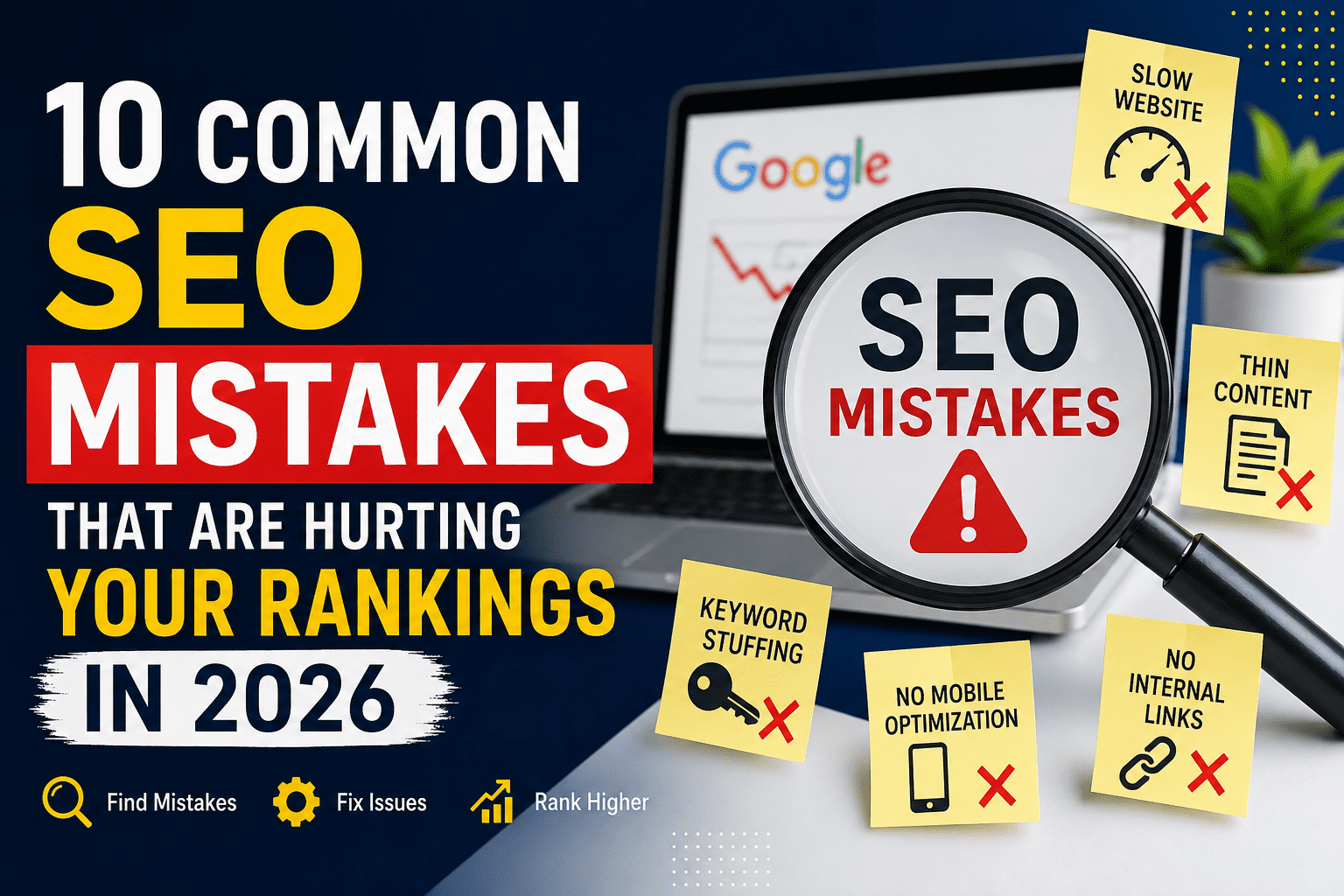
In this guide, we'll explore the 10 common SEO mistakes that continue to hurt websites in 2026 and provide practical solutions to help you improve your rankings, attract more organic traffic, and build long-term online success. For a deeper look at how AI is changing search, read our guide on SEO vs AEO.
Why Avoiding SEO Mistakes Matters
SEO is much more than ranking higher on Google. It is about creating the best possible experience for your visitors while helping search engines understand your website.
A single SEO mistake may not destroy your rankings, but several small mistakes combined can significantly reduce your visibility.
Common SEO mistakes often lead to:
- Lower search rankings
- Reduced organic traffic
- Poor user experience
- Higher bounce rates
- Lower conversion rates
- Less visibility in AI-powered search platforms
Fortunately, these mistakes can be identified and corrected. Once fixed, your website becomes more valuable to both users and search engines. Start by improving your site's foundation with tips from our Hafeez Digital Studio homepage.
🎯 Mistake #1: Ignoring Search Intent
One of the biggest reasons websites fail to rank is ignoring search intent.
Search intent refers to the reason behind a user's search query. Google wants to display pages that best satisfy what users are looking for—not just pages that contain matching keywords.
For example, someone searching for "best SEO tools for beginners" expects a list of tools with recommendations, features, and pricing. They are not looking for a basic definition of SEO.
Similarly, a search for "how to speed up a WordPress website" requires practical, step-by-step instructions instead of general information.
If your content doesn't answer the user's question completely, your chances of ranking decrease regardless of your keyword optimization.
How to Fix It
- Understand the purpose behind every keyword.
- Study the top-ranking pages before writing.
- Provide direct answers early in your article.
- Cover the topic in depth instead of writing shallow content.
- Focus on solving user problems rather than chasing keywords.
When your content satisfies user intent, both visitors and search engines are more likely to trust your website.
📄 Mistake #2: Publishing Thin or Low-Quality Content
Publishing content simply to increase the number of blog posts is a common mistake.
Search engines now reward websites that provide original, detailed, and valuable information.
Thin content usually includes:
- Short articles with little useful information
- Duplicate or copied content
- Poorly edited AI-generated articles
- Pages written only for keywords
- Outdated or inaccurate information
Publishing this type of content makes it difficult to build authority in your niche.
Instead, focus on creating comprehensive guides that genuinely help readers solve their problems.
How to Fix It
- Write in-depth articles that fully cover the topic.
- Include examples, statistics, and practical advice.
- Keep your content updated regularly.
- Add visuals such as screenshots, charts, or infographics.
- Edit AI-assisted content carefully to ensure originality and accuracy.
High-quality content remains one of the strongest ranking factors in 2026.
⚡ Mistake #3: Slow Website Speed
Website speed has a direct impact on both user experience and search rankings.
Modern users expect pages to load within just a few seconds. If your website is slow, many visitors will leave before reading your content, increasing your bounce rate and reducing engagement.
Google also considers page speed as part of its overall page experience signals. Test your site using Google PageSpeed Insights.
Common causes of slow websites include:
- Large, uncompressed images
- Poor-quality web hosting
- Too many plugins
- Heavy JavaScript and CSS files
- No browser caching or content delivery network (CDN)
How to Fix It
- Compress images before uploading them.
- Use modern image formats such as WebP.
- Enable browser caching and file compression.
- Minify CSS and JavaScript files.
- Choose reliable hosting with strong performance.
- Regularly test your website using performance tools.
A faster website not only improves SEO but also increases user satisfaction and conversion rates.
📱 Mistake #4: Poor Mobile Experience
More than half of all web traffic now comes from mobile devices. Because of this, Google primarily evaluates the mobile version of your website when determining rankings.
A website that looks great on desktop but performs poorly on smartphones can lose valuable organic traffic.
Common mobile issues include:
- Text that is difficult to read
- Buttons placed too close together
- Images that don't resize properly
- Slow mobile loading speeds
- Pop-ups that block the screen
These problems create frustration for visitors and may negatively affect your rankings.
How to Fix It
- Use a responsive website design.
- Test your website on multiple screen sizes.
- Optimize images and videos for mobile devices.
- Improve mobile loading speed.
- Make buttons and navigation easy to use with touch screens.
A mobile-friendly website is no longer optional—it is essential for achieving sustainable SEO success in 2026.
🔗 Mistake #5: Ignoring Internal Linking
Many website owners spend hours creating new content but overlook one of the simplest SEO strategies—internal linking.
Internal links connect one page of your website to another, helping search engines understand your site's structure while guiding visitors to related content. Without proper internal links, important pages may remain difficult for search engines to discover and users may leave your website after viewing only one page.
For example, if you publish a blog about Technical SEO, you should naturally link it to related articles about On-Page SEO, Google Search Console, AI Search Optimization, or Website Speed Optimization. This creates a strong content network that improves your website's topical authority. See our full breakdown in How to Rank in AI Search Engine.
Why Internal Linking Matters
- Helps Google discover and index pages faster.
- Distributes authority across your website.
- Increases page views and average session duration.
- Reduces bounce rate.
- Strengthens topical authority.
How to Fix It
- Add 3–5 relevant internal links to every new article.
- Use descriptive anchor text instead of phrases like "Click Here."
- Link to your most important service pages whenever relevant.
- Update older articles with links to your newest content.
A well-planned internal linking strategy improves both SEO performance and user experience.
🚫 Mistake #6: Keyword Stuffing
Years ago, repeating the same keyword multiple times could improve rankings. Today, this strategy does the opposite.
Keyword stuffing makes content difficult to read and creates a poor user experience. Modern search engines understand context, synonyms, and user intent, making excessive keyword repetition unnecessary.
For example, instead of writing:
"Best SEO company offers the best SEO services because our SEO company provides the best SEO solutions."Write naturally:
"Our SEO services help businesses improve their online visibility through technical optimization, high-quality content, and long-term digital marketing strategies."The second version is more readable and provides greater value to users.
How to Fix It
- Use your focus keyword naturally.
- Include related keywords and synonyms.
- Write for people first, search engines second.
- Avoid forcing keywords into every paragraph.
- Prioritize readability over keyword frequency.
Remember, quality always beats quantity when it comes to keyword optimization.
⚙️ Mistake #7: Ignoring Technical SEO
Even the best content may struggle to rank if your website has technical issues.
Technical SEO ensures that search engines can crawl, understand, and index your website efficiently.
Common technical SEO problems include:
- Broken links
- Crawl errors
- Duplicate pages
- Missing XML sitemap
- Poor URL structure
- Missing canonical tags
- Indexing issues
- Incorrect robots.txt configuration
Many website owners never perform a technical SEO audit, allowing these issues to accumulate over time.
How to Fix It
- Regularly audit your website for technical errors.
- Submit an updated XML sitemap.
- Fix broken links and redirect outdated URLs.
- Use clean, descriptive URLs.
- Optimize Core Web Vitals.
- Monitor indexing status in Google Search Console.
Technical SEO creates the foundation for all your other SEO efforts. Without it, even excellent content may fail to reach its full ranking potential.
🔄 Mistake #8: Never Updating Old Content
Publishing new articles is important, but maintaining existing content is equally valuable.
Many websites publish blog posts and never revisit them. Over time, statistics become outdated, screenshots no longer match current interfaces, and recommendations lose relevance.
Google favors fresh, accurate, and updated information—especially in industries like SEO, technology, AI, and digital marketing.
Refreshing existing content often requires far less effort than creating an entirely new article while delivering significant SEO benefits.
What Should You Update?
- Outdated statistics
- Broken external links
- Old screenshots
- New industry trends
- Internal links to recent articles
- Meta titles and descriptions
- FAQs based on current search trends
How to Fix It
- Review important blog posts every 6–12 months.
- Add new sections whenever major industry changes occur.
- Improve readability with updated formatting.
- Include recent examples and practical insights.
- Republish the article with the latest information if necessary.
Regular content updates demonstrate to both users and search engines that your website remains active, trustworthy, and relevant.
📈 Real-World Example
Imagine two businesses operating in the same industry.
Business A publishes one blog every week but never updates old articles, ignores internal linking, and has several technical issues.
Business B publishes high-quality articles, regularly updates existing content, fixes technical SEO problems, and builds a strong network of internal links.
After several months, Business B is far more likely to achieve higher rankings, attract more organic traffic, and build greater authority—not because it publishes more content, but because it maintains higher content quality and a better overall website experience.
This example highlights an important SEO principle: consistent optimization often delivers better long-term results than simply producing more content.
💡 SEO Pro Tips
To strengthen your SEO strategy in 2026:
- Publish content that answers real user questions.
- Build topic clusters instead of isolated blog posts.
- Improve page speed and mobile performance.
- Add relevant internal links to every article.
- Update your best-performing content regularly.
- Monitor technical SEO issues each month.
- Focus on quality rather than publishing frequency.
Following these best practices will help create a stronger foundation for sustainable search rankings.
✅ Mistake #9: Weak E-E-A-T Signals
In 2026, having well-written content alone is no longer enough. Google wants to know who created the content and whether they are qualified to write about the topic.
This is where E-E-A-T—Experience, Expertise, Authoritativeness, and Trustworthiness—becomes essential.
Imagine two websites publishing the same SEO guide. One includes an experienced author, a detailed About page, real-world examples, and business contact information. The other has anonymous content with no proof of expertise. Which one is more trustworthy?
Google is far more likely to trust the first website because it demonstrates credibility.
How to Improve E-E-A-T
- Create a professional About Us page.
- Add an author bio to every article.
- Display your experience and qualifications.
- Include client testimonials or case studies where appropriate.
- Keep your contact information accurate and easy to find.
- Regularly update older content with new insights.
Building trust takes time, but it is one of the most valuable long-term SEO investments you can make.
🤖 Mistake #10: Ignoring AI Search and Answer Engine Optimization (AEO)
Search is changing rapidly. Millions of users now search through AI platforms such as ChatGPT, Google Gemini, Microsoft Copilot, and Perplexity instead of relying only on traditional search engines.
Many websites still optimize only for Google rankings and ignore AI-powered search experiences.
This is a major mistake.
Modern SEO now includes Answer Engine Optimization (AEO)—the practice of creating content that AI systems can easily understand, summarize, and recommend. Learn the difference in detail here: SEO vs AEO Guide.
Websites that produce structured, helpful, and authoritative content are far more likely to appear in AI-generated answers.
How to Optimize for AI Search
- Write clear question-and-answer sections.
- Use descriptive headings.
- Publish comprehensive content.
- Add FAQ sections.
- Implement structured data (Schema Markup).
- Build topical authority by publishing related articles.
- Focus on solving user problems instead of simply targeting keywords.
Businesses that embrace both SEO and AEO today will have a significant competitive advantage in the years ahead.
🆚 Case Study: Two Websites, Two Different Results
Consider two websites in the same industry.
Website A
- Publishes short 500-word articles.
- Uses excessive keywords.
- Has slow loading pages.
- Rarely updates old content.
- Has very few internal links.
- Ignores technical SEO.
Website B
- Publishes comprehensive 1,500+ word guides.
- Optimizes for user intent.
- Uses natural keyword placement.
- Updates content regularly.
- Builds strong internal links.
- Focuses on E-E-A-T.
- Optimizes for AI search.
After six months, Website B consistently attracts more organic traffic, earns higher rankings, and builds greater trust with users.
The lesson is simple: successful SEO is not about shortcuts. It is about consistently providing value.
Final SEO Checklist
Before publishing any page or blog post, ask yourself these questions:
- Does the content satisfy user intent?
- Is it original, accurate, and valuable?
- Is the website fast and mobile-friendly?
- Have you added relevant internal links?
- Are images compressed and optimized?
- Have you avoided keyword stuffing?
- Is the content technically optimized?
- Have you included FAQs where appropriate?
- Does the article demonstrate experience and expertise?
- Is the content optimized for both Google Search and AI-powered search platforms?
If the answer is "Yes" to all of these questions, your content has a much stronger chance of performing well in search results.
🏆 Conclusion
SEO in 2026 is no longer about chasing algorithms or repeating keywords. It is about understanding your audience, solving real problems, and creating content that delivers genuine value.
The common SEO mistakes discussed in this guide—such as ignoring search intent, publishing thin content, neglecting technical SEO, overlooking internal linking, and failing to optimize for AI search—can significantly limit your website's growth if left unaddressed.
By avoiding these mistakes and following modern SEO best practices, you can improve your search rankings, increase organic traffic, strengthen your website's authority, and create a better experience for your visitors.
Remember that SEO is an ongoing process, not a one-time task. Regular content updates, technical improvements, and a focus on user experience will help your website remain competitive as search technology continues to evolve.
The future belongs to businesses that combine traditional SEO with Answer Engine Optimization (AEO) and AI-friendly content strategies. Start making these improvements today, and you'll be well-positioned for long-term success.
❓ Frequently Asked Questions
Ignoring search intent is one of the most common SEO mistakes because even well-written content may fail to rank if it doesn't answer the user's actual question.
No. Modern search engines understand context and natural language. Overusing keywords can reduce readability and negatively impact your rankings.
Review and refresh your important articles every six to twelve months, or sooner if there are major industry updates.
Absolutely. Technical SEO ensures that search engines can crawl, index, and understand your website while providing a better user experience.
Answer Engine Optimization is the process of optimizing content so AI-powered search platforms like ChatGPT, Gemini, and Perplexity can understand, reference, and recommend your content.
Final Thoughts
SEO is constantly evolving, but one principle remains the same: websites that consistently help users will always have the greatest opportunity to succeed. Focus on quality, trust, and continuous improvement, and your rankings will reflect those efforts over time.