How Query Fan-Out Is Changing SEO: A Practical Guide for 2026
Search used to be pretty simple.
You typed something into Google, Google returned a list of pages, and you tried to get your page as high as possible for that particular search.
For years, that basic idea shaped SEO.
But AI-powered search is changing what happens after you press Search.
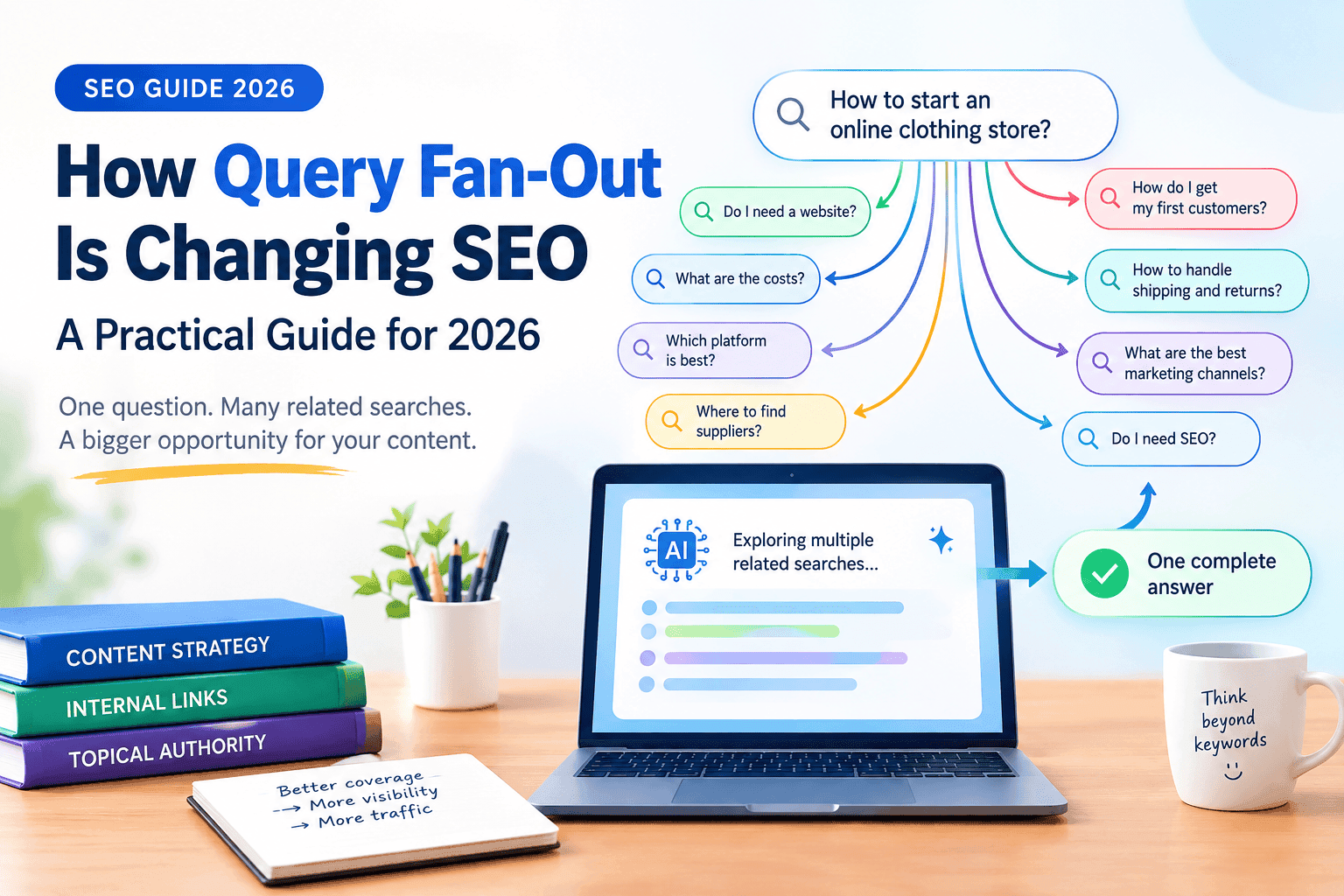
A user might type one question, while the system explores several related questions behind the scenes before producing an answer.
This process is commonly called query fan-out.
It sounds technical, but the idea is actually quite easy to understand.
Let’s break it down without turning this into a computer-science lesson.
1. What Is Query Fan-Out?
Imagine someone searches:
“What laptop should I buy for graphic design?”
A traditional search might largely focus on those words.
But an AI-powered search system may need much more information before giving a useful answer.
It could explore questions such as:
Which laptops are suitable for graphic design?
How much RAM does graphic design require?
Which processors are suitable for Adobe Photoshop?
Is a dedicated GPU necessary?
Which screen resolution is better for designers?
What laptops offer good performance at different budgets?
The original question has effectively branched into several smaller questions.
That’s query fan-out.
In simple terms:
One question → multiple related searches → information from different sources → one combined answer.
Research and industry analysis published in 2026 describe query fan-out as a process in which AI search systems expand a user’s original query into related sub-queries to gather broader context.
And this isn’t just an interesting technical concept.
It changes how content can be discovered.
Here’s another example
Suppose someone asks:
“How can I improve my website speed?”
An AI system may need information about:
image compression
caching
JavaScript
CSS
hosting
Core Web Vitals
mobile performance
server response time
The user didn’t type all those words.
But they’re connected to the question.
That’s the important idea behind query fan-out. What is query fan-out?
2. How One Search Question Becomes Multiple Searches
Let’s make the process even simpler.
Imagine you ask an AI search system:
“Is WordPress good for a small business?”
The system doesn’t necessarily stop at that exact sentence.
It may need to investigate different parts of the decision.
For example:
Main question
Is WordPress good for a small business?
↓
Possible related questions
What does WordPress cost?
Is WordPress easy to manage?
Is WordPress secure?
Can WordPress rank in Google?
Can a small business add online payments?
How difficult is WordPress SEO?
What are the alternatives?
The exact fan-out will vary depending on the system, query, context, and other factors. Fan-out queries can also change rather than behaving like a fixed list of keywords.
But the underlying idea remains:
The system is trying to understand the question more completely.
Why would it do that?
Because a short question often hides a much bigger information need.
When someone asks:
“Which laptop should I buy?”
They probably don’t want a random model name.
They may actually want to know:
their budget
performance
battery life
screen quality
software compatibility
reliability
upgrade options
value for money
A good answer needs context.
Query fan-out is one way AI-powered search can gather that context.
The traditional model vs the newer model
You can think about the difference like this:
Traditional search
One query → search results
AI-assisted search
One query → related searches → multiple sources → synthesized answer
This doesn’t mean traditional SEO has suddenly disappeared.
In fact, research and industry analysis in 2026 suggests that AI search still relies heavily on web retrieval and search indexes. The difference is that the system may retrieve information through several related searches rather than relying only on the original wording.
That’s why understanding the topic behind a query matters.
3. Why Exact-Match Keywords Are No Longer Enough
Let’s say you’re writing an article targeting:
“WordPress website speed”
You could repeat that phrase throughout the article.
The title could contain it.
The introduction could contain it.
Five headings could contain it.
The conclusion could contain it.
And you could put it into every image’s alt text.
But would that make the article genuinely useful?
Not necessarily.
Imagine a visitor searching for:
“How do I make my WordPress website load faster?”
They don’t necessarily care whether your article uses the exact phrase “WordPress website speed” twenty times.
They want an answer.
They want to know what to change.
That’s a very important distinction.
Think about the topic, not just the keyword
If your main topic is WordPress website speed, your article might naturally discuss:
image sizes
caching
plugins
hosting
JavaScript
CSS
fonts
database optimization
mobile performance
page-building tools
These aren’t random keywords.
They’re parts of the same problem.
This is where query fan-out becomes interesting for content creators.
An AI system may explore several of these related concepts when trying to answer a broader question.
So instead of asking:
“How many times should I use my keyword?”
ask:
“What information would someone need to understand this topic properly?”
That’s a much better content question.
Don’t turn fan-out into another keyword-stuffing exercise
This is important.
You might read about query fan-out and think:
“Great! I’ll find every fan-out query and put all of them into one article.”
That’s not the goal.
Fan-out queries are generated dynamically and can vary between prompts and systems. Ahrefs’ 2026 research specifically notes that many fan-out queries are synthetic rather than traditional keywords people routinely type into search engines.
So don’t chase every possible variation.
Instead, use fan-out thinking to discover what information belongs around your main topic.
That’s a much more sustainable approach.
4. A Simple Real-World Example
Let’s use a website owner as our example.
Suppose Sarah owns a small online clothing store.
She wants to publish an article targeting:
“How to start an online clothing store.”
The old SEO approach might look like this:
Main keyword:
“How to start an online clothing store”
Then the article might repeat that phrase while briefly covering everything else.
But let’s think like a real customer.
Someone asking that question probably has dozens of smaller questions.
Their hidden questions might include:
Getting started
Do I need a website?
How much money do I need?
Should I use Shopify or WordPress?
Products
Where can I find suppliers?
How many products should I launch with?
How should I photograph clothing?
Website
What pages do I need?
How should product pages be structured?
How can customers pay?
Marketing
How do I get my first customers?
Should I use Instagram?
Do I need SEO?
Operations
How should I handle shipping?
What happens with returns?
How do I manage inventory?
Now look at what happened.
Sarah started with one topic.
But the topic contains many related information needs.
That’s exactly the kind of thinking that becomes useful when planning content for modern search.
Does Sarah need 20 separate articles?
Not necessarily.
This is another common mistake.
You don’t want to create:
Article 1: How to choose clothing suppliers
Article 2: How to choose clothing suppliers for beginners
Article 3: Best clothing suppliers for beginners
Article 4: Finding clothing suppliers online
Article 5: Where to find clothing suppliers
when all five pages essentially answer the same question.
That can create unnecessary repetition.
Instead, Sarah could create a strong main guide covering the overall process and then create genuinely useful supporting articles where deeper explanations are needed.
For example:
Main guide
How to Start an Online Clothing Store
Supporting guide
How to Photograph Clothing Products for an Online Store
Supporting guide
How to Create Product Pages That Convert
Supporting guide
How to Handle Shipping and Returns for an Online Store
Now the website has a connected information structure.
And when one article naturally mentions another, internal links can guide readers deeper into the topic.
That’s something you can already see in your own content strategy—for example, your article about how to optimize content for AI-powered search can naturally connect with more specific articles when a reader needs a deeper explanation.
The Bigger Lesson for SEO
Query fan-out doesn’t mean:
“Keywords are dead.”
That’s an oversimplification.
Keywords still help us understand what people search for.
The bigger change is that one keyword doesn’t always represent the entire information need anymore.
A useful content strategy starts with the main query and then asks:
What would the reader probably need to know next?
Then:
What would they ask after that?
And:
What information would help them make a decision?
This naturally leads to better content planning.
It also fits nicely with the broader approach you’ve already been using on your site: instead of publishing isolated articles, you can connect related guides so readers can move naturally from one question to the next.
For example, someone reading your guide on how to check whether a website appears in AI search results may naturally want to know how to measure that visibility afterward. That’s where your related guide on tracking AI search visibility becomes useful.
That’s search-journey thinking.
And it’s much more valuable than simply adding another keyword to an article.
What We’ll Cover Next
So far, we’ve established one simple idea:
A single search can represent a much larger information journey.
In Part 2, we’ll turn that idea into an actual content strategy.
We’ll look at:
How to discover the questions around your main topic
How to separate related search intents
How to decide whether a question belongs in the same article or deserves its own page
How internal links can connect the whole journey
And how to avoid turning your website into dozens of thin, repetitive articles
That’s where query fan-out starts becoming genuinely useful for an SEO strategy.
Part 2: Turning Query Fan-Out Into a Practical Content Strategy
In Part 1, we looked at what query fan-out means and why one search question can lead to several related searches.
Now let’s make it useful.
If you’re running a website, the real question isn’t:
“How does Google’s AI work?”
The more useful question is:
“How can I use this idea when planning my content?”
That’s what we’re going to do in this part.
5. How to Find the Questions Around Your Main Topic
Let’s say your website sells WordPress services.
You decide to create a guide around:
“How much does a WordPress website cost?”
That’s your starting point.
But don’t immediately open your keyword tool and start collecting hundreds of variations.
First, think like the customer.
Someone asking about the cost of a website probably has several concerns behind that question.
They might be wondering:
Does hosting cost extra?
Do I need to buy a domain?
Is WordPress free?
How much does a professional design cost?
What about maintenance?
Do plugins cost money?
How much does SEO cost?
Can I build it myself?
What happens if I hire a freelancer?
What is the difference between a cheap and expensive website?
Now you’ve uncovered something important.
The main keyword was only the doorway.
The real topic is much larger.
Where can you discover these related questions?
You don’t have to rely entirely on expensive SEO software.
Start with places where real people ask real questions.
1. Google autocomplete
Start typing your main topic into Google and look at the suggestions.
For example:
WordPress website cost…
You may see different variations and related searches.
These can give you clues about what people are trying to understand.
2. Google’s “People also ask”
Search your main topic and look at the questions that appear.
Don’t copy them blindly.
Read them and ask:
“What concern is this question revealing?”
That’s often more useful than the exact wording.
3. Reddit and forums
Community discussions can be extremely useful for discovering problems that keyword tools don’t make obvious.
Someone may ask:
“Why did my website developer charge me for something I thought was free?”
That isn’t just a keyword.
It’s a content opportunity.
You can turn real questions into useful explanations.
4. Your own customers
This is one of the most valuable sources.
If five customers ask you the same question, you may already have your next article.
And because the question came from a real person, the resulting content is less likely to sound generic.
5. Search Console
Your own website can tell you what Google already associates with your pages.
Suppose an article is ranking for:
WordPress website cost
but Search Console also shows impressions for:
WordPress maintenance cost
and:
WordPress website monthly expenses
That tells you something.
Your page may already be touching a broader topic.
Instead of creating three nearly identical articles, you could consider whether the existing page needs a useful section covering those questions. How to view fan-out query generated by AI
6. Build Content That Covers Related Intents
Now comes the tricky part.
You’ve found twenty related questions.
Do you put all twenty into one giant article?
No.
That’s where many content strategies go wrong.
Query fan-out is not an instruction to create enormous pages containing everything remotely related to a topic.
Instead, group questions according to search intent.
Let’s use our WordPress website cost example again.
Group 1: Basic information
What is WordPress?
Is WordPress free?
What does a domain cost?
What does hosting cost?
These questions can probably fit naturally into a beginner-focused guide.
Group 2: Professional website costs
How much does a professional WordPress website cost?
How much does a freelancer charge?
How much does an agency charge?
What affects the price?
These deserve more detailed discussion.
Group 3: Ongoing expenses
How much does WordPress maintenance cost?
How much do plugins cost?
What about security?
What about backups?
These could become a dedicated supporting article if the topic is substantial enough.
Group 4: DIY vs professional
Can I build a WordPress website myself?
Should I hire a freelancer?
When should I use an agency?
Again, that’s a different decision-making intent.
Notice what we’re doing.
We’re not simply collecting keywords.
We’re organizing questions people have around the same problem.
One topic doesn’t always mean one page
This is probably the most important practical lesson.
Suppose you discover:
“How much does WordPress cost?”
“How much does WordPress maintenance cost?”
“How much does a WordPress developer charge?”
These are related.
But they aren’t necessarily the same question.
A reader who wants to understand the total cost of owning a website may appreciate all three in one comprehensive guide.
But someone specifically researching maintenance may want a much deeper explanation.
That’s where your judgment matters.
Ask:
Can I answer this question properly in a small section?
If yes, include it.
If answering it properly would require 1,000 additional words, examples, screenshots, or its own explanation, it may deserve a separate article.
7. Use Internal Links to Connect the Search Journey
This is where query fan-out connects beautifully with internal linking.
Think of your website as a library.
One article answers the main question.
Another answers a related question.
A third goes deeper into a specific problem.
Internal links help readers move between them.
For example, suppose your main article is:
How Much Does a WordPress Website Cost?
Inside that article, you might naturally mention:
“The final cost also depends on
Part 3: AI Search, Real Examples, Mistakes, and the Final Checklist
By now, the idea behind query fan-out should be fairly clear.
A person asks one question.
The search system may explore several related questions to understand the topic better.
That creates an important opportunity for website owners.
Instead of asking:
“How do I rank for this one keyword?”
you can start asking:
“What information might a search system need before it can confidently answer this question?”
That small change in thinking can completely change how you plan content.
9. How Query Fan-Out Can Affect AI Search Visibility
Let’s say you publish an excellent article targeting:
“How to start a small business website.”
Your article ranks reasonably well for that exact topic.
That’s good.
But an AI search system answering the same question may also need information about:
website platforms
domain names
hosting
website costs
essential pages
mobile design
security
SEO
contact forms
payment options
If your content covers several of these areas clearly, your page may be relevant to more of the related searches used to build the final answer.
Research published by Ahrefs in 2026 describes this as one of the important differences between traditional keyword-focused search and AI search: a single prompt can be expanded into multiple related searches before the final response is produced.
But don’t misunderstand this
Query fan-out does not mean:
“Write an article containing every possible question.”
That’s a recipe for a huge, boring page.
Instead, think about coverage.
Your content should cover the important parts of the topic that a real reader would reasonably expect.
A useful example
Suppose your target topic is:
“How to improve WordPress website speed.”
A weak article might say:
Use caching.
Compress images.
Remove unnecessary plugins.
And that’s it.
A stronger guide could explain:
Images
What size should images be?
Which formats can be useful?
How can large images affect loading?
Caching
What does caching actually do?
When should it be used?
Plugins
How can unnecessary plugins affect performance?
How can you identify problematic ones?
Mobile
Why can a page feel slower on a phone?
What should you test?
Measurement
How do you know whether your changes actually helped?
Now you’ve covered the topic from several useful angles.
That’s the kind of thinking query fan-out encourages.
Don’t chase the exact hidden query
This is one of the most important lessons.
Fan-out queries aren’t necessarily a stable keyword list.
Research from Ahrefs notes that these queries can be synthetic and can change between prompts and AI systems.
So imagine you discover one fan-out query such as:
“best image compression settings for WordPress blogs”
Don’t immediately create a page called:
“Best Image Compression Settings for WordPress Blogs.”
First ask:
Is this a genuinely useful topic for my audience?
If yes, cover it.
If it’s simply a tiny variation of something you’ve already explained, don’t create another thin article.
That’s the difference between using query fan-out as research and chasing every AI-generated phrase.
learn more about query fan-out
10. Real Example: Turning One Keyword Into a Complete Content Map
Let’s build a practical content map.
Imagine you run a website about SEO and web design.
Your starting topic is:
“SEO for small businesses.”
Instead of immediately writing one article, take a few minutes to map the information around it.
Step 1: Identify the main question
SEO for small businesses
This is your broad topic.
Step 2: Identify major subtopics
You might find:
Local SEO
Technical SEO
Content
Website speed
Keyword research
Google Business Profile
Reviews
Link building
Mobile usability
Now you’ve got a basic topic map.
Step 3: Identify different search intents
Some people want to learn.
Others want to compare.
Others want to solve a specific problem.
For example:
Learning
What is SEO for a small business?
Problem solving
Why isn’t my business website getting traffic?
Local
How can a local business appear in Google Maps?
Technical
How do I improve website speed?
Content
What should a small business blog about?
These aren’t all the same intent.
That’s important.
Step 4: Decide what belongs together
You could create one strong guide:
SEO for Small Businesses: A Practical Beginner’s Guide
Then create deeper supporting articles where necessary.
For example:
Supporting article
How to Build a Small Business Keyword Strategy
Supporting article
How to Improve Local Search Visibility
Supporting article
How Website Speed Affects Small Business Websites
Supporting article
How to Build Useful Content for Local Customers
Now you have a connected content system.
And the main guide can naturally link to the supporting articles.
This approach also makes sense for your own website because your existing articles already cover different parts of the broader search journey. Instead of repeatedly creating articles around the same broad phrase, you can connect them where the reader genuinely needs the next explanation.
Step 5: Fill the gaps instead of multiplying pages
This is where many content strategies go wrong.
Imagine you already have a strong article explaining local SEO.
You discover another related query:
“How to improve local search visibility.”
Before creating a new article, check your existing content.
Maybe your current article already answers 80% of it.
In that case, improve the existing article.
Add:
A missing explanation
A useful example
A new section
A screenshot
A relevant internal link
Updated information
You don’t always need another URL.
Sometimes the best SEO move is simply to make an existing page more complete.
11. Common Query Fan-Out SEO Mistakes
The concept is useful, but it’s easy to misuse.
Here are some mistakes worth avoiding.
Mistake 1: Trying to optimize for every fan-out query
You don’t need to predict every possible question an AI system could generate.
Those queries can vary.
Better: understand the broader information needs around your topic.
Mistake 2: Creating one article for every tiny variation
For example:
How to improve WordPress speed
How to improve WordPress website speed
How to make WordPress faster
How to speed up a WordPress website
How to make a WordPress site load faster
If all five articles provide essentially the same answer, you’re probably creating unnecessary duplication.
Better: combine closely related questions when the search intent is essentially the same.Google Search Central — Creating Helpful, Reliable, People-First Content
Mistake 3: Making every article enormous
Comprehensive doesn’t mean ridiculously long.
If a question can be answered properly in 800 words, don’t stretch it to 3,000 words just because you heard that “long content ranks.”
Readers notice when an article is padded.
Better: cover the topic completely, then stop.
Mistake 4: Forgetting search intent
Two queries can contain similar words but represent different needs.
Someone searching:
“WordPress website cost”
might want pricing.
Someone searching:
“How to build a WordPress website”
wants a process.
Someone searching:
“WordPress vs Shopify”
wants a comparison.
Don’t force all three into one generic article.
Mistake 5: Ignoring internal links
If you have useful supporting content but don’t connect it, readers may never find it.
Internal links are especially useful when they answer the reader’s next logical question.
For example, if an article explains why a website isn’t appearing in AI search, it can naturally point readers toward a guide on how to check whether their website appears in AI search results.
The link isn’t there because “Google likes internal links.”
It’s there because the reader might genuinely want that next step.
That’s the mindset you want.
Mistake 6: Treating AI-generated fan-out queries like normal keywords
Ahrefs’ research makes an important distinction here: fan-out queries can be generated dynamically and may have little or no traditional search volume.
So don’t spend hours trying to find exact monthly search volume for every possible fan-out query.
The more useful question is:
“What topic or information gap does this query reveal?”
That’s where the real value lies.
12. Practical Query Fan-Out Checklist + FAQs
Before publishing an article, use this simple checklist.
Topic Checklist
☐ What is the main question I’m answering?
☐ Who is asking it?
☐ What problem are they trying to solve?
☐ What related questions would naturally come next?
Content Checklist
☐ Have I covered the important aspects of the topic?
☐ Have I explained the subject rather than simply repeated keywords?
☐ Have I included practical examples?
☐ Have I answered the obvious follow-up questions?
☐ Have I avoided unnecessary sections?
Content Structure Checklist
☐ Is there one clear main topic?
☐ Are the headings easy to understand?
☐ Are closely related questions grouped together?
☐ Are genuinely different topics separated into supporting articles?
Internal Linking Checklist
☐ Does this article link to relevant supporting content?
☐ Does each internal link help the reader?
☐ Can a reader move naturally from one question to the next?
☐ Have I avoided adding links simply for the sake of adding links?
Quality Checklist
☐ Is the information accurate?
☐ Are examples realistic?
☐ Does the article offer something useful beyond generic advice?
☐ Have I updated information that may have changed?
☐ Would I personally find this article useful if I were searching for the answer?
That last question is underrated.
If you wouldn’t want to read your own article, adding another keyword probably won’t fix it.
Frequently Asked Questions
Is query fan-out the same as keyword research?
No.
Traditional keyword research looks at what people search for.
Query fan-out looks at how an AI search system may expand a question into related searches while trying to construct an answer.
They can complement each other, but they aren’t the same thing. Ahrefs also distinguishes fan-out queries from People Also Ask: PAA reflects questions based largely on search behavior, while fan-out queries reflect what an AI system may need to answer the original prompt.
Do I need to know the exact fan-out queries for my topic?
No.
In fact, trying to predict every exact query can be counterproductive because fan-out queries can vary.
Use them as clues about the broader questions and context surrounding your topic.
Should I create a separate page for every related question?
Not necessarily.
If several questions have the same search intent, they can often be handled in one strong article.
Create a separate page when the question deserves a genuinely